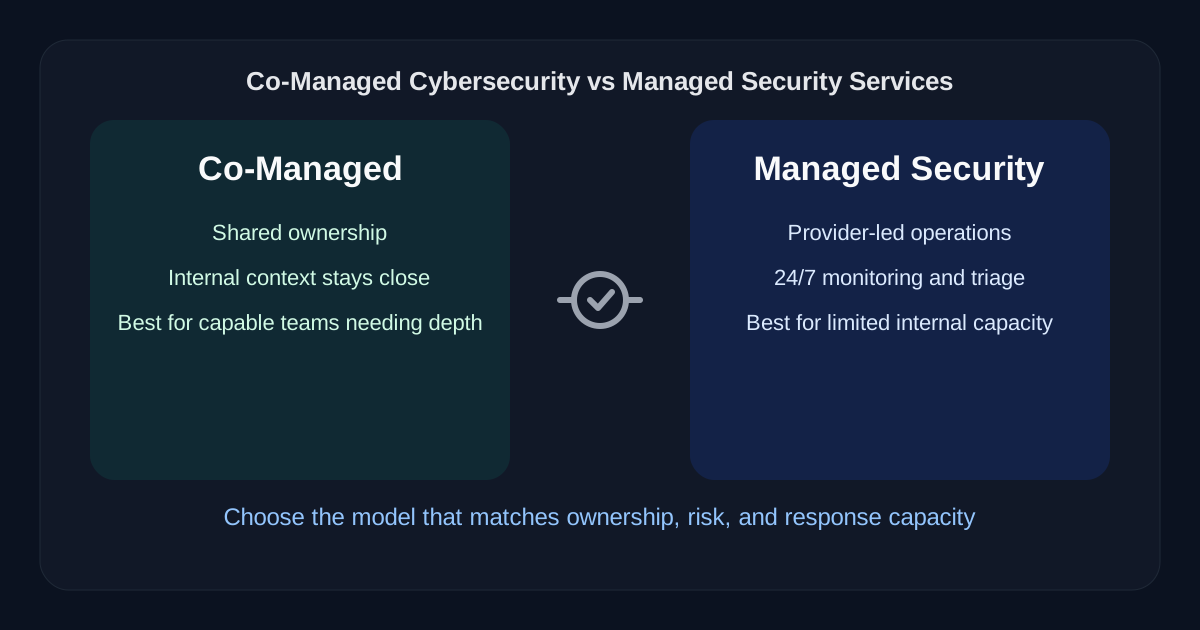

When should you use co-managed cybersecurity instead of managed security services?
You should use co-managed cybersecurity when your internal IT or security team still wants to own strategy, business context, and key decisions but needs help with 24/7 monitoring, specialized tooling, threat investigation, or response capacity. You should use managed security services when your organization needs an outside partner to take more complete day-to-day ownership of security operations because internal bandwidth, staffing, or maturity is not enough to run that function consistently.123
That distinction matters because many mid-market teams are not deciding between “do security” and “do nothing.” They are deciding how security ownership should work in the real world. Does the internal team have enough time to watch alerts after hours? Can it investigate suspicious activity fast enough? Is someone clearly accountable for escalation, containment, and reporting? If those answers are fuzzy, the service model matters just as much as the tools.
At Datapath, we think buyers get the best outcome when they compare these models around operating reality: who monitors, who investigates, who approves changes, who owns remediation, and who leadership expects to answer when something serious happens.
What is the difference between co-managed cybersecurity and managed security services?
Co-managed cybersecurity is a shared operating model. Your internal team keeps meaningful responsibility, and the outside provider supplements it with coverage, expertise, or specific services such as MDR, log monitoring, firewall oversight, vulnerability management, or incident-response support.14
Managed security services are a more provider-led model. The outside partner usually takes primary responsibility for recurring security operations such as monitoring, alert triage, detection engineering, threat response workflows, reporting, and parts of remediation coordination.235
In practice, the boundary usually comes down to these questions:
| Decision area | Co-managed cybersecurity | Managed security services |
|---|---|---|
| Operational ownership | Shared between internal team and provider | Primarily provider-led |
| Best fit | Internal team exists but needs help | Internal coverage or maturity is limited |
| Business context | Mostly owned in-house | Often translated through provider processes |
| After-hours monitoring | Common reason to add provider | Usually included as core service |
| Response decisions | Often joint | Often provider-led with customer approval points |
| Main risk | Blurry handoffs | Overreliance on provider if scope is weak |
That is why this topic is not just a naming question. It is an accountability question.
When does co-managed cybersecurity make the most sense?
Co-managed cybersecurity usually makes the most sense when the internal team is competent but overloaded.
We see that pattern often in mid-market organizations with one to five internal IT leaders carrying too many responsibilities at once. They already manage user support, infrastructure, vendor coordination, Microsoft 365, audits, onboarding, and ongoing projects. Security still matters, but it competes with everything else.
1. Your internal team knows the environment well, but cannot watch it around the clock
A lot of teams understand their systems better than any outside provider ever will. They know which applications are fragile, which users create the most support noise, which vendors are hard to reach, and which business workflows cannot tolerate disruption. That knowledge is valuable.
The problem is that business context does not create twenty-four-hour coverage. If alerts start firing at 2 a.m., or suspicious sign-in activity appears over a holiday weekend, the internal team may not have the staffing depth to monitor, investigate, and respond quickly enough.26
That is where co-managed cybersecurity works well. The outside partner provides the always-on monitoring and specialist capacity, while the internal team stays close to decision-making and remediation priorities.
2. You need specialized security skills without replacing internal ownership
Cybersecurity operations now span endpoint telemetry, email security, identity controls, cloud posture, firewall policy, vulnerability prioritization, and incident coordination. Many mid-market teams do not need a full internal SOC, but they do need access to people who work in those domains every day.34
A co-managed model is often the right fit when the business wants support for:
- managed detection and response
- SIEM or log review support
- phishing and identity-incident investigation
- firewall or secure-access rule tuning
- compliance evidence preparation
- tabletop planning and incident-response exercises
That lets the internal team stay involved without having to hire for every specialty.
3. Leadership wants collaboration, not full outsourcing
Some organizations are not comfortable handing all security operations to an outside provider. That caution is reasonable. Security decisions often require business tradeoffs, legal sensitivity, vendor coordination, and knowledge of how operational systems actually behave.
If leadership wants a provider to function more like an extension of the team than a full replacement, co-managed cybersecurity is usually the cleaner model. It supports shared responsibility while preserving institutional knowledge and executive visibility.
4. You operate in a regulated environment where internal context still matters
Healthcare, finance, K-12, and government-adjacent organizations often need security support that aligns with very specific regulatory, workflow, and data-handling realities. An outside provider can add monitoring and expertise, but internal stakeholders still need to guide priorities around patient systems, financial workflows, student data, or public-service continuity.67
That is one reason co-managed support often works well for teams already using guidance like our HIPAA audit log requirements for Microsoft 365, GLBA Safeguards Rule checklist, CIPA web filtering requirements, and broader resources and guides. The internal team usually still needs to steer the business context even when an outside partner strengthens the security layer.
When are managed security services the better fit?
Managed security services are usually the better fit when the business needs a provider to take primary responsibility for ongoing security operations.
1. You do not have enough internal bandwidth to run security consistently
If the internal team is already stretched thin on support, infrastructure, cloud administration, and vendor management, asking that same group to run meaningful security operations is often unrealistic. Monitoring, tuning, escalation, reporting, and response coordination take sustained attention.25
In that situation, a managed security partner is often the better answer than a shared model. It creates a clearer operating structure and reduces the chance that alerts, detections, or remediation tasks fall into a gap between teams.
2. You want one primary partner accountable for monitoring and response
Some businesses do not want security operations split between internal and external owners. They want one provider responsible for watching the environment, triaging suspicious activity, escalating defined incidents, and reporting on what happened.
That preference often makes sense when leadership wants cleaner service accountability, especially after a near miss, an audit finding, a cyber insurance push, or a series of recurring incidents.
3. You are building security maturity from a low baseline
A co-managed model assumes the internal team can own its side of the relationship. If documentation is weak, change control is inconsistent, roles are unclear, and nobody has time to participate in investigations or decisions, a shared model may create confusion instead of resilience.
Managed security services are usually stronger when the organization needs a provider to establish more of the operating rhythm, including:
- recurring monitoring and reporting
- alert triage standards
- escalation rules
- investigation workflows
- incident documentation
- recommendations for control improvement
4. You need faster access to mature security operations without building a SOC
Many mid-market organizations need enterprise-style monitoring outcomes but do not need, or cannot justify, building a full internal SOC. Managed security services can close that gap faster by giving the business access to an established operations team, security tooling, and repeatable workflows without the hiring burden.35
For buyers working through broader questions around managed cybersecurity services, endpoint detection and response vs antivirus, and how much a mid-market firm should spend on cybersecurity monitoring, that provider-led model is often easier to operationalize than a partial build-it-yourself approach.
What should mid-market teams compare before choosing either model?
The right decision usually comes down to four things: ownership, coverage, speed, and business fit.
Who owns the alerts?
This is the first question we would ask. If a suspicious login, ransomware signal, or phishing escalation appears, who is responsible for initial triage? Who decides whether it is benign, suspicious, or urgent? Who calls the business contact? If the answer is “it depends,” the model needs more definition.
Who owns remediation?
Detection without remediation clarity is a weak operating model. Some providers will investigate but not touch systems. Others can isolate endpoints, disable accounts, recommend firewall changes, or lead containment with customer approval. Buyers should understand not just who sees the problem, but who is expected to help fix it.
Who owns business-context decisions?
This is where co-managed models often shine. The internal team usually knows which clinical systems, school workflows, vendor integrations, or finance platforms are business-critical. That context can be essential during containment decisions. If that knowledge is still strongest internally, a shared model may be more realistic than fully provider-led security.
How much collaboration can your team actually sustain?
A co-managed model only works if the internal team can stay engaged. If ticket load, project work, or staffing shortages already make the team unavailable, managed security services may be cleaner because they reduce the amount of coordination required to keep operations moving.
What mistakes do companies make when picking between co-managed and managed security?
The biggest mistake is buying a service label instead of defining the operating boundaries.
We see several versions of that problem:
- assuming “co-managed” automatically means better collaboration
- assuming “managed” automatically means complete remediation ownership
- expecting 24/7 monitoring without confirming what happens after detection
- assuming compliance evidence is included when only tooling is included
- failing to define who approves disruptive actions like account disablement or endpoint isolation
- leaving too much response responsibility with one exhausted internal generalist
Another common mistake is separating cybersecurity from the rest of the IT operating model. Security handoffs usually cross identity, endpoint, cloud, networking, user support, and vendor management. If your security partner and your broader IT support structure do not align, response quality usually suffers.
That is why we often encourage buyers to connect this decision to adjacent planning such as how to compare managed IT pricing, what a managed IT contract SLA usually includes, and how to assess if your MSP SLA covers critical clinical workflows.
Why Datapath for co-managed cybersecurity or managed security planning?
At Datapath, we think the right security model should match the team you actually have, not the one you wish you had. Some organizations need an outside partner to strengthen a capable internal team with better monitoring, tooling, and specialist depth. Others need a provider to take the lead so security operations stop depending on whoever happens to be available that day.
We help regulated and growth-focused organizations evaluate that choice around real-world accountability: who owns the alerts, who owns the decisions, who owns the remediation path, and how security work connects back to uptime, compliance, and executive confidence. If your team is weighing the tradeoffs now, review our managed IT services overview, explore our resources and guides, compare related posts like Co-Managed IT vs Managed IT and Managed Cybersecurity Services, or talk with our team about what model actually fits your environment.
Frequently asked questions
Is co-managed cybersecurity the same as co-managed IT?
Not exactly. Co-managed IT is broader and can include help desk, infrastructure, vendor support, and project delivery. Co-managed cybersecurity focuses specifically on shared security responsibilities such as monitoring, detection, investigation, and response support.
When is co-managed cybersecurity better than managed security services?
It is usually better when the internal team is capable and wants to retain meaningful ownership, but needs specialist depth, after-hours coverage, or help running security tools and investigations consistently.
When are managed security services the better fit?
Managed security services are usually the better fit when the business lacks internal bandwidth, needs a provider-led operating model, or wants one partner primarily accountable for recurring security monitoring and escalation workflows.
Can regulated organizations still use a co-managed model?
Yes. In fact, many regulated organizations benefit from keeping internal context close to the decision-making process while using an outside partner for monitoring, investigation support, and specialized security operations.
What should buyers ask before signing with a security provider?
Ask who monitors after hours, who investigates alerts, who approves and executes remediation, what tooling is included, what reporting is provided, and how the provider handles incidents that cross into identity, cloud, endpoint, or compliance workflows.
Sources
- Acronis: MSP cybersecurity and the difference between MSPs and MSSPs
- Gartner Market Guide for Co-Managed Security Monitoring Services
- SonicWall: Co-Managed Security Services
- CISA Cybersecurity Performance Goals
- NIST Cybersecurity Framework 2.0
- Microsoft: Security operations guidance
- IBM: Managed security services overview
