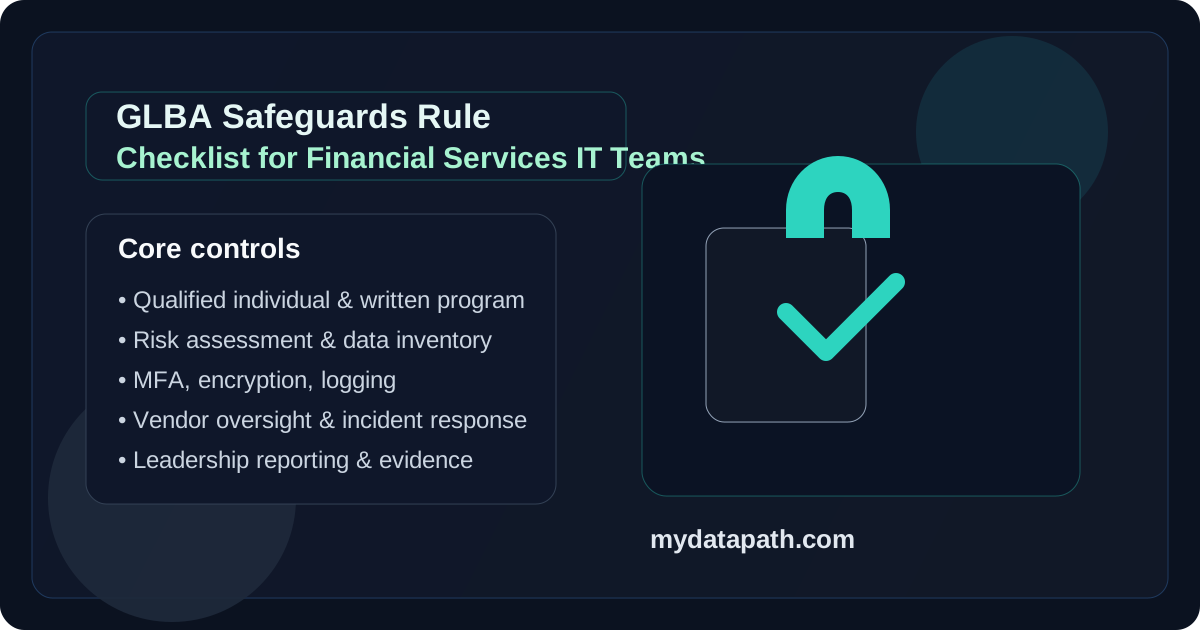

What should a GLBA compliance checklist include?
A practical GLBA compliance checklist should cover scope, governance, written program requirements, risk assessment, access control, encryption, secure development, logging, incident response, service-provider oversight, and board or leadership reporting. The goal is simple: protect customer information with administrative, technical, and physical safeguards that are appropriate to the size and complexity of the business and the sensitivity of the data involved.12
That matters because the FTC’s Safeguards Rule is not just asking financial services firms to buy tools. It requires covered institutions to develop, implement, and maintain a written information security program and to operate it in a disciplined way over time.13 In practice, the hardest part is rarely awareness. It is ownership, evidence, and consistency.
Use this guide to connect the search question to the operating work behind it:
| Search intent | What the checklist should answer | Where Datapath helps |
|---|---|---|
| GLBA compliance checklist | What must be scoped, owned, documented, controlled, tested, and reported | GLBA compliance services and cybersecurity compliance services |
| GLBA Safeguards Rule checklist | How the written security program maps to risk assessment, MFA, encryption, logging, vendor oversight, and reporting | GLBA Safeguards Rule compliance services and managed cybersecurity services |
| FTC Safeguards Rule checklist | Which official safeguard areas need documented ownership, operating evidence, testing, and reporting | GLBA Safeguards Rule compliance services |
| GLBA service provider oversight requirements | Which vendors touch customer information, what safeguards they owe, and how oversight evidence is maintained | GLBA service provider oversight support and vendor risk guidance |
| GLBA risk assessment | Which systems, data, threats, controls, owners, and remediation gaps belong in the written assessment | GLBA risk assessment support and cybersecurity risk assessment services |
| GLBA incident response requirements | Which roles, escalation paths, evidence, communications, and recovery steps are ready before an event | Incident response retainer services |
| GLBA audit checklist | Which operating proof leadership can review before an exam, customer review, insurer request, or incident | GLBA compliance services and cybersecurity compliance services |
| GLBA compliance checklist for document handling | How paper, file shares, portals, email, retention, disposal, and transfer workflows protect customer information | secure financial data transfer services and GLBA compliance services |
Need GLBA safeguards evidence your leadership can use?
Datapath helps financial teams connect access control, vendor oversight, incident response, backup readiness, and reporting into a practical security operating model.
FTC Safeguards Rule checklist: the nine operating checks
An FTC Safeguards Rule checklist should turn the Rule’s required program elements into operating evidence. The FTC describes a reasonable program around nine practical areas: a Qualified Individual, a written risk assessment, safeguards for identified risks, monitoring and testing, staff training, service-provider monitoring, program updates, a written incident response plan, and written reporting by the Qualified Individual to the board or senior leadership.3
For a GLBA compliance audit checklist, that means the question is not only “do we have the policy?” It is “can we prove this control is assigned, reviewed, tested, updated, and tied to remediation?”
| FTC Safeguards Rule checklist area | Evidence a financial services IT team should keep |
|---|---|
| Qualified Individual | Named owner, reporting path, program review cadence, exception approval trail |
| Written risk assessment | Customer-information inventory, systems and vendors in scope, threat criteria, likelihood and impact notes, remediation owners |
| Safeguards for identified risks | MFA, access control, encryption, logging, disposal, change-management, backup, endpoint, and cloud-control evidence |
| Monitoring and testing | Continuous monitoring notes, vulnerability scans, penetration testing where applicable, retest records, and control-review tickets |
| Staff training | Security awareness records, role-specific training, phishing or social-engineering follow-up, and policy acknowledgments |
| Service provider oversight | Vendor register, due diligence, access paths, contract security expectations, incident-notification paths, and periodic reassessments |
| Incident response | Written response plan, roles, escalation matrix, communication path, evidence handling, recovery priorities, and post-incident remediation |
| Leadership reporting | Written Qualified Individual reports covering risk assessment, safeguards, service providers, test results, security events, and recommended changes |
This is where GLBA search intent becomes commercial intent. If the checklist exposes missing evidence, unclear vendor ownership, or response plans that have not been tested, Datapath can help turn the findings into managed remediation through GLBA Safeguards Rule compliance services, managed cybersecurity services, and incident response retainer services.
At Datapath, we think the best way to approach GLBA is as an operating model. A good checklist should help leadership answer four practical questions:
- Are we actually covered?
- Do we know where customer information lives?
- Are the required controls really operating?
- Can we prove it without chaos when scrutiny arrives?
Who needs a GLBA Safeguards Rule checklist?
A GLBA checklist is most useful for financial institutions subject to the FTC’s jurisdiction and for IT teams, compliance leads, and service partners supporting those environments. The Rule’s coverage is broader than many people expect. Under 16 CFR Part 314, examples of covered entities include mortgage lenders, payday lenders, finance companies, mortgage brokers, account servicers, check cashers, wire transferors, collection agencies, credit counselors, tax preparation firms, certain investment advisers, and other businesses significantly engaged in financial activities.12
That scope issue matters because teams sometimes assume GLBA only applies to large banks. It does not. The FTC’s own guidance emphasizes that what matters is the nature of the activity, not whether a company casually thinks of itself as a “bank” or “finance company.”3
The first section of the checklist should therefore confirm:
- which legal entities are in scope
- which products or services make the business a covered financial institution
- which systems store, process, or transmit customer information
- which vendors or affiliates handle that information on the company’s behalf
- which regulator has enforcement authority over the environment
If coverage is vague, the rest of the compliance work will usually be vague too.
Why does the checklist start with governance and a written program?
Because the Safeguards Rule is explicit: the program must be written, appropriate to the business, and supervised by a Qualified Individual.13 That means a useful GLBA checklist should begin with governance before it dives into controls.
A strong governance section should verify that the organization has:
- designated a qualified individual to oversee the information security program
- assigned internal accountability if part of the work is outsourced
- documented the written information security program
- defined review cadence and leadership reporting
- identified owners for risk, remediation, vendors, and incidents
This is one of the clearest places where weak compliance programs reveal themselves. A business may have MFA, encryption, EDR, and backups, but if nobody owns the program formally, nobody is responsible for validating whether the controls actually map to GLBA obligations. The FTC’s guidance is blunt about this: if a service provider helps run the program, responsibility still remains with the covered institution.3
For Datapath’s audience, that usually means the checklist should not just say “appoint a qualified individual.” It should identify who receives reports, how exceptions are escalated, and how decisions get documented.
Who can serve as the GLBA Qualified Individual?
The FTC guidance says the Qualified Individual does not need a specific degree or title; what matters is real-world knowledge suited to the company’s circumstances.3 The role may be internal or may involve an affiliate or service provider, but the covered institution still needs internal supervision and accountability.
For IT and compliance teams, the practical checklist should confirm:
- who oversees the written information security program
- who receives and reviews program reports
- who approves exceptions, compensating controls, and remediation priorities
- how outsourced security or IT work is supervised
- how the organization documents decisions when risk remains open
Datapath can support the technical evidence and remediation workflow around the Qualified Individual, but formal legal interpretation and regulator-facing decisions should remain with qualified counsel, auditors, or compliance advisers.
What should a GLBA risk assessment include?
The checklist should require a written risk assessment and a recurring inventory of customer information, systems, applications, locations, and personnel that can access that information. The FTC states that you cannot formulate an effective information security program until you know what information you have and where it is stored, and the Rule requires periodic reassessment as operations and threats change.3
That makes risk assessment the backbone of the whole program.
A practical GLBA risk-assessment section should verify:
- what customer information exists and what qualifies as nonpublic personal information
- where it is collected, stored, transmitted, backed up, or archived
- which internal users, contractors, and vendors can access it
- foreseeable internal and external threats
- how the business evaluates likelihood and potential impact
- which safeguards are already in place and where the control gaps are
- how reassessments are triggered by system, vendor, or business-model changes
A lot of businesses skip straight to controls because controls feel concrete. But if the inventory is incomplete, the controls are usually misaligned. Unknown SaaS tools, stale admin accounts, shadow file shares, misconfigured cloud storage, and inherited vendor access are exactly the kinds of problems that turn a “compliant enough” environment into a messy incident.
What technical safeguards should every GLBA checklist verify?
A useful GLBA Safeguards Rule checklist should verify a baseline of concrete technical safeguards around access, encryption, application security, monitoring, disposal, and resilience. The revised FTC guidance calls out specific areas such as access controls, data inventory, encryption, secure application procedures, multi-factor authentication, secure disposal, change management, logging, monitoring, and training.3
A practical control checklist usually includes the following areas:
| Control area | What the team should verify | Why it matters |
|---|---|---|
| Access control | Least privilege, unique accounts, prompt deprovisioning, privileged access review | Limits unnecessary exposure of customer information |
| MFA | Multi-factor authentication for access to customer information, or approved equivalent control | Reduces credential-compromise risk |
| Encryption | Customer information encrypted at rest and in transit, or documented compensating control | Protects sensitive data from theft and interception |
| Asset and data inventory | Systems, apps, storage locations, data flows, and users are documented | Prevents blind spots |
| Secure development / app assessment | Internally developed and third-party apps are evaluated for security | Reduces software-driven exposure |
| Logging and monitoring | Critical security events are logged, reviewed, and retained | Enables detection and evidence |
| Disposal | Customer information is securely disposed when no longer needed | Lowers retention and breach risk |
| Change management | Material technology changes are reviewed for security impact | Prevents control drift |
| Incident response | The business has a written response process with roles and communication paths | Improves containment and recovery |
The point is not to create a monster spreadsheet no one can maintain. The point is to make sure each required control area has an owner, a review cadence, and evidence that can survive executive review or regulator scrutiny.
What does the checklist need to say about MFA and encryption?
It should say more than “turn them on.” The checklist should verify where MFA is enforced, where customer information is accessible, which exceptions exist, and who approved them. The FTC specifically identifies multi-factor authentication as a required safeguard unless the qualified individual has approved reasonably equivalent or more secure access controls in writing.23
Likewise, the checklist should verify where customer information is encrypted at rest and in transit, and where compensating controls exist if encryption is not feasible.13
We recommend checking:
- admin access to servers, network devices, cloud consoles, and SaaS admin panels
- remote access pathways, VPNs, and support tooling
- endpoint encryption and server-side storage protections
- email, file transfer, and API transmission paths involving customer data
- key-management ownership and rotation practices where applicable
- exception handling for legacy systems that cannot meet the preferred standard
This is also where a lot of teams discover that “MFA is deployed” really means “MFA exists for some systems.” A checklist worth using should distinguish broad intent from actual coverage.
What does a GLBA compliance checklist need for document handling?
GLBA document handling should cover more than paper files. Customer information may move through Microsoft 365, file shares, email attachments, secure portals, tax systems, payment workflows, scanned documents, backups, vendor platforms, and archived records. The checklist should confirm that each workflow has an approved handling method, access control, encryption or compensating control, retention rule, disposal rule, audit trail, and incident escalation path.
| Document workflow | What to verify | Evidence to keep |
|---|---|---|
| Paper and scanned files | Intake, storage, scanning, shredding, and retention are documented | Handling procedure, retention schedule, disposal record |
| Microsoft 365 and file shares | Sharing is limited by role, guest access is reviewed, and sensitive locations are monitored | Permission review, DLP or sensitivity settings, audit logs |
| Secure file transfer | Customer information uses approved encrypted transfer methods instead of ad hoc email or consumer tools | Platform configuration, access logs, transfer record |
| Vendor portals | Vendor access, upload/download rights, and incident-notification paths are documented | Vendor register, contract terms, access review |
| Backups and archives | Retention, restore access, encryption, and disposal expectations are understood | Backup policy, restore evidence, archive controls |
Financial firms with recurring customer-data movement can pair the GLBA checklist with Datapath’s secure financial data transfer services so document handling, file sharing, vendor portals, and evidence retention are governed together.
What are GLBA Safeguards Rule service provider oversight requirements?
GLBA Safeguards Rule service provider oversight requirements call for covered financial institutions to identify vendors that can access or affect customer information, choose providers capable of maintaining safeguards, require protections by contract where appropriate, and periodically evaluate whether those providers continue to protect customer information. Internal ownership still stays with the covered institution.13
That matters because financial services environments are rarely self-contained. Customer information often touches:
- managed IT providers
- cloud hosting platforms
- tax and accounting software vendors
- payment and transfer providers
- collections or servicing partners
- document-management and e-signature systems
- outsourced security vendors and SOC partners
A strong vendor section should verify:
- which providers handle or can materially affect customer information
- what each provider is contractually responsible for
- whether due diligence was performed before onboarding
- whether the provider’s access paths are documented and limited
- whether incident notification requirements are defined
- whether the business reviews provider changes, attestations, or control evidence over time
For searchers asking about a GLBA Safeguards Rule service provider oversight requirement in the singular, the practical answer is recurring proof. One contract clause is not enough. The business should be able to show which providers are in scope, which systems or customer-information workflows they touch, what security expectations apply, how access is limited, and when provider suitability was last reassessed.
This is where GLBA overlaps with broader Datapath concerns around accountability. A vendor may be technically capable and still operationally vague. That is a risk in itself.
Financial services teams that need help proving vendor accountability can use Datapath’s GLBA Safeguards Rule compliance services to connect service-provider review, contract evidence, access control, monitoring, and remediation tracking.
What are GLBA Safeguards Rule incident response requirements?
GLBA Safeguards Rule incident response requirements should be treated as a written operating plan: roles, decision authority, containment steps, investigation workflow, evidence handling, recovery priorities, communication paths, and post-incident remediation. The checklist should also verify testing, monitoring, and leadership reporting so response plans stay usable before a real event.13
For most organizations, this means the checklist should verify:
- incident response roles and decision-making authority
- contact paths for executives, legal, communications, and technical responders
- procedures for containment, investigation, eradication, and recovery
- log review and escalation workflows
- vulnerability and control testing cadence
- annual or otherwise recurring reporting by the qualified individual to the board or governing body where applicable
- evidence that identified issues are tracked through remediation
Testing matters because a lot of security programs sound better in policy than they perform under pressure. Leadership reporting matters because compliance without visibility usually decays. If the people responsible for the business cannot see open risk, unresolved exceptions, and recurring weak points, the program drifts.
The FTC also added breach-notification requirements in a later amendment, which took effect in 2024 for certain notification scenarios.3 That does not replace an incident-response process. It makes a documented process more important.
What should a GLBA audit checklist include?
A GLBA audit checklist should organize the operating proof behind the written information security program. At minimum, include scope and coverage notes, Qualified Individual governance, customer-information inventory, written risk assessment, MFA and access-control evidence, encryption and compensating-control records, logging and monitoring proof, secure disposal records, service-provider oversight evidence, incident-response plan and test evidence, backup readiness, vulnerability remediation, exception approvals, leadership reporting, and open remediation owners.
For buyer or customer diligence, the useful output is not just a completed checklist. It is an evidence index that shows what was reviewed, where the proof lives, who owns exceptions, and when gaps will be retested.
What should the first 90 days of GLBA cleanup look like?
In the first 30 days, the organization should confirm scope, assign ownership, and inventory systems and customer information. In days 31 through 60, it should complete the written risk assessment, tighten access and MFA coverage, and review encryption and vendor responsibilities. In days 61 through 90, it should validate logging, incident response, disposal, and reporting workflows, then document the remaining remediation roadmap.
A practical first-90-days checklist looks like this:
- Confirm whether the business is in scope under the Rule.
- Designate the qualified individual and define governance.
- Inventory customer information, systems, apps, and vendors.
- Complete a written risk assessment.
- Review MFA, least privilege, and account lifecycle controls.
- Validate encryption coverage and approved exceptions.
- Review service-provider oversight and contract language.
- Build or refresh the incident-response plan.
- Define evidence collection and leadership reporting cadence.
- Turn open gaps into a dated remediation plan.
That is also where related Datapath resources can help frame adjacent priorities. Financial services leaders comparing broader operating partners should also review our financial services solutions page, the PCI DSS compliance checklist, and our post on fintech cybersecurity.
Why Datapath for GLBA-related security operations?
We approach GLBA-related work the same way we approach other regulated-industry IT problems: with accountability, practical control mapping, and evidence that leadership can actually use. The goal is not to generate compliance theater. It is to create an operating rhythm where governance, security controls, vendor oversight, and incident readiness reinforce each other.
For financial services teams balancing customer trust, uptime, third-party risk, and regulatory expectations, that usually means making the environment easier to understand and easier to defend. If your organization is trying to tighten security ownership, clean up vendor accountability, or turn GLBA obligations into a program that holds up under scrutiny, compare Datapath’s GLBA Safeguards Rule compliance services, financial services cybersecurity services, cybersecurity compliance services, cybersecurity risk assessment services, vCISO services, and incident response retainer services.
Turn the checklist into an operating plan.
Datapath can help your team identify GLBA control gaps, clarify vendor accountability, and build reporting that leadership can use before pressure arrives.
Frequently Asked Questions
What should a GLBA compliance checklist include?
A GLBA compliance checklist should include coverage analysis, a written information security program, a qualified individual, written risk assessment, customer-information inventory, access control, MFA, encryption, secure disposal, logging, testing, service-provider oversight, incident response, and recurring leadership reporting.13
What is the GLBA Safeguards Rule?
The GLBA Safeguards Rule is the FTC rule in 16 CFR Part 314 that requires covered financial institutions to develop, implement, and maintain a written information security program with reasonable administrative, technical, and physical safeguards to protect customer information.1
Who needs a GLBA Safeguards Rule checklist?
Any financial institution subject to the FTC’s Safeguards Rule, or IT and compliance teams supporting one, should use a checklist. Coverage can include many non-bank financial businesses such as lenders, brokers, servicers, tax preparers, debt collectors, and similar organizations engaged in financial activities.13
What are GLBA Safeguards Rule service provider oversight requirements?
Covered financial institutions should identify service providers that can access or affect customer information, choose providers capable of maintaining safeguards, require appropriate contractual protections, and periodically evaluate whether those providers continue to protect customer information.13
What are GLBA Safeguards Rule incident response requirements?
Covered financial institutions should maintain a written incident response plan with roles, decision authority, containment steps, investigation workflow, evidence handling, recovery priorities, communication paths, and remediation practices that fit the organization and the information at risk.13
What should a GLBA risk assessment include?
A GLBA risk assessment should identify customer information, systems, users, vendors, reasonably foreseeable threats, existing safeguards, likelihood, potential impact, control gaps, remediation priorities, and reassessment triggers when systems, vendors, or business processes change.13
What should a GLBA audit checklist include?
A GLBA audit checklist should include scope, Qualified Individual governance, customer-information inventory, written risk assessment, MFA and access-control evidence, encryption and compensating-control records, monitoring proof, secure disposal evidence, service-provider oversight records, incident-response evidence, backup readiness, vulnerability remediation, exception approvals, leadership reporting, and open remediation owners.
What is the difference between a GLBA compliance checklist and a GLBA compliance audit checklist?
A GLBA compliance checklist identifies the required program areas. A GLBA compliance audit checklist goes further by organizing the proof: evidence locations, review dates, control owners, exception approvals, remediation tickets, test results, service-provider records, and leadership reports.
What does a GLBA compliance checklist need for document handling?
It should verify approved handling methods for paper records, scanned files, Microsoft 365 sharing, email attachments, file shares, secure portals, vendor platforms, backups, retention, disposal, audit logs, and incident escalation paths for customer information.
Who can serve as the GLBA Qualified Individual?
The Qualified Individual does not need a specific title or degree, but should have real-world knowledge suited to the organization’s circumstances. The role can involve an employee, affiliate, or service provider, but the covered institution still needs internal accountability and supervision.3
What are FTC Safeguards Rule breach notification requirements?
The FTC guidance says the Rule was amended in 2023 to require covered entities to report certain data breaches and security incidents, with those notification requirements taking effect in May 2024.3 Treat notification readiness as part of incident-response planning and confirm legal/reportability decisions with qualified counsel.
How often should GLBA service provider oversight be reviewed?
The FTC guidance describes periodic reassessments of service providers as part of keeping the information security program current.3 In practice, financial services IT teams should review provider access, contract expectations, incident-notification paths, and control evidence during onboarding, renewal, material scope changes, and recurring governance reviews.
Does GLBA require multi-factor authentication?
Yes, the revised Rule generally requires MFA for individuals accessing customer information systems unless the qualified individual has approved a reasonably equivalent or more secure alternative in writing.23
Does GLBA require encryption?
The Rule expects customer information to be encrypted in transit and at rest, with documented alternative compensating controls if encryption is not feasible in a particular case.13
What is the biggest GLBA mistake most teams make?
Usually it is weak ownership. Many teams have pieces of the control set in place, but no clean inventory, no formal governance, no recurring risk reassessment, and no evidence map tying controls to responsible owners.
How can a managed cybersecurity provider support GLBA safeguards?
A managed cybersecurity provider can help operate the technical and evidence routines behind GLBA: identity review, endpoint coverage, monitoring, vendor-access review, backup readiness, vulnerability remediation, incident-response readiness, reporting, and remediation tracking. The covered institution still retains responsibility for the program.
Sources
- 16 CFR Part 314 — Standards for Safeguarding Customer Information
- Federal Register: Standards for Safeguarding Customer Information (2021 final rule)
- FTC Safeguards Rule: What Your Business Needs to Know
- Gramm-Leach-Bliley Act | Federal Trade Commission
Footnotes
-
16 CFR Part 314 — Standards for Safeguarding Customer Information ↩ ↩2 ↩3 ↩4 ↩5 ↩6 ↩7 ↩8 ↩9 ↩10 ↩11 ↩12 ↩13 ↩14
-
Federal Register: Standards for Safeguarding Customer Information (2021 final rule) ↩ ↩2 ↩3 ↩4
-
FTC Safeguards Rule: What Your Business Needs to Know ↩ ↩2 ↩3 ↩4 ↩5 ↩6 ↩7 ↩8 ↩9 ↩10 ↩11 ↩12 ↩13 ↩14 ↩15 ↩16 ↩17 ↩18 ↩19 ↩20 ↩21 ↩22 ↩23