What are incident response retainer services?
Incident response retainer services give an organization pre-approved access to response planning, escalation contacts, forensic coordination, containment guidance, evidence handling, communications support, and post-incident remediation before a cyber emergency starts.
Are cyber incident response services different from an incident response retainer?
Cyber incident response services are the work performed during or after an event. An incident response retainer establishes the relationship, activation process, readiness work, and response expectations before the event so the organization does not lose time during procurement or role confusion.
How should buyers compare incident response retainer services?
Compare incident response retainer services by reviewing activation authority, first-hour response meaning, DFIR scope, evidence handling, counsel and insurer coordination, readiness hours, after-hours coverage, reporting deliverables, and fit with your internal IT or MSP operating model.
What questions should buyers ask before signing an IR retainer?
Ask who can activate the retainer, what the response SLA provides, which DFIR services are included, whether counsel-directed work is supported, how cyber insurance is coordinated, what evidence package is delivered, and whether unused hours can support readiness work.
What should an incident response retainer include?
A practical retainer should define activation authority, response SLAs, forensic and containment scope, counsel and insurer coordination, evidence handling, communication paths, after-hours escalation, readiness reviews, tabletop exercises, and post-incident reporting.
Can an AI DFIR retainer replace in-house response capability?
No. An AI DFIR retainer can add triage speed, investigation depth, evidence discipline, and surge capacity, but internal teams still need business context, access authority, recovery priorities, and vendor relationships. AI-assisted triage should stay human-led and explainable.
Do mid-market companies need incident response retainer services?
Many mid-market companies benefit from a retainer when they rely on Microsoft 365, cloud identity, remote access, third-party vendors, regulated data, or lean internal IT staffing. The retainer gives leadership a clearer response path before ransomware, account compromise, or data exposure creates pressure.
Does Datapath replace breach counsel or a forensic response firm?
Datapath can coordinate with breach counsel, insurers, forensic responders, MDR partners, and internal teams. The goal is to keep technical context, containment actions, evidence needs, recovery decisions, and business communication aligned instead of fragmented.
Can incident response retainer services include ransomware response readiness?
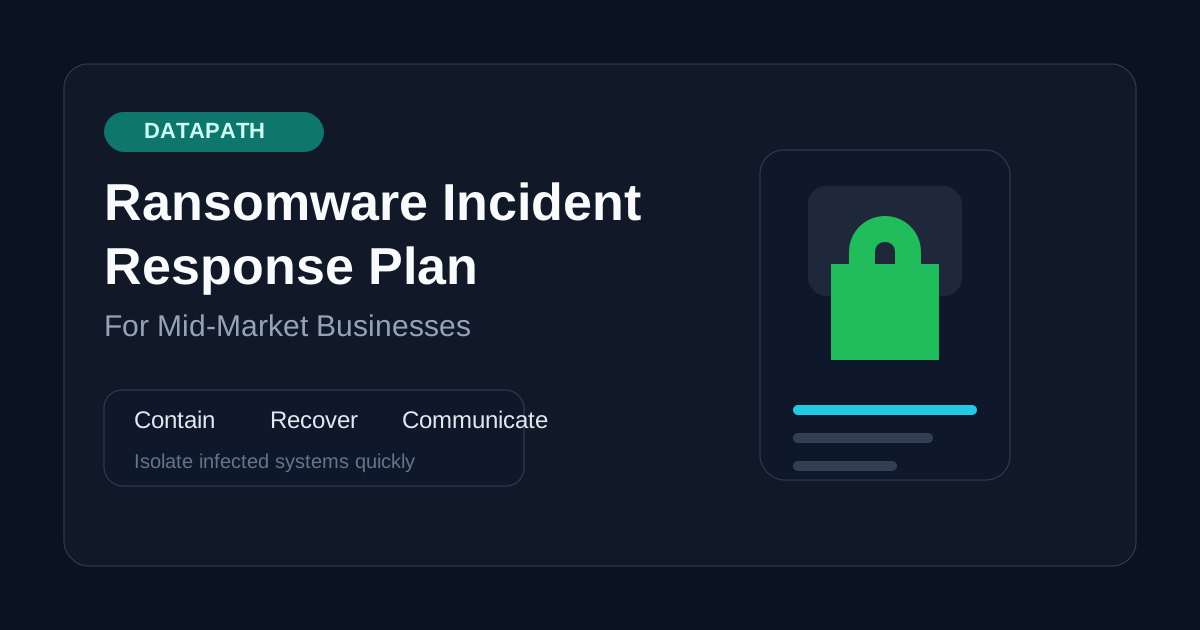
Yes. Datapath can connect ransomware readiness to tabletop exercises, identity hardening, endpoint visibility, firewall and remote-access review, backup validation, communication planning, recovery sequencing, and remediation tracking.
Can incident response retainer services cover business email compromise?
Yes. Datapath can include BEC scenarios in retainer planning, including compromised Microsoft 365 mailbox containment, session revocation, mailbox rule review, finance escalation, evidence capture, recipient notification, and post-incident hardening.
Can Datapath help with Microsoft 365 compromised email account response?
Yes. Datapath can help apply Microsoft 365 account-containment steps, review sign-ins, MFA methods, app consent, roles, forwarding, inbox rules, and message traces, then coordinate the business side of BEC response with finance, leadership, legal, insurers, and external recipients.
Can Datapath facilitate cyber incident response tabletop exercises?
Yes. Datapath can facilitate cyber tabletop exercises that test roles, declaration authority, containment decisions, communications, evidence preservation, vendor coordination, backup assumptions, and post-exercise remediation ownership.
Can tabletop exercises use CISA-style scenarios or enterprise templates?
Yes. Datapath can adapt CISA-style tabletop resources and enterprise incident response templates to the organization's real systems, vendors, decision-makers, regulatory exposure, recovery expectations, and communications paths.
Can Datapath support ICS or operational technology tabletop scenarios?
Datapath can help teams plan cyber tabletop exercises that account for industrial control systems or operational technology assumptions, including remote access, safety constraints, vendor dependencies, manual operations, containment decisions, and restoration sequencing.
How do incident response services connect to managed cybersecurity?
Managed cybersecurity reduces incident likelihood through monitoring, triage, remediation, and control improvement. Incident response services define what happens when a serious event still occurs, including escalation, containment, evidence preservation, recovery coordination, and leadership reporting.
Can Datapath support local incident response planning in Modesto or Fresno?
Yes. Datapath supports Central Valley and multi-site organizations with incident readiness, managed IT, cybersecurity operations, backup planning, and response coordination across Modesto, Fresno, nearby California markets, and Central Ohio service areas.