
What does HIPAA require in a contingency plan?
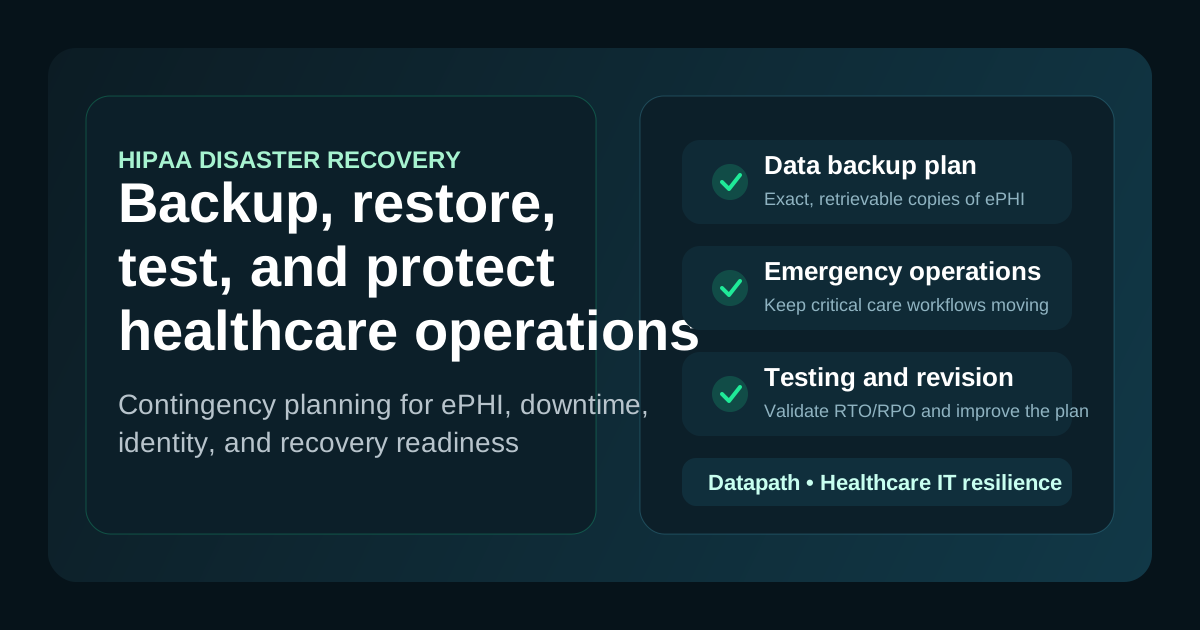
A HIPAA contingency plan should define how a covered entity or business associate responds when an emergency or other occurrence damages systems that contain electronic protected health information (ePHI). Under 45 CFR 164.308(a)(7), the plan must address data backup, disaster recovery, and emergency mode operations, with testing/revision and applications/data criticality analysis handled as addressable specifications.1
That is the compliance baseline. In practice, healthcare leaders also need an operating plan that shows what gets restored first, how clinicians work during downtime, who owns vendor escalation, and what evidence proves backups can actually be restored. A binder is not enough if the EHR, identity provider, imaging archive, phone system, or Microsoft 365 tenant fails during a real event.
Review healthcare disaster recovery planning
Which HIPAA contingency plan requirement matches your search intent?
Healthcare buyers and IT leaders use a lot of similar phrases for the same problem: how to protect ePHI availability when systems are disrupted. The table below maps common search language to the practical requirement behind it.
| If your search sounds like this | What you are really trying to answer | Where to focus first |
|---|---|---|
| ”HHS HIPAA contingency plan data backup disaster recovery emergency mode operation plan” | What does the official HIPAA Security Rule require? | 45 CFR 164.308(a)(7), plus documented procedures for each implementation specification |
| ”HHS HIPAA Security Rule contingency plan data backup disaster recovery emergency mode operations” | Are the HHS and eCFR contingency-plan phrases pointing to the same standard? | Yes. Map the query to the contingency plan standard, three required specifications, two addressable specifications, and retained evidence |
| ”HIPAA disaster recovery plan requirements” | What has to be in the recovery plan itself? | Data restoration procedures, recovery roles, system priorities, evidence, and vendor dependencies |
| ”Data backup and recovery HIPAA” | How should ePHI backups be created and restored? | Retrievable exact copies, backup scope, encryption, access controls, restore testing, and offline or isolated copies |
| ”HIPAA compliant disaster recovery” | What makes recovery more than generic IT backup? | ePHI protection, emergency mode safeguards, criticality analysis, testing, and documented decisions |
| ”Disaster recovery plan for EHR” | How do we recover clinical systems and keep care moving? | EHR access, identity services, downtime forms, patient documentation, vendor escalation, and reconciliation |
| ”Healthcare patient data backup recovery RTO requirements HIPAA” | Does HIPAA require a specific recovery time? | No universal RTO is named in the rule; set defensible RTO/RPO targets from risk, criticality, and clinical impact |
What does the HHS HIPAA contingency plan data backup, disaster recovery, and emergency mode operation standard require?
When people search for the full phrase “HHS HIPAA contingency plan data backup disaster recovery emergency mode operation plan,” they are usually looking for the core HIPAA Security Rule contingency planning standard. The same answer applies to searches for “HHS HIPAA Security Rule contingency plan data backup disaster recovery emergency mode operations.” The standard is found at 45 CFR 164.308(a)(7), and it requires covered entities and business associates to establish and implement policies and procedures for responding to an emergency or other occurrence that damages systems containing ePHI.1
The practical answer is this: HIPAA contingency planning is not one document with one backup setting. It is a set of connected procedures that show how ePHI is copied, restored, protected, prioritized, tested, and used during emergency operations.
| HIPAA contingency requirement | What HHS is asking for | Practical healthcare evidence |
|---|---|---|
| Contingency plan standard | Policies and procedures for emergencies or other occurrences that damage systems containing ePHI | Approved plan, owner, activation criteria, scope, review cadence, and leadership accountability |
| Data backup plan | Procedures to create and maintain retrievable exact copies of ePHI | Backup coverage list, frequency, retention, monitoring, failure escalation, encryption, access controls, and restore tests |
| Disaster recovery plan | Procedures to restore any loss of data | Recovery runbooks, restore order, vendor escalation, validation checks, timing evidence, and post-recovery reconciliation |
| Emergency mode operation plan | Procedures that let critical business processes continue while protecting ePHI in emergency mode | EHR downtime workflows, paper forms, alternate communications, emergency access, patient-data handling, and re-entry process |
| Testing and revision procedures | Periodic testing and revision of contingency plans | Tabletop notes, restore-test evidence, findings, owners, due dates, and updated plan versions |
| Applications and data criticality analysis | Assessment of the relative criticality of applications and data | Tiered system inventory, RTO/RPO targets, clinical impact, vendor dependencies, and leadership-approved recovery sequence |
For most healthcare teams, the useful deliverable is a combined contingency plan matrix: each system that touches ePHI, the backup method, recovery priority, downtime workflow, vendor dependency, owner, test evidence, and open risk. That matrix can then feed a dedicated healthcare disaster recovery planning engagement, internal audit review, cyber insurance renewal, or leadership risk register.
If the organization uses hosted EHR, cloud storage, SaaS billing, imaging, or a managed services provider, this matrix should also name which party creates backups, who can restore data, how business associate evidence is requested, and what happens if the vendor is unavailable. The HHS summary of the Security Rule frames contingency planning around backing up ePHI, restoring lost data, and continuing critical business processes that protect ePHI during emergency mode.2 The eCFR text is concise; the operating evidence needs to be much more specific.
What are the five HIPAA contingency planning components?
The HIPAA Security Rule’s contingency plan standard includes five implementation specifications: data backup plan, disaster recovery plan, emergency mode operation plan, testing and revision procedures, and applications/data criticality analysis.1 Three are required specifications and two are addressable, but all five should be treated as connected parts of healthcare resilience.
| HIPAA contingency component | Status | What the plan should prove |
|---|---|---|
| Data backup plan | Required | ePHI can be copied, protected, monitored, and restored from retrievable exact copies |
| Disaster recovery plan | Required | The organization has procedures to restore lost data after a disruption |
| Emergency mode operation plan | Required | Critical business processes can continue while protecting ePHI in emergency mode |
| Testing and revision procedures | Addressable | Contingency plans are tested periodically and improved when evidence shows gaps |
| Applications and data criticality analysis | Addressable | Specific applications and data are ranked by relative criticality to support recovery priorities |
“Addressable” does not mean “optional.” HHS explains that the Security Rule is flexible and scalable, and regulated entities choose reasonable and appropriate safeguards based on size, complexity, technical environment, costs, and ePHI risk.2 If a healthcare organization chooses not to implement an addressable specification exactly as written, it still needs a documented rationale and an equivalent way to manage the risk.
Does HIPAA require a 1-hour RTO for patient data recovery?
HIPAA does not set one universal 1-hour recovery time objective (RTO) for every healthcare organization or every system. The current Security Rule text requires contingency procedures, retrievable exact copies of ePHI, procedures to restore data loss, emergency mode operation procedures, testing/revision, and applications/data criticality analysis. It does not name a single recovery-time number for all environments.1
That does not mean RTO and recovery point objective (RPO) targets are unimportant. It means the healthcare organization should define them through risk analysis, application criticality, clinical impact, vendor dependencies, and tested recovery evidence. A 1-hour RTO may be appropriate for EHR access, medication workflows, imaging, or identity systems in some environments. It may be unrealistic for lower-priority systems or unsupported by existing contracts.
Use a model like this:
| System tier | Example systems | Typical planning question |
|---|---|---|
| Tier 1: patient-care and access-critical | EHR, identity, core network, voice, medication workflows, emergency communications | What must be usable first to continue care and protect ePHI? |
| Tier 2: clinical and operational continuity | Imaging, lab integrations, scheduling, file systems, Microsoft 365, claims workflows | What must return quickly to prevent operational harm and data-quality issues? |
| Tier 3: deferred business systems | Reporting, archival systems, noncritical admin tools | What can safely wait while higher-priority services recover? |
If a vendor promises a 1-hour RTO, ask what that promise covers. Is it one application, the full EHR workflow, identity access, network connectivity, data consistency, endpoint access, and staff workflow? Recovery metrics are only useful when the scope is clear.
For a 1-hour patient data RTO, define the exact patient-data access outcome before accepting the number. “Data is restored” is different from “clinicians can authenticate, locate the right patient, view current records, document care, order medication or labs, and reconcile downtime notes after the system returns.”
| 1-hour RTO planning question | Why it matters for patient data |
|---|---|
| Which patient-data systems are in scope? | EHR, imaging, lab, medication, identity, network, phones, and patient communication tools may have different recovery paths. |
| What is the recovery point objective? | A 1-hour RTO can still leave unacceptable data loss if the RPO is not defined and tested. |
| Does the commitment include identity and endpoint access? | Restored data is not usable if staff cannot sign in, connect, or reach the restored application. |
| How is downtime documentation reconciled? | Temporary paper or offline records need a controlled path back into the system of record. |
| What evidence proves the target? | Use restore-test results, timestamps, screenshots, tickets, application validation, and user acceptance notes. |
What should a HIPAA data backup plan include?
A HIPAA data backup plan should identify all ePHI sources, define backup frequency, assign ownership, protect backup access, monitor failures, and prove restores through testing. NIST SP 800-66 Rev. 2 recommends asking whether backup procedures include all ePHI, whether backup logs are reviewed, and whether data restoration tests confirm backup integrity.3
For healthcare environments, the backup plan should include:
- EHR databases and document repositories
- PACS, VNA, imaging archives, and modality exports where applicable
- identity systems, SSO, MFA, VPN, firewall, and network configurations needed for access
- Microsoft 365, email, SharePoint, Teams, and cloud file repositories
- billing, scheduling, lab, referral, and patient communication platforms
- endpoint, server, SaaS, and cloud workloads that create, receive, maintain, or transmit ePHI
- backup job monitoring, failure escalation, and restore-test evidence
- encryption, privileged access controls, and separation from production credentials
- offline, isolated, immutable, or otherwise protected recovery copies where ransomware risk is material
The plan should also name who reviews backup failures and how quickly they escalate. A failed backup job is not just an IT alert when it affects ePHI availability.
What should a HIPAA disaster recovery plan include?
A HIPAA disaster recovery plan should document procedures to restore lost data, define the order of recovery, identify recovery owners, and connect technical restoration to clinical continuity. The eCFR requirement is concise, but healthcare implementation is not. Restoring a database is different from restoring a usable care workflow.1
A practical disaster recovery plan should cover:
| Recovery area | What to document |
|---|---|
| Activation criteria | Who declares a disaster, what triggers the plan, and how severity is classified |
| Recovery scope | Which applications, data sets, devices, networks, cloud services, and vendors are included |
| Recovery order | Which systems return first, based on applications/data criticality analysis |
| Roles and escalation | Internal owners, executive decision makers, MSP contacts, EHR vendors, telecom providers, and security partners |
| Access dependencies | Active Directory, Entra ID, MFA, VPN, endpoint management, privileged access, and emergency access workflows |
| Restore procedures | Backup location, restore steps, validation checks, and data integrity review |
| Evidence | Test results, screenshots, logs, tickets, recovery metrics, and plan updates |
| Post-recovery work | Data reconciliation, incident review, user communication, and remediation tracking |
For a broader healthcare continuity model, pair this page with Datapath’s healthcare disaster recovery plan checklist and EHR downtime contingency checklist.
What should an emergency mode operation plan include?
An emergency mode operation plan should explain how critical business processes continue while protecting ePHI during and immediately after a crisis. This is one of the required HIPAA contingency planning specifications, and NIST frames emergency mode around continuing critical functions that involve ePHI.13
In healthcare, emergency mode planning should answer:
- How will clinicians document care if the EHR is unavailable?
- Which downtime forms are approved, current, and accessible?
- How are medication, lab, referral, imaging, and patient intake workflows handled?
- Which communication channels remain available if email, phones, or Teams are down?
- How is temporary access approved, logged, and revoked?
- How are paper records or temporary files reconciled back into systems?
- How are patients, staff, vendors, and leadership informed?
- How is ePHI protected when normal systems are unavailable?
HHS OIG has noted that EHR disruptions can prevent or limit hospital staff access to records, and that contingency plans specify how to recover EHR systems and access backup copies of EHR data.4 That is the operational reality behind the regulation. Emergency mode planning is not just a compliance term; it is how care teams avoid improvising during downtime.
How should testing and revision work?
Testing and revision should prove that the plan works, expose gaps, assign owners, and update procedures based on evidence. A backup job that reports “success” is not the same thing as a verified restore. A tabletop conversation is useful, but it should eventually connect to technical recovery tests and clinical downtime workflow validation.
A defensible testing program should include:
- Tabletop exercises for EHR outage, ransomware, cloud/SaaS outage, facility loss, and vendor failure.
- Restore testing for Tier 1 systems and representative ePHI data sets.
- Identity and access recovery tests, including privileged access and MFA dependencies.
- Review of backup logs, restore logs, screenshots, tickets, and timing evidence.
- Downtime workflow drills for clinical and administrative teams.
- Post-test findings with owners, due dates, and closure evidence.
- Revision of the contingency plan after major system, vendor, facility, or workflow changes.
CMS emergency preparedness requirements add a broader healthcare operating lens for Medicare and Medicaid participating providers and suppliers, including emergency preparedness plans, communication plans, policies and procedures, and training/testing programs.5 HIPAA and CMS are not the same framework, but healthcare IT leaders should make sure technology recovery supports emergency operations rather than living in a separate silo.
How should applications and data criticality analysis be done?
Applications and data criticality analysis should rank specific systems and data by patient-care impact, ePHI exposure, operational dependency, vendor dependency, and acceptable downtime. HIPAA names this analysis as part of contingency planning because recovery order should be decided before pressure, not during an outage.1
Start with these questions:
- Which systems directly affect patient care or safety?
- Which systems store, process, or transmit ePHI?
- Which systems are required for authentication, connectivity, or endpoint access?
- Which vendors must be available for restoration?
- Which workflows can run manually, and for how long?
- Which data can tolerate a longer RPO, and which cannot?
- Which systems have tested restores, and which are assumed recoverable?
The output should be a ranked recovery list, not a vague inventory. If every application is marked critical, leadership has not actually made a recovery decision.
What should healthcare organizations ask backup and recovery vendors?
Healthcare organizations should ask vendors to prove recovery scope, timing, evidence, ePHI protection, and escalation ownership. A sales deck can make a platform look HIPAA-ready, but the contract, recovery architecture, and testing evidence show whether it can support a real contingency plan.
Ask these questions before signing:
| Vendor question | Why it matters |
|---|---|
| Which ePHI systems are in scope, and which are excluded? | Prevents false assumptions about SaaS, imaging, identity, or legacy systems |
| What exact RTO/RPO is promised, and for which systems? | Separates marketing claims from measurable recovery commitments |
| How are backups protected from ransomware and credential compromise? | Tests whether recovery copies survive the most likely destructive events |
| How often are restores tested, and can we see evidence? | Confirms recoverability instead of backup-job success alone |
| Who owns recovery during an incident? | Clarifies MSP, vendor, internal IT, and executive responsibilities |
| How are emergency access and temporary workflows handled? | Protects ePHI when normal systems are impaired |
| Does the plan include identity, endpoints, network, and cloud dependencies? | Ensures restored data can actually be used by staff |
Datapath helps healthcare organizations evaluate these questions across healthcare IT support, managed IT services, cybersecurity services, HIPAA-compliant IT services, and related recovery work such as medical imaging backup and disaster recovery.
How does disaster recovery planning relate to HIPAA hosting requirements?
Disaster recovery planning relates to HIPAA hosting requirements because a hosting provider, cloud platform, EHR vendor, or managed services partner may support systems that create, receive, maintain, or transmit ePHI. HIPAA does not make a hosting vendor’s marketing language the contingency plan. The healthcare organization still needs to understand what is hosted, what is backed up, who can restore it, what the business associate agreement covers, and what evidence proves ePHI availability during an outage.
For the query “how does disaster recovery planning relate to HIPAA hosting requirements?” the practical answer is shared responsibility. Hosting can provide infrastructure resilience, but the covered entity or business associate still needs documented procedures, tested recovery, emergency mode workflows, and vendor escalation paths.
| HIPAA hosting issue | Disaster recovery planning question |
|---|---|
| Business associate relationship | Does the agreement cover hosted ePHI, recovery support, incident escalation, subcontractors, and evidence access? |
| Hosted application scope | Which EHR, imaging, patient portal, billing, identity, database, file, and integration systems are actually in scope? |
| Backup ownership | Does the host create backups, does the healthcare organization create its own backup, or are both required? |
| RTO/RPO commitments | Are recovery targets contractual, tested, and tied to usable clinical workflows rather than infrastructure only? |
| Emergency access | How will authorized staff reach patient data if normal SSO, VPN, endpoints, or network paths fail? |
| Evidence and testing | Can the organization review restore results, timestamps, tickets, recovery reports, and plan updates? |
| Exit and portability | How can data be exported, restored elsewhere, or accessed if the hosting relationship ends or the vendor is impaired? |
This is where hosting, disaster recovery, vendor management, and contingency planning overlap. A HIPAA-aware recovery review should test whether hosted systems support the organization’s required data backup, disaster recovery, and emergency mode operation procedures instead of assuming the hosting platform solves them automatically.
For HIPAA-compliant data backup and disaster recovery, ask whether the hosting or SaaS provider can prove retrievable ePHI copies, restore procedures, emergency access, RTO/RPO scope, incident escalation, export or portability paths, and post-recovery evidence. If those answers are split between the provider, internal IT, and a managed services partner, the contingency plan should show the handoff rather than leaving it to a contract appendix.
What does a strong HIPAA contingency plan look like in practice?
A strong HIPAA contingency plan is specific, tested, role-based, and usable under pressure. It ties regulation to real workflows: how ePHI is backed up, how systems are restored, how emergency operations continue, how criticality is ranked, and how evidence is produced for leadership, auditors, insurers, and incident-response teams.
At a minimum, leadership should be able to answer:
- Which systems and data contain or support ePHI?
- Which backups are restorable, and when were they last tested?
- Which systems recover first, and who approved that order?
- How do clinicians and staff work during EHR or identity downtime?
- Who contacts vendors, regulators, insurers, and leadership if the outage is security-related?
- What evidence proves the plan has been tested and revised?
- Which risks remain unresolved, and who owns remediation?
If those answers are scattered across tickets, vendor portals, old spreadsheets, and people’s memory, the contingency plan is not mature enough.
Why Datapath for HIPAA contingency planning and healthcare disaster recovery?
Datapath works with healthcare organizations that need IT support, cybersecurity, backup readiness, cloud operations, and compliance-aware reporting to operate as one system. HIPAA contingency planning should not sit apart from daily IT operations. It should connect to how users authenticate, how backups are monitored, how endpoints are managed, how vendors escalate, and how leadership sees risk.
If your organization is reviewing HIPAA disaster recovery plan requirements, validating a 1-hour RTO claim, preparing for a healthcare continuity review, or trying to reduce EHR downtime risk, talk with Datapath about a practical recovery readiness assessment.
FAQ: HIPAA contingency plans and disaster recovery
Does HIPAA require a contingency plan?
Yes. 45 CFR 164.308(a)(7) requires covered entities and business associates to establish and implement policies and procedures for responding to emergencies or other occurrences that damage systems containing ePHI.1
What are the required HIPAA contingency plan specifications?
The required specifications are the data backup plan, disaster recovery plan, and emergency mode operation plan. Testing/revision procedures and applications/data criticality analysis are addressable specifications.1
Does HIPAA require a disaster recovery plan?
Yes. The HIPAA contingency plan standard includes a required disaster recovery plan implementation specification for procedures to restore any loss of data.1
Does HIPAA require a 1-hour RTO?
No universal 1-hour RTO is stated in the current HIPAA Security Rule text. Healthcare organizations should set RTO and RPO targets based on risk analysis, application criticality, patient-care impact, contracts, and tested recovery capability.12
Does a 1-hour patient data RTO satisfy HIPAA?
A 1-hour patient data RTO may support a HIPAA contingency plan for high-priority systems, but it is not automatically sufficient by itself. The organization should define which patient data and workflows are covered, what RPO applies, how identity and network access recover, and what testing evidence proves the target.
What does HHS mean by HIPAA contingency plan data backup, disaster recovery, and emergency mode operation?
HHS points regulated entities to the HIPAA Security Rule contingency plan standard. Data backup, disaster recovery, and emergency mode operation are required specifications, while testing/revision and applications/data criticality analysis are addressable specifications that still require documented decisions and evidence.
What is the HHS HIPAA Security Rule contingency plan standard?
The HHS HIPAA Security Rule contingency plan standard is 45 CFR 164.308(a)(7). It requires policies and procedures for emergencies or other occurrences that damage systems containing ePHI, including required data backup, disaster recovery, and emergency mode operation specifications plus addressable testing/revision and applications/data criticality analysis.
How does disaster recovery planning relate to HIPAA hosting requirements?
HIPAA hosting and disaster recovery planning overlap when hosted systems create, receive, maintain, or transmit ePHI. Healthcare organizations should confirm backup ownership, recovery scope, business associate obligations, RTO/RPO commitments, emergency access, testing evidence, and exit or portability procedures.
Is backup alone enough for HIPAA contingency planning?
No. Backups are only one component. HIPAA contingency planning also includes disaster recovery, emergency mode operation, testing and revision, and applications/data criticality analysis.1
How often should a HIPAA contingency plan be tested?
HIPAA requires periodic testing and revision procedures as an addressable specification. The practical cadence should reflect risk, system criticality, operational change, vendor change, and incident lessons learned.13
Should EHR downtime workflows be part of the plan?
Yes. If the EHR is unavailable, clinicians still need safe documentation, communication, medication, and reconciliation procedures. HHS OIG has highlighted EHR disruption risk and the role of contingency plans in recovering EHR systems and accessing backup data.4
Who should own HIPAA disaster recovery planning?
Ownership should be shared across executive leadership, IT, security, compliance, clinical operations, vendors, and the managed IT provider. One coordinator should maintain the plan, but the recovery process depends on cross-functional decisions and evidence.
Sources
- 45 CFR § 164.308 — Administrative safeguards
- HHS: Summary of the HIPAA Security Rule
- NIST SP 800-66 Rev. 2: Implementing the HIPAA Security Rule
- CMS: Emergency Preparedness Rule
- HHS OIG: Hospitals largely reported addressing requirements for EHR contingency plans
