
What should a managed cybersecurity service package include?
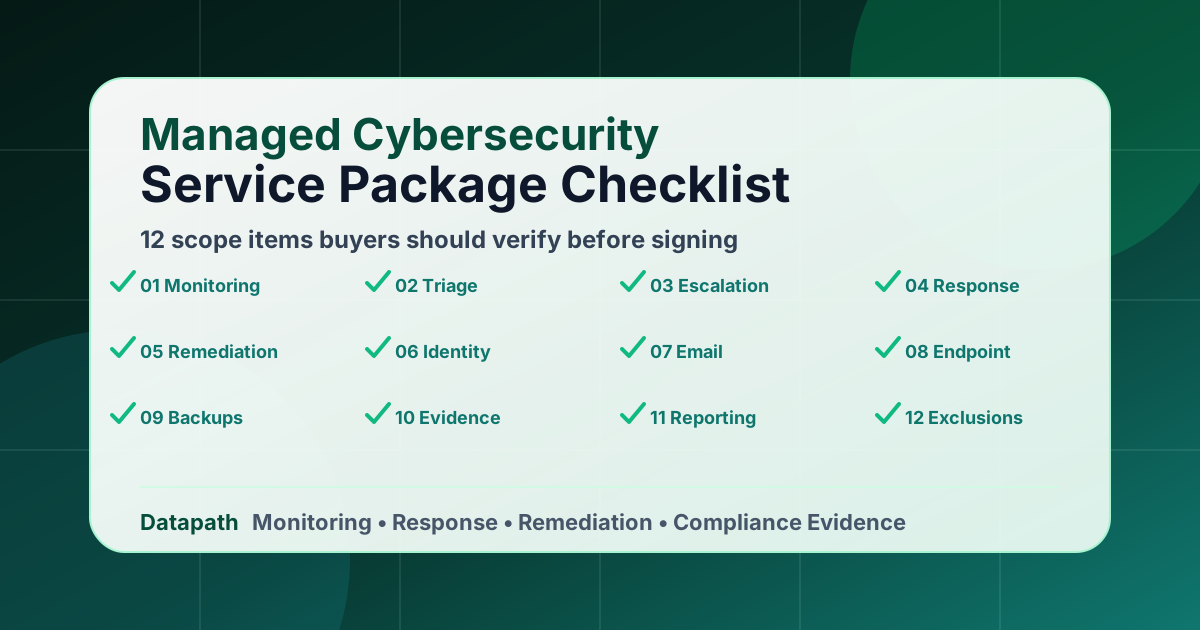
A managed cybersecurity service package should include 12 defined areas: monitoring scope, alert triage, after-hours escalation, response authority, vulnerability remediation, identity review, email protection, endpoint coverage, backup readiness, compliance evidence, executive reporting, and written exclusions. If a proposal cannot explain who owns each area, it is not mature enough for a regulated or mid-market business.
The phrase “managed cybersecurity” is easy to misuse. Some providers mean 24/7 analyst review and coordinated response. Others mean a software bundle, an endpoint license, or a dashboard that your internal team still has to watch. That difference matters when a suspicious sign-in appears at 2:00 a.m., a cyber insurance questionnaire asks for evidence, or ransomware exposes that backups were monitored but never restore-tested.
Datapath’s current GSC data shows commercial demand around managed cybersecurity packages and related evaluation questions. The best next piece is not another broad definition of managed cybersecurity services. It is a buyer-facing listicle that tells IT leaders exactly what to verify before signing.
Need help comparing managed cybersecurity packages?
Datapath can review monitoring scope, triage rules, remediation ownership, incident-response boundaries, compliance evidence, and reporting before you lock into a provider.
1. Monitored systems and telemetry sources
A managed cybersecurity service package should start by naming what is monitored. “Security monitoring” is not specific enough. The proposal should identify whether the provider watches endpoints, Microsoft 365, identity systems, email security, firewalls, cloud platforms, backup alerts, vulnerability data, servers, remote access, and privileged-user activity.
CISA’s Cyber Essentials guidance tells organizations to learn what is on the network, maintain hardware and software inventories, know who is on the network, and understand what is happening across network, perimeter, host, data, and user activity.1 A package that skips asset and telemetry scope cannot credibly promise monitoring coverage.
Ask for a table like this:
| Signal source | Included? | Who reviews it? | After-hours rule |
|---|---|---|---|
| Endpoint detection and response | Yes/no | Provider/internal/shared | Severity threshold |
| Microsoft 365 identity alerts | Yes/no | Provider/internal/shared | Admin or risky sign-in trigger |
| Email security alerts | Yes/no | Provider/internal/shared | User-reported phishing trigger |
| Firewall and network events | Yes/no | Provider/internal/shared | Critical block/allow pattern |
| Backup or recovery alerts | Yes/no | Provider/internal/shared | Failed backup or restore-risk trigger |
If the provider cannot fill in the table, the package is still a concept, not an operating model.
2. Human alert triage, not alert forwarding
The second checklist item is human triage. A real managed cybersecurity package should say who reviews alerts, how false positives are tuned, which alerts become incidents, and how evidence is recorded. Tool-generated alerts are raw material. Triage is the managed service.
For a lean IT team, alert forwarding can be worse than no service because it creates the illusion of coverage while leaving internal staff buried in noise. We see this most often when companies buy a security platform and assume the provider is investigating every signal. The buyer should ask for sample triage notes, escalation criteria, and examples of closed benign events versus validated incidents.
Useful triage fields include:
- affected user or asset
- alert source and severity
- business criticality
- evidence reviewed
- false-positive or true-positive decision
- containment recommendation
- internal owner
- follow-up ticket or exception
This is where security alert triage services and managed cybersecurity monitoring either become operationally useful or collapse into dashboard watching.
3. After-hours escalation rules
A managed cybersecurity service package must define after-hours escalation. Cyber incidents do not respect office hours, but not every alert deserves a 2:00 a.m. phone call. The package should explain which events trigger immediate escalation, who receives the call, what backup contacts exist, and what happens if no one responds.
CISA’s Cyber Essentials crisis-response guidance recommends incident response and disaster recovery plans with roles, responsibilities, recovery priorities, and outside contacts.1 That applies directly to managed cybersecurity. A provider cannot support crisis response if escalation contacts and authority are improvised during the crisis.
At minimum, the proposal should define:
- severity levels;
- phone, SMS, ticket, and email escalation paths;
- primary and backup contacts;
- expected acknowledgement windows;
- what the provider may do before business approval;
- how leadership is notified;
- how incident notes are preserved.
Weak language sounds like “we monitor 24/7.” Strong language says exactly what happens when a critical endpoint, identity, or ransomware signal appears after hours.
4. Response authority and containment boundaries
Response authority is where many managed cybersecurity packages get vague. The proposal should say whether the provider can disable an account, isolate an endpoint, block an IP address, revoke sessions, reset credentials, quarantine email, change firewall rules, or only recommend those actions.
Neither model is automatically wrong. Some organizations want tight approval control. Others need the provider to act quickly within pre-approved containment boundaries. What fails is silence. If nobody knows whether the provider can contain a compromised account, response slows down exactly when speed matters.
NIST SP 800-61 says incident response requires planning and resources and gives guidance for analyzing incident-related data and determining appropriate response.2 A managed package should operationalize that idea with documented authority, not just a generic incident-response promise.
Ask these questions before signing:
- Which containment actions are pre-authorized?
- Which actions require written approval?
- Who approves disruptive steps after hours?
- How are actions documented for legal, insurance, or audit review?
- When does the provider hand off to a separate incident-response retainer?
If the package excludes hands-on response, Datapath recommends pairing it with incident response retainer services or a clearly documented internal response workflow.
5. Vulnerability remediation follow-through
A good managed cybersecurity package should include more than vulnerability scanning. It should define how findings are prioritized, assigned, remediated, verified, and reported. A monthly PDF full of critical findings is not remediation.
CISA’s Cyber Essentials names patch and update management as one of the first things organizations should do, including replacing unsupported systems and testing and deploying patches quickly.1 For mid-market teams, the hard part is usually not knowing that patching matters. The hard part is assigning owners, handling exceptions, coordinating maintenance windows, and proving closure.
A credible package should include:
- authenticated scanning or another defined discovery method;
- prioritization by exploitability, asset criticality, and exposure;
- owner routing for IT, application, vendor, or business teams;
- remediation SLA targets;
- exception and risk-acceptance tracking;
- verification scans or evidence checks;
- reporting on overdue and repeat findings.
For deeper program design, compare this checklist with Datapath’s vulnerability management program guide and cybersecurity risk assessment services.
6. Identity and Microsoft 365 security review
Identity coverage belongs in the package because most business systems now sit behind cloud identity. The provider should define how it reviews MFA coverage, privileged accounts, risky sign-ins, conditional access, legacy authentication, external sharing, mailbox rules, and offboarding gaps.
CISA recommends MFA for all users where possible, starting with privileged, administrative, and remote-access users.1 For Microsoft 365-heavy organizations, that means security cannot stop at endpoint monitoring. A compromised mailbox or admin account can expose files, SharePoint, Teams, billing systems, HR data, and customer records.
The service package should answer:
| Identity area | Buyer verification question |
|---|---|
| MFA coverage | How do you find users or admins not protected by MFA? |
| Privileged access | How often are admin roles reviewed? |
| Conditional access | Who reviews risky location, device, and session patterns? |
| Mailbox rules | What happens after suspicious forwarding or inbox rules appear? |
| Offboarding | How are terminated users, vendors, and stale accounts removed? |
If the provider cannot describe Microsoft 365 and identity ownership, the package is missing one of the highest-risk areas for modern mid-market environments.
7. Email security and phishing response workflow
Email security should include more than a filtering product. The package should define how user-reported phishing is handled, how suspicious messages are analyzed, how malicious emails are removed, how mailbox compromise is investigated, and how recurring themes feed awareness training.
CISA’s Cyber Essentials tells leaders to develop staff awareness around phishing and business email compromise.1 That is not just annual training. It is an operational loop: users report suspicious messages, analysts validate them, malicious messages are removed, and patterns inform controls and coaching.
A strong package connects email security to Microsoft 365 phishing protection services, identity review, and user support. A weak package says “email security included” but cannot explain what happens after a finance employee reports a fake invoice or a partner receives an MFA prompt they did not initiate.
8. Endpoint coverage and device control
Endpoint coverage should define which laptops, desktops, servers, and mobile devices are protected, what software is deployed, who monitors detections, and how isolation or remediation occurs. It should also clarify whether unmanaged BYOD devices, seasonal staff devices, lab systems, point-of-sale systems, or operational technology are included.
The buyer’s practical question is simple: if an endpoint is suspicious, who acts? The answer should not require three vendors and four internal meetings. If Datapath or another provider is also delivering managed IT services, endpoint response can often connect directly to patching, user support, device replacement, encryption checks, and recovery steps.
Good endpoint package language includes:
- device inventory assumptions;
- EDR or equivalent monitoring coverage;
- deployment and health-check responsibility;
- isolation authority;
- patch and configuration ownership;
- local administrator controls;
- evidence retained after suspicious activity.
Do not accept endpoint line items that list a product name but omit operating responsibility.
9. Backup readiness and ransomware recovery checks
Backup readiness belongs in managed cybersecurity because ransomware response depends on recoverability. CISA says regularly backing up data is a critical part of cybersecurity strategy and recommends scheduled recovery tests to verify backup integrity and refine recovery point and recovery time objectives.3
A managed package does not necessarily have to run the backup platform. It does need to say whether backup failures, immutable-copy status, restore tests, ransomware recovery assumptions, and recovery evidence are reviewed. If backup monitoring is excluded, that exclusion should be visible.
Ask the provider:
- Are backup failures part of security monitoring?
- Are Microsoft 365, file shares, servers, and critical SaaS data covered?
- Are restore tests performed or only backup jobs monitored?
- Are offline, encrypted, or immutable copies part of the design?
- Who reports recovery readiness to leadership?
For organizations that handle regulated data or uptime-sensitive operations, backup readiness should connect to disaster recovery services and the broader managed cyber program.
10. Compliance evidence and cyber insurance support
Compliance support should be concrete. A managed cybersecurity package should say which evidence it produces: alert notes, vulnerability remediation records, MFA status, backup-test evidence, incident notes, access review outputs, policy support, exception logs, and executive reports.
NIST Cybersecurity Framework 2.0 is built to help organizations understand and improve cybersecurity risk management.4 In practical buyer terms, that means the provider’s reporting should map security activity to governance, protection, detection, response, and recovery decisions—not just ticket volume.
Do not accept “compliance included” without specifics. Better wording is:
- monthly vulnerability and remediation report;
- quarterly identity and privileged-access review;
- backup restore-test evidence summary;
- incident and alert handling record;
- open risk and accepted-exception register;
- cyber insurance questionnaire support boundaries;
- audit support hours included or excluded.
This matters for HIPAA, GLBA, CJIS, CMMC, PCI DSS, SOC 2, cyber insurance, and customer due-diligence reviews. The managed package should make evidence easier to produce, not guarantee compliance by slogan.
11. Executive reporting and business review cadence
Executive reporting is often the difference between a technical service and an accountable operating model. The package should define monthly or quarterly reporting, who attends, what metrics are reviewed, and which decisions are escalated to leadership.
In our experience with regulated and mid-market teams, the best reporting is not a giant dashboard. It is a short decision packet that shows:
| Report area | Leadership question answered |
|---|---|
| Confirmed incidents | What happened, how fast did we respond, and what changed? |
| Vulnerability exposure | Which risks are overdue and who owns them? |
| Identity security | Are admin, MFA, and access-review gaps shrinking? |
| Backup readiness | Can we recover the systems the business depends on? |
| Exceptions | Which risks did we accept and when do they expire? |
| Roadmap | What should be funded or fixed next? |
This is where vCISO services can strengthen the package. Monitoring teams produce signals. Leadership still needs prioritization, tradeoff decisions, and roadmap accountability.
12. Written exclusions, assumptions, and separately billed work
The final checklist item is the one buyers skip: exclusions. A managed cybersecurity service package should clearly say what is not included. If exclusions are vague, every urgent event becomes a commercial argument.
Look for exclusions around:
- incident-response forensics;
- ransomware negotiation or legal coordination;
- breach notification support;
- new tool implementation;
- SIEM log ingestion overages;
- after-hours noncritical work;
- unsupported systems;
- third-party vendor remediation;
- project work;
- compliance audit attendance;
- penetration testing;
- cloud architecture changes.
Exclusions are not automatically bad. Hidden exclusions are bad. Datapath’s approach is to separate recurring managed cybersecurity services, co-managed IT services, cybersecurity compliance services, incident response, and project work so buyers can compare scope honestly.
Quick comparison: strong package vs weak package
Use this table before shortlisting providers.
| Area | Strong package | Weak package |
|---|---|---|
| Monitoring | Named systems and severity rules | ”24/7 monitoring” with no source list |
| Triage | Human review and evidence notes | Alert forwarding |
| Response | Documented authority and approval paths | ”We notify you” |
| Remediation | Owners, SLAs, verification | Scanner report only |
| Identity | MFA, admin, risky sign-in, offboarding review | Endpoint-only focus |
| Backups | Failure alerts and restore-test evidence | Backup platform not discussed |
| Compliance | Specific artifacts and boundaries | ”Helps with compliance” |
| Reporting | Risk decisions and roadmap | Ticket counts and dashboards |
| Exclusions | Clear contract boundaries | Undefined incident and project scope |
Why Datapath for managed cybersecurity service package evaluation?
Datapath helps mid-market and regulated organizations turn cybersecurity from a tool stack into an accountable service model. That means defining who watches alerts, who investigates, who contains suspicious activity, who coordinates remediation, who validates backups, who produces evidence, and who explains risk to leadership.
If your team is comparing providers, start with Datapath’s managed cybersecurity services, cybersecurity risk assessment services, and resource guides. When you are ready to pressure-test a proposal, contact Datapath and ask for a managed cybersecurity package review.
Frequently Asked Questions
What is a managed cybersecurity service package?
A managed cybersecurity service package is the written scope for recurring security operations. It should define monitored systems, triage, escalation, response authority, vulnerability management, identity review, backup readiness, compliance evidence, reporting cadence, and exclusions.
Is managed cybersecurity the same as MDR or MSSP services?
Not always. MDR usually emphasizes managed detection and response, while MSSP services may cover broader monitoring and security operations. A managed cybersecurity package should explain the actual responsibilities instead of relying on labels.
Should a managed cybersecurity package include incident response?
It should include incident triage, escalation, coordination, and clearly defined containment authority if those services are part of scope. Deep forensics, legal coordination, breach notification, and ransomware recovery may require a separate incident-response retainer.
How do I compare managed cybersecurity providers?
Compare providers by operating responsibility, not tool lists. Ask what is monitored, who reviews alerts, what happens after hours, which response actions are authorized, how vulnerabilities are remediated, what evidence is produced, and what is excluded.
Does managed cybersecurity include vulnerability remediation?
A mature package should include vulnerability prioritization, owner routing, SLA tracking, exception management, and verification evidence. Some cheaper packages include scanning only, so buyers should confirm whether remediation follow-through is included or billed separately.
Can managed cybersecurity be bundled with managed IT services?
Yes. Bundling can work well when the same provider can act across users, endpoints, Microsoft 365, firewalls, backups, and support workflows. The contract should still separate helpdesk, monitoring, response, remediation, compliance evidence, and project work.
