What are AI policy enforcement tools for large organizations?
AI policy enforcement tools for large organizations are the identity, security, data, SaaS, endpoint, logging, and governance controls that turn an AI acceptable-use policy into daily operating behavior. The goal is not to buy one magic AI governance product. The goal is to prevent sensitive data exposure, unauthorized tools, unmanaged vendor risk, and unprovable compliance decisions.
For a 100+ employee organization, AI adoption fails when policy lives in a PDF while employees experiment in browsers, SaaS apps, copilots, extensions, meeting tools, chatbots, and file-sharing workflows. Leaders need a practical enforcement layer: who can use which AI systems, what data classifications are allowed, what alerts matter, how exceptions get approved, and where evidence is stored.
That is why we recommend treating AI governance as an IT operating model. At Datapath, our managed IT and cybersecurity work often starts by connecting policy language to controls the business already owns: Microsoft 365, identity, endpoint management, network security, backups, ticketing, and executive review. If your team is already working through an AI tool approval workflow or a secure AI adoption roadmap, the tools below become the enforcement map.
Need to make AI policy enforceable?
Datapath helps regulated and mid-market teams convert AI acceptable-use policies into identity, data, SaaS, and evidence controls that leadership can actually govern.
Which enforcement tools should leaders compare first?
The first comparison should be based on control coverage, not vendor category labels. CISA’s cloud migration guidance emphasizes shared services, secure migration, and cloud security posture management as organizations move more work into cloud environments.1 NIST’s public cloud guidance similarly frames cloud adoption as a security, privacy, outsourcing, acquisition, and planning issue because data and services move outside the organization’s direct boundary.2
AI adoption creates the same operating reality. Employees may use an AI feature inside an approved platform, a browser-based assistant, an unmanaged SaaS trial, a meeting note tool, or a vendor workflow that quietly processes sensitive data. The enforcement stack has to cover all of those paths.
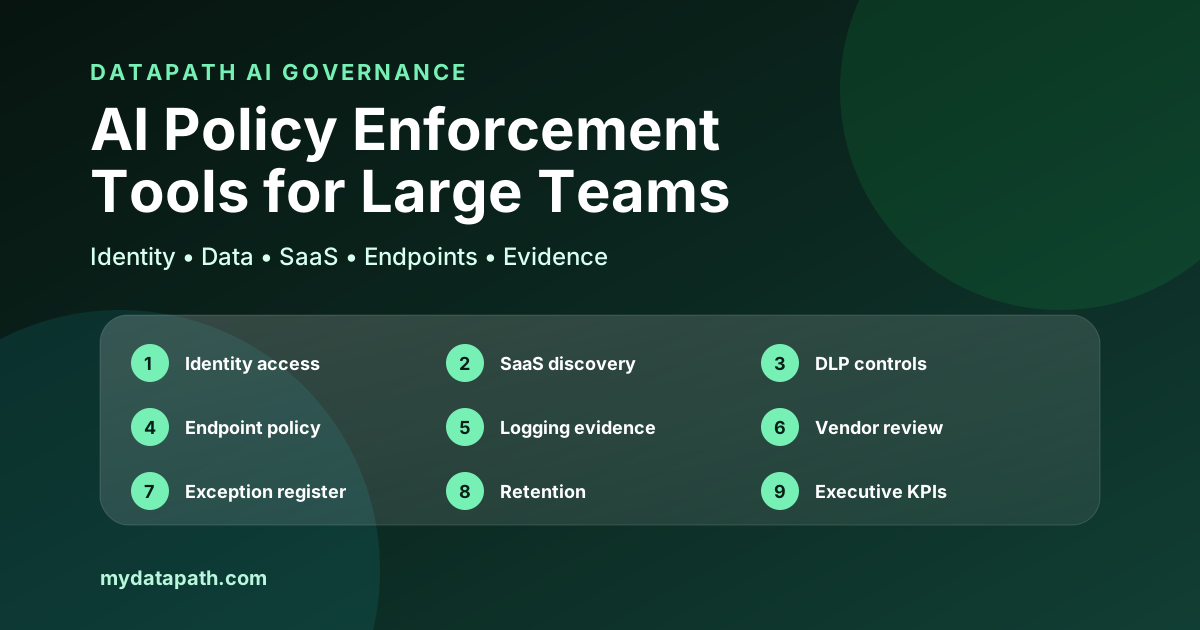
1. Identity and conditional access controls
Identity is the first AI policy enforcement tool because most approved AI systems depend on user identity, group membership, and access conditions. If the organization cannot reliably say who has access, which roles are privileged, and which users are excluded from baseline controls, it cannot enforce AI policy with confidence.
For Microsoft-centered environments, start with Entra ID groups, Conditional Access, multifactor authentication, privileged role governance, and guest access reviews. Tie approved AI access to job function and data classification instead of granting broad access because a tool is popular. Our Entra ID access review checklist covers the privileged-access side of that foundation.
2. SaaS discovery and shadow IT monitoring
Large organizations rarely have one AI tool. They have approved platforms, tolerated browser tools, embedded SaaS features, procurement trials, browser extensions, and employee-created accounts. SaaS discovery helps IT see which applications are in use before sensitive prompts, uploads, or integrations become a compliance problem.
A useful enforcement process should answer four questions:
| Discovery question | Why it matters |
|---|---|
| Which AI apps are employees accessing? | Unapproved tools create data and contractual blind spots. |
| Which departments are using them? | Risk varies between marketing, HR, finance, operations, and clinical or student-data workflows. |
| What authentication method is used? | Personal accounts and unmanaged SSO bypass policy. |
| Who owns review? | Findings need a business owner, not just an alert. |
Pair this with a clear AI governance policy so discovery results can be approved, blocked, or exception-managed without argument every time a new app appears.
3. Data loss prevention for prompts, uploads, and outputs
AI policy enforcement has to protect data at the point of use. DLP controls can help detect or restrict regulated data, financial records, student information, source material, client files, or internal strategy documents before employees paste them into unapproved systems.
DLP is not perfect. It can miss context, create false positives, and frustrate users if policies are too broad. The correct first step is to define data classes and high-risk workflows: PHI, student records, payment information, legal material, HR files, confidential contracts, credentials, and security diagrams. Then tune enforcement by risk level instead of pretending every prompt carries the same exposure.
4. Endpoint and browser management
Endpoint management gives IT a practical way to enforce approved browsers, extensions, device compliance, patch posture, and application controls. This matters because many AI policy failures happen outside formal SaaS procurement: a browser extension summarizes a client file, a desktop app records a meeting, or an unmanaged device uses a personal AI account.
For regulated teams, endpoint enforcement should include managed devices, browser-extension review, local data controls, screen recording and transcript rules, and restrictions on unsanctioned software. This is where managed IT services and endpoint standards intersect with AI governance.
5. Cloud logging and security monitoring
If an AI incident happens, leadership needs evidence: sign-ins, admin changes, file activity, sharing events, endpoint telemetry, SaaS activity, ticket decisions, and response notes. Logging is an enforcement tool because it proves whether policy worked and gives the team a way to investigate exceptions.
Microsoft’s Cloud Adoption Framework organizes adoption around strategy, planning, readiness, migration, modernization, governance, security, and management.3 AI governance should use the same discipline. Security controls without logs are hard to validate. Logs without review are just storage. The operating model needs both.
6. Vendor risk and contract review workflows
An AI tool may be technically useful and still unacceptable for a regulated workflow. Vendor review should cover data retention, model training terms, subprocessors, breach notification, admin controls, audit logs, SSO support, data residency, export rights, and termination procedures.
This is not legal theater. It is how IT, compliance, finance, and department leaders avoid signing up for a tool that cannot meet the business’s obligations. For organizations that outsource part of IT, vendor review should be tied into the broader outsourced IT support guide so responsibilities are explicit.
7. Ticketing, approval, and exception registers
The most underrated AI policy enforcement tool is a ticketing workflow. Every approval, denial, exception, remediation task, control change, and review outcome should leave a record. That record lets leadership distinguish governed adoption from informal experimentation.
Use an exception register for cases where the business chooses to allow a restricted tool or workflow temporarily. Each exception should include the owner, business reason, data type, compensating control, expiration date, and next review. If nobody owns the exception, the exception is really just unmanaged risk.
8. Backup, retention, and recovery controls
AI tools can change how information is created, summarized, stored, and deleted. That can affect retention, eDiscovery, incident response, and recovery. Before employees use AI to process operational records, the organization should decide where final outputs live, how drafts are retained, and whether generated content becomes an official business record.
CISA’s small business cybersecurity guidance points out that moving from on-premises services to secure cloud alternatives can reduce operational burden when done correctly, but it also frames cybersecurity as a leadership and culture issue rather than an IT-only task.4 The same is true for AI records. The business has to decide what must be recoverable and provable.
9. Executive reporting and KPI dashboards
Dashboards do not enforce policy by themselves, but they force accountability. Leadership should be able to see approved AI tools, denied tools, open exceptions, DLP events, training completion, unresolved vendor reviews, high-risk departments, and recurring policy violations.
For 100+ employee teams, we recommend a monthly operating review and a quarterly executive summary. The dashboard should not drown executives in raw alerts. It should show whether AI adoption is becoming safer, messier, or stalled. Datapath’s AI risk register guidance explains how to translate technical findings into leadership-ready risk decisions.
How should large organizations choose the right stack?
The right stack depends on where employees use AI, what regulated data exists, and how mature the current IT operating model is. Do not start with vendor demos. Start with the workflows that would create the most damage if misused.
Map tools to business workflows
List the departments already using AI or asking for it: executive leadership, finance, HR, legal, customer service, operations, clinical teams, teachers, analysts, marketing, or software teams. Then map the data each group touches and the systems where that data lives.
This reveals whether the first enforcement priority is DLP, identity, SaaS discovery, meeting-transcript governance, endpoint management, or vendor review. For a healthcare practice, PHI exposure may dominate. For a school district, student data and app approvals may come first. For a financial-services firm, client data, retention, and vendor due diligence may drive the control sequence.
Use a control matrix, not a shopping list
A control matrix keeps the decision grounded. Build a simple table for each candidate tool or existing platform capability:
| Control area | Required evidence | Owner | Review cadence |
|---|---|---|---|
| Identity access | Group membership, admin roles, access reviews | IT/security | Monthly or quarterly |
| Data protection | DLP policy, event sample, exception record | IT/compliance | Monthly |
| SaaS approval | App inventory, vendor review, business owner | IT/procurement | Monthly |
| Endpoint/browser | Managed device report, extension inventory | IT operations | Monthly |
| Logging/response | Audit logs, incident tickets, escalation notes | Security/IT | Weekly to monthly |
| Executive oversight | KPI summary, open risks, decisions needed | Leadership sponsor | Quarterly |
This format helps leaders compare native Microsoft controls, security platforms, governance tools, and MSP-delivered processes without losing sight of accountability.
Pilot before broad enforcement
Microsoft’s migration planning guidance recommends assessing readiness and skills, choosing the migration path, sequencing workloads, defining rollback, and engaging stakeholders.5 Apply the same method to AI policy enforcement. Pilot controls with one department or data class before rolling enforcement across the whole organization.
A good pilot should test user impact, false positives, exception handling, reporting quality, and help desk readiness. If the pilot generates hundreds of alerts nobody can review, the process is not mature enough for broad deployment.
Why Datapath for AI policy enforcement tools for large organizations?
AI governance gets messy when policy, security, compliance, identity, endpoints, SaaS, and executive reporting are treated as separate projects. We help organizations connect those pieces into a managed operating model: define the policy, map the data, configure the controls, review exceptions, and report progress in language leadership can act on.
Datapath is a fit for regulated and mid-market teams that need AI adoption to align with managed cybersecurity services, healthcare IT, financial services IT, K-12 technology governance, and government IT modernization. We also maintain practical resources for buyers evaluating provider accountability through our Datapath resource guides.
Ready to enforce AI policy without slowing the business down?
Datapath can review your AI usage, Microsoft 365 controls, SaaS exposure, vendor process, and reporting gaps, then turn them into a practical enforcement roadmap.
Frequently Asked Questions
What is the best AI policy enforcement tool for a large organization?
The best AI policy enforcement tool is usually not one product. It is a stack of identity controls, SaaS discovery, DLP, endpoint management, vendor review, logging, and executive reporting tied to a clear operating process.
How do large organizations stop employees from using unapproved AI tools?
Start with policy clarity, SaaS discovery, managed identity, browser and endpoint controls, procurement review, and a fast approval path for legitimate business use. If approval is slow or vague, employees will route around it.
Should AI governance live with IT, security, compliance, or legal?
AI governance should have a business sponsor and shared ownership across IT, security, compliance, legal, procurement, and department leaders. IT can enforce many controls, but leadership has to decide risk tolerance, approved use cases, and exception rules.
What evidence should leaders review for AI policy compliance?
Review approved tool inventories, access groups, DLP events, blocked apps, vendor reviews, exception registers, training completion, incident tickets, and unresolved risk decisions. Evidence should show whether the policy is operating, not merely documented.
How often should AI policy enforcement controls be reviewed?
High-risk controls should be reviewed monthly at the operational level and quarterly with executive sponsors. New tools, new data workflows, incidents, audits, and major Microsoft 365 or SaaS changes should trigger off-cycle review.
Sources
Footnotes
-
CISA, CISA Releases Second Version of Guidance for Secure Migration to the Cloud. ↩
-
NIST CSRC, SP 800-144: Guidelines on Security and Privacy in Public Cloud Computing. ↩
-
Microsoft Learn, Cloud Adoption Framework for Microsoft. ↩
-
Microsoft Learn, Plan your migration - Cloud Adoption Framework. ↩
