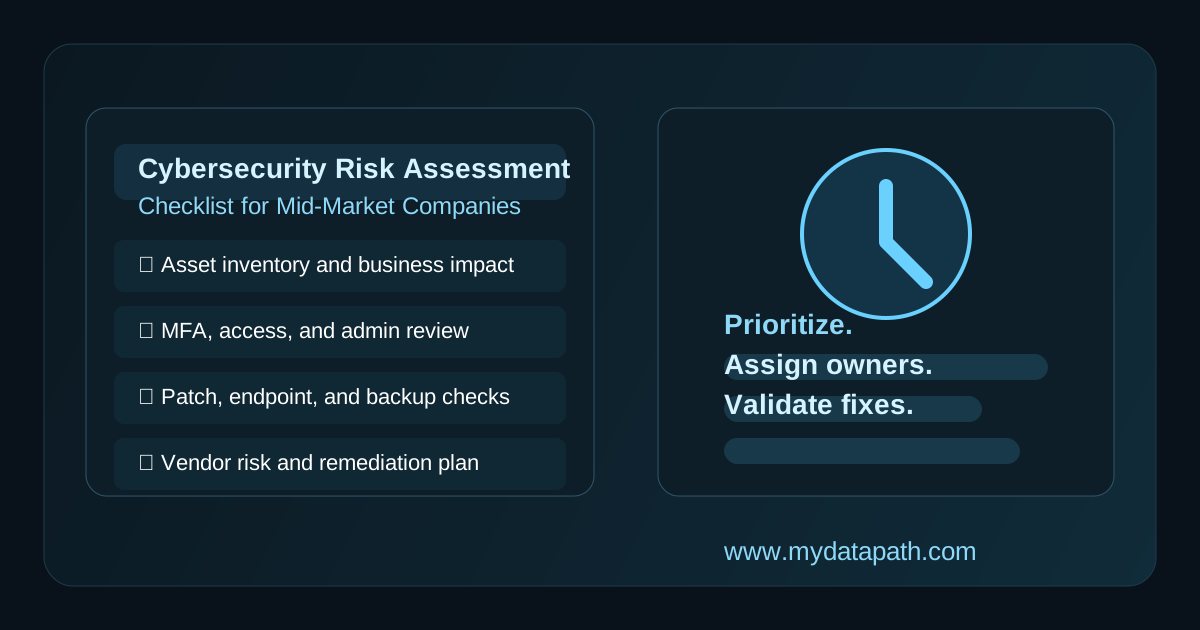

What should a cybersecurity risk assessment checklist for mid-market companies include?
A mid-market cybersecurity solution selection checklist should cover asset inventory, business-critical systems, identity and access controls, endpoint and patch management, backup and recovery readiness, vendor risk, incident response, user awareness, and a documented remediation plan. The goal is not just to “find issues” or buy a tool. It is to rank exposure by business impact, compare the right solution path, and turn decisions into clear action owners, deadlines, and follow-up.12
That matters because mid-market companies usually sit in the most awkward part of the risk curve. They are large enough to depend on Microsoft 365, cloud apps, remote access, vendors, compliance obligations, and cyber insurance controls, but often not large enough to maintain a deep internal security bench. In practice, that means security gaps often hide in the handoffs between IT operations, vendors, leadership, and business owners.
In our view, a useful checklist should make those gaps visible fast. If it only produces a vague list of “best practices,” it is not doing enough.
How should mid-market teams use the checklist to select cybersecurity solutions?
Mid-market teams should use the checklist to decide whether a gap needs a tool, a managed service, a process change, or a remediation project. Start with business-critical systems, then score each candidate solution against evidence, integration, response ownership, recovery impact, vendor risk, and the internal team capacity required to operate it.
| Selection question | What to compare | Why it matters |
|---|---|---|
| Which business risk does this solve? | Identity compromise, endpoint exposure, ransomware recovery, vendor access, compliance evidence, or alert overload | Prevents buying isolated tools that do not reduce the top business risk |
| Who operates it every week? | Internal IT, Datapath, a software vendor, or a shared responsibility model | Clarifies whether the solution will be maintained after rollout |
| What evidence will leadership receive? | Control status, findings, exceptions, remediation owners, due dates, and validation notes | Turns selection into audit, cyber insurance, and board-ready proof |
| How does it connect to existing systems? | Microsoft 365, EDR, firewall, backups, ticketing, identity, and vendor access paths | Reduces tool sprawl and missed handoffs |
| What happens during an incident? | Escalation path, containment owner, communication owner, recovery sequence, and outside responder role | Separates passive monitoring from usable response capability |
| What must be fixed before purchase? | Asset gaps, stale accounts, backup failures, unsupported systems, or missing policies | Stops a new platform from hiding unresolved operational risk |
For many mid-market companies, the best answer is a mixed path: a focused cybersecurity risk assessment to confirm gaps, managed cybersecurity services for recurring operations, and targeted remediation for identity, backup, vendor, or incident-response weaknesses.
Is a cybersecurity compliance checklist different from a risk assessment checklist?
A cybersecurity compliance checklist for mid-market companies is the evidence-and-control view of the same work. A risk assessment ranks exposure by business impact. The compliance checklist turns those findings into artifacts leadership, auditors, cyber insurers, and customers can review: which systems are in scope, which safeguards are operating, which vendors have access, which backups have been tested, and who owns remediation.
Use the checklist this way:
| Compliance checklist item | Evidence to gather | Datapath service path |
|---|---|---|
| Asset and system inventory | Critical systems, data locations, system owners, business impact notes | Cybersecurity risk assessment services |
| Identity and access controls | MFA coverage, admin reviews, access review notes, offboarding records | Microsoft 365 identity security services |
| Endpoint, patch, and vulnerability controls | EDR status, patch reports, vulnerability findings, exception tracking | Managed cybersecurity services |
| Backup and recovery readiness | Restore-test results, RPO/RTO notes, backup alerts, immutable-copy evidence | Disaster recovery services |
| Vendor and third-party risk | Vendor access lists, security obligations, incident notice terms, review cadence | Vendor risk management services |
| Incident response evidence | Escalation plan, tabletop notes, cyber insurance contacts, responder roles | Incident response retainer services |
If the checklist exposes missing proof, stale access, untested recovery, or unclear ownership, treat it as a remediation queue rather than a finished audit binder. Datapath can help turn that queue into a scoped cybersecurity risk assessment or ongoing cybersecurity compliance service plan.
Why is a cybersecurity risk assessment more important for mid-market companies now?
A risk assessment matters more now because mid-market environments are more interconnected, more cloud-dependent, and less tolerant of downtime than they were even a few years ago. IBM’s Cost of a Data Breach research continues to show that security incidents create material financial damage, while CISA and NIST both emphasize that governance, protection, detection, response, and recovery have to operate as one system rather than separate projects.134
For a mid-market company, one weak admin account, one stale server, one untested backup job, or one overprivileged vendor can create consequences far beyond the IT team. Finance, operations, customer service, legal, and leadership all end up absorbing the fallout.
How should you structure a practical cybersecurity risk assessment checklist?
The most useful structure starts with what the business depends on, then works outward into controls, dependencies, and recovery. That keeps the assessment tied to operational reality instead of turning into a generic technical audit.
1. Identify assets, systems, and business dependencies first
You cannot assess cyber risk well if you do not know what is actually in scope. NIST’s Cybersecurity Framework 2.0 and common assessment models both point back to the same foundation: know what assets, data, users, systems, and workflows matter most.12
Your checklist should confirm:
- servers, endpoints, cloud services, network devices, and key applications
- where sensitive data lives and how it moves
- which systems support revenue, operations, compliance, or customer delivery
- who owns each system or workflow
- which vendors or third parties support critical functions
- whether shadow IT or legacy systems exist outside normal review
This step is where many mid-market companies discover that a forgotten server, unmanaged SaaS application, or undocumented vendor dependency is still tied to a critical workflow.
2. Rank business impact, not just technical severity
A risk assessment should not stop at vulnerability lists. It should help leadership answer a more useful question: if this system fails or is compromised, what happens to the business?
That means the checklist should capture:
- business impact rating for each critical asset or process
- operational dependencies between systems
- tolerance for downtime
- likely regulatory or contractual exposure
- whether the issue affects customer trust, finance, patient care, or production continuity
A medium-severity technical issue tied to payroll, Microsoft 365 identity, EHR access, or a production workflow can matter more than a theoretically severe issue on a low-impact system. That is why business context has to sit beside technical findings.2
3. Review identity, access, and privilege discipline
Identity failures remain one of the fastest ways risk becomes a real incident. A practical checklist should verify whether access is tightly governed or quietly drifting.
Key review points include:
- MFA coverage for users, administrators, VPN, and remote access
- privileged account inventory and review cadence
- onboarding and offboarding controls
- role-based access alignment
- dormant accounts, shared accounts, and break-glass access handling
- conditional access or equivalent controls where appropriate
CISA’s Cyber Essentials guidance continues to emphasize phishing-resistant MFA, privilege discipline, and stronger identity controls because account compromise is still one of the simplest paths into a business environment.3
4. Validate endpoint, server, and patch-management controls
Mid-market companies usually have enough infrastructure sprawl for patching and baseline control drift to become a real problem. Your checklist should test whether endpoints and servers are just “covered by tools” or actually being governed.
Review:
- endpoint detection and response coverage
- antivirus or modern endpoint protection status
- operating system and third-party patch cadence
- unsupported or end-of-life systems
- vulnerability scanning coverage and review frequency
- local admin usage and device hardening
- encryption status for laptops and sensitive systems
This is also where asset inventory and remediation discipline should connect. It is not enough to know systems are missing updates. Someone needs to own the exception and the timeline to close it.
5. Test backup, recovery, and resilience assumptions
A surprising number of companies say they have backups when what they really have is backup software and good intentions. A risk assessment checklist should force the team to verify whether recovery is real.
That includes:
- backup coverage for critical systems and SaaS platforms
- retention settings and failure alerting
- restore testing cadence
- documented RPO and RTO expectations
- separation or immutability controls for backup copies
- recovery dependencies on vendors, credentials, or aging infrastructure
- emergency communication and escalation paths
If a business cannot explain how it would restore Microsoft 365 data, a critical file share, or a line-of-business platform under pressure, that is not a backup strategy. It is a recovery gap. Buyers who discover those issues often also need related work around backup and disaster recovery, Microsoft 365 security best practices, and immutable backup strategy.
6. Include third-party and vendor risk in the checklist
Mid-market companies often inherit risk through vendors long before they notice it internally. Cloud providers, payroll systems, managed service providers, software vendors, consultants, and outsourced support teams can all create privileged-access or continuity exposure.
A strong checklist should ask:
- which vendors have access to sensitive data or systems
- whether vendors use MFA and role-based access
- what notification timeline exists for incidents
- whether contracts define security obligations clearly
- whether backups, subcontractors, and recovery dependencies are documented
- whether high-risk vendors are reassessed periodically
That is one reason we treat this topic as closely related to our third-party cyber risk assessment checklist. For many mid-market teams, vendor exposure is one of the biggest blind spots in the environment.
7. Check incident response, business continuity, and communications
A checklist should not just assess prevention. It should also review how the business would respond when prevention fails.
That section should verify:
- whether an incident response plan exists and is current
- who owns technical containment, legal review, communications, and executive escalation
- whether leadership has participated in a tabletop exercise
- how evidence is preserved during an event
- what systems are most critical to restore first
- whether cyber insurance, legal counsel, and outside responders are preselected
NIST and CISA both reinforce that response and recovery have to be designed before the incident, not improvised during it.13
8. Turn findings into a remediation plan leadership can use
This is where many assessments fail. They surface issues, but they do not create a practical follow-through model.
A useful cybersecurity risk assessment checklist should end with:
| Checklist area | What to document | Why it matters |
|---|---|---|
| Finding | The specific gap or control weakness | Keeps remediation concrete |
| Business impact | Operational, financial, compliance, or customer effect | Helps leadership prioritize |
| Risk level | Likelihood and impact rating | Supports triage |
| Owner | Internal team or vendor responsible | Prevents orphaned tasks |
| Due date | Expected remediation timeline | Creates accountability |
| Validation method | How closure will be verified | Stops checkbox-only fixes |
That structure gives leadership something much more useful than a generic report. It creates a working queue for risk reduction.
What does a concise cybersecurity risk assessment checklist look like?
If you need the short version, start here:
- asset inventory and business-critical system mapping
- data classification and data-flow review
- MFA, admin access, and user-lifecycle controls
- endpoint security, server hardening, and patching discipline
- vulnerability scanning and exception tracking
- backup coverage, restore testing, and resilience controls
- vendor and third-party access review
- incident response ownership and tabletop readiness
- security awareness and phishing-resistance training
- remediation plan with owners, deadlines, and executive reporting
That is not the entire assessment, but it is a strong baseline for most mid-market environments.
What mistakes make cybersecurity risk assessments less useful?
The most common failure is treating the assessment like a one-time audit artifact instead of an operating tool. We usually see weaker assessments break down in a few predictable ways:
- findings are purely technical and never tied to business impact
- the scope excludes vendors, cloud apps, or backup dependencies
- high-risk items have no owner or due date
- the report is too long to drive action and too vague to guide remediation
- leadership sees output once and never gets follow-up visibility
- the review is not repeated after major system or vendor changes
A better assessment model connects directly to remediation planning, service reviews, and strategic decision-making. That is also why this topic overlaps with broader Datapath guidance on managed cybersecurity services, cybersecurity remediation planning, and how to build a vulnerability management program.
Why Datapath for cybersecurity risk assessment work?
We think a cybersecurity risk assessment should make the environment easier to govern, not just produce a report that gets saved and forgotten. That means tying technical findings to business dependencies, user access, vendor exposure, backup readiness, and a remediation path leadership can actually follow.
For mid-market companies, the real value is usually clarity: what matters most, what should be fixed first, which issues belong to vendors versus internal teams, and how progress will be measured over time.
If your team is evaluating its current posture, start with cybersecurity risk assessment services, route framework and evidence gaps into cybersecurity compliance services, and turn recurring control work into managed cybersecurity services.
Need a compliance-ready risk assessment?
We help mid-market teams turn cyber findings into evidence, owner-assigned remediation, executive reporting, and fewer compliance blind spots.
FAQ: cybersecurity risk assessment checklist for mid-market companies
What is a cybersecurity risk assessment checklist?
It is a structured review used to identify important assets, evaluate likely threats and control gaps, rank risk by business impact, and document what needs to be remediated first.
What is a mid-market cybersecurity solution selection checklist?
It is a decision tool that helps leadership compare cybersecurity tools, managed services, process fixes, and remediation projects against actual business risk. For mid-market companies, the checklist should show which gaps affect critical systems, which provider owns follow-through, what evidence will be produced, and whether internal IT has capacity to operate the solution.
What should a cybersecurity compliance checklist for mid-market include?
It should include asset and data inventory, identity controls, endpoint and patch evidence, backup and restore proof, vendor-risk review, incident-response evidence, user awareness, compliance obligations, and remediation owners with due dates.
How does a cybersecurity compliance checklist support audits or cyber insurance?
It gives leadership a practical evidence map before an audit, renewal, customer security review, or board discussion. Instead of relying on generic control claims, the business can show proof, exceptions, open findings, accepted risk, and remediation status.
How often should a mid-market company perform a cybersecurity risk assessment?
At minimum, most mid-market companies should review core risk annually and again after major infrastructure changes, vendor changes, acquisitions, or meaningful security incidents.
What should be prioritized first after a risk assessment?
The first priorities are usually high-impact findings tied to identity, privileged access, exposed systems, critical backups, vendor access, and incident-response gaps because those weaknesses can create the fastest operational damage.
Is a vulnerability scan the same as a cybersecurity risk assessment?
No. A vulnerability scan is one input. A true risk assessment also weighs business impact, ownership, control effectiveness, recovery readiness, and third-party exposure.
Sources
- NIST Cybersecurity Framework 2.0
- NIST SP 800-30 Rev. 1: Guide for Conducting Risk Assessments
- CISA Cyber Essentials
- IBM Cost of a Data Breach Report