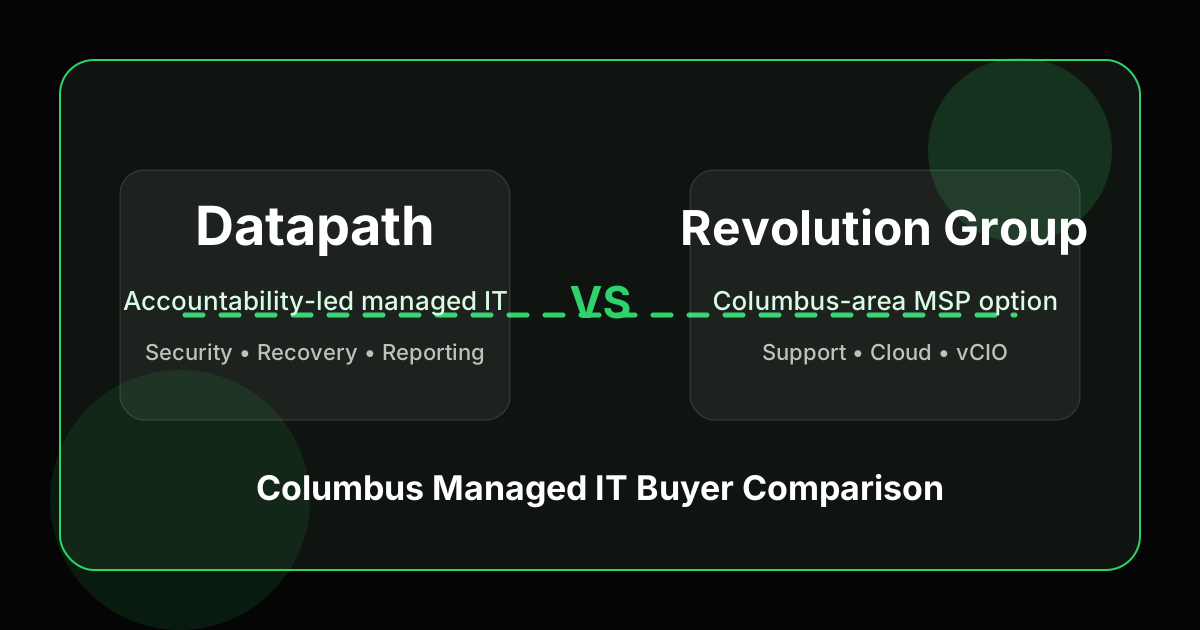
How should Columbus buyers compare Datapath vs Revolution Group?
Columbus buyers should compare Datapath vs Revolution Group by separating service categories from operating accountability. Both providers publicly connect themselves to managed IT, cybersecurity, cloud work, vCIO-style strategy, and support for Central Ohio businesses. The useful question is not whether both can name those services; it is which provider best matches the buyer’s risk profile, compliance pressure, internal IT capacity, recovery expectations, and need for executive visibility.1234
This comparison is intentionally fair. We are writing from Datapath’s perspective, but the goal is not to attack Revolution Group. Revolution Group appears to be a relevant Columbus and Central Ohio MSP option with public positioning around managed IT, cybersecurity, cloud migration, Microsoft 365, Azure, strategic IT planning, and 24/7 support. Serious buyers should evaluate them directly if those requirements match their environment.123
The mistake is treating two proposals as equivalent because both say “managed IT.” A business with sensitive data, multiple sites, lean internal IT, cyber insurance pressure, healthcare workflows, financial services obligations, or board-level risk reporting needs a sharper comparison. It needs to know who owns identity cleanup, vendor escalation, backup evidence, vulnerability follow-through, after-hours communication, and roadmap decisions after the sale.
If your team is building a broader Central Ohio shortlist, start with Datapath’s Dublin managed IT services page, our Columbus managed IT services page, and our guide to the best MSP for 100+ employees. Those pages explain the Datapath operating model beyond this one-provider comparison.
What does Revolution Group publicly emphasize?
Revolution Group publicly emphasizes managed IT support, cybersecurity, IT strategy and virtual CIO guidance, cloud solutions, Microsoft 365, Azure, backup, and Central Ohio business support. Its homepage describes the company as a managed IT and cybersecurity partner for growing businesses in Columbus and throughout Central Ohio, with managed IT support, cyber threat detection, endpoint protection, security awareness training, IT roadmap planning, budget planning, risk management, and cloud migration or optimization.1
Revolution Group’s managed IT page describes a service set that includes IT strategy, managed IT support, IT projects, cybersecurity, virtual CIO direction, 24/7 remote and on-site IT support, dedicated account management, and technology planning tied to business goals.2 Its managed security page says Revolution Group provides managed security services in Columbus and across Ohio and describes identity and access management, data protection, endpoint protection, security training, policy work, and vulnerability scanning.3
Those are legitimate service categories. Buyers should still verify current scope, support hours, contractual response language, cybersecurity tooling, included versus project work, backup validation practices, and whether regulated-industry evidence is part of the recurring service or an add-on.
Comparison table: Datapath vs Revolution Group
| Evaluation area | Revolution Group public positioning | Datapath fit for the same buyer question |
|---|---|---|
| Core MSP model | Columbus and Central Ohio managed IT partner for growing businesses, with help desk, network and cloud management, proactive monitoring, and 24/7 remote and on-site support language.12 | Managed IT for organizations that need accountable ownership across helpdesk, endpoints, Microsoft 365, networks, vendors, backup evidence, cybersecurity operations, and executive reporting.45 |
| Cybersecurity | Public site describes cybersecurity, endpoint protection, AI-powered threat detection, 24/7 security monitoring, identity and access management, data protection, training, policy creation, and vulnerability scanning.13 | Datapath ties cybersecurity to managed IT operations, vulnerability follow-through, alert triage, Microsoft 365 hardening, firewall support, compliance evidence, recovery planning, and leadership-ready reporting.6 |
| Cloud and Microsoft 365 | Public site emphasizes cloud migration, Microsoft 365, Azure, cloud management, and cloud optimization for Central Ohio businesses.12 | Datapath supports cloud and Microsoft 365 work when it must connect back into identity governance, backup assumptions, user support, vendor ownership, security baselines, cost review, and operational stability.45 |
| vCIO and strategy | Public materials describe virtual CIOs, IT roadmap planning, budget planning, risk management, dedicated account management, and business-aligned technology goals.12 | Datapath’s vCIO-style fit is strongest when roadmap decisions need to be grounded in tickets, monitoring, security findings, backup evidence, compliance pressure, lifecycle risk, and executive reporting.7 |
| Backup and recovery | Public materials reference backup in managed IT and cloud contexts and position proactive monitoring and management around continuity concerns.12 | Datapath emphasizes backup oversight, restore-test evidence, disaster recovery planning, Microsoft 365 backup review, ransomware assumptions, and recovery accountability as part of managed operations.8 |
| Best-fit buyer | Likely attractive for Central Ohio businesses seeking a Columbus-area MSP with managed IT, cybersecurity, cloud, IT strategy, and 24/7 support positioning. | Stronger fit for regulated, multi-site, healthcare, financial services, K-12, government, or accountability-heavy teams that want governance, security evidence, transition discipline, and clear ownership. |
Where are the real differences likely to show up?
The real differences are likely to show up in accountability style, evidence quality, transition planning, and how each provider translates technical activity into leadership decisions. Two MSPs can both offer help desk, monitoring, cybersecurity, cloud, and vCIO support while still producing different outcomes when a problem crosses users, vendors, cloud tools, security alerts, and executive risk.
A buyer should ask both providers to explain how they handle situations like these:
- A Microsoft 365 account is compromised and risky inbox rules appear.
- A line-of-business vendor blames the network while users blame the application.
- A backup platform reports success, but a realistic restore test exposes a gap.
- An internal IT manager needs support capacity without losing control of the environment.
- A cyber insurance renewal asks for evidence across MFA, EDR, backups, endpoint patching, and incident response.
- Leadership wants a roadmap with owners, risk, timing, and budget impact, not a ticket export.
Those moments expose whether the provider is mainly a support vendor or a governance partner. Datapath’s strongest fit is the second model: help the client run IT as an accountable business function, not just as a queue of technical requests.
When might Revolution Group be the better fit?
Revolution Group may be the better fit for a Central Ohio buyer that wants a Columbus-area MSP with public emphasis on managed IT, cybersecurity, cloud migration, Microsoft 365, Azure, vCIO guidance, and 24/7 support. Its own materials present a broad service menu for growing businesses in Columbus and Central Ohio and describe technology planning, proactive support, cybersecurity, cloud work, and business-aligned IT strategy.123
Revolution Group may deserve close consideration when the buyer values:
- a Columbus and Central Ohio-focused MSP option
- published positioning around 24/7 remote and on-site IT support
- managed IT, cybersecurity, cloud, Microsoft 365, Azure, and IT projects under one provider
- virtual CIO planning and business technology strategy language
- security services that include identity, data protection, endpoint protection, awareness training, and vulnerability scanning
That does not make Revolution Group the best fit for every Columbus buyer. It means they are relevant enough that serious Central Ohio MSP evaluations should not ignore them.
When is Datapath likely the better fit?
Datapath is likely the better fit when the buyer wants managed IT, cybersecurity, recovery readiness, transition discipline, and leadership accountability treated as one operating model. This matters most when the organization has compliance pressure, distributed users, lean internal IT leadership, cyber insurance requirements, healthcare or financial data, public-sector expectations, or a board that wants clearer reporting.
Datapath is usually strongest for buyers that need:
- recurring ownership of support, infrastructure, cybersecurity, cloud administration, and vendors
- executive reporting that explains what changed, what risk remains, and what decision is needed next
- Microsoft 365, endpoint, firewall, backup, identity, and user support managed together
- compliance-aware operating discipline for HIPAA, GLBA, CJIS, CMMC, SOC 2, PCI DSS, or insurance questionnaires
- co-managed support that respects internal IT authority while adding escalation depth
- transition planning when the organization is replacing an MSP and cannot afford lost documentation, orphaned admin access, or unresolved backup assumptions
The difference is not that Datapath is the only provider with tools. Tools are table stakes. The difference is that Datapath’s positioning is accountability-led: clients should know who owns the issue, what has changed, what risk remains, and what leadership needs to decide next.
What should regulated or multi-site organizations ask before choosing?
Regulated and multi-site organizations should ask questions that expose control ownership, escalation authority, recovery evidence, and reporting quality. Generic questions like “do you provide cybersecurity?” produce generic answers. Better questions force both providers to explain how the work actually runs.
Use this scorecard before comparing price:
| Buyer question | Why it matters |
|---|---|
| Who owns MFA exceptions, privileged access, terminated-user cleanup, and conditional access changes? | Identity drift can quietly become the biggest exposure in Microsoft 365-heavy environments. |
| How often are backups test-restored, and what evidence does leadership receive? | Backup monitoring without restore evidence can create false confidence. |
| What happens after hours if an alert, outage, or vendor failure affects operations? | Response promises need escalation rules, authority, and communication paths. |
| What appears in a monthly or quarterly business review? | Leadership needs risk, trend, roadmap, and ownership visibility, not only ticket counts. |
| What work is included in recurring managed IT versus scoped separately as a project? | Scope ambiguity creates surprise cost and unresolved responsibility. |
| How do you support cyber insurance, HIPAA, GLBA, SOC 2, CMMC, CJIS, or customer security questionnaires? | Compliance-adjacent work depends on documentation, evidence, and follow-through. |
| How do you transition a client from another MSP without losing admin control or documentation? | A sloppy handoff can leave hidden risk after the new agreement starts. |
A strong MSP should answer these questions with process, examples, and responsibility boundaries. If the answer is mostly a tool list, the buyer still has work to do.
How should buyers handle pricing in a Datapath vs Revolution Group comparison?
Buyers should compare pricing only after they normalize scope. A lower monthly number can be rational if it covers less work, and a higher number can be wasteful if it includes services the organization does not need. The mistake is pretending two proposals are comparable because both say “managed IT.”
Before deciding, separate recurring operations from project work. Help desk, endpoint management, Microsoft 365 administration, patch follow-through, backup oversight, firewall support, vendor coordination, cloud administration, and reporting may belong in managed IT scope. Migrations, major remediation, hardware refreshes, one-time cleanup, and unusual after-hours work may be scoped separately. The best proposal is the one that makes those boundaries explicit.
Datapath buyers should also ask whether cybersecurity work is merely listed or actually operated. MFA administration, endpoint detection, email security tuning, vulnerability remediation, firewall policy review, backup validation, incident escalation, and evidence reporting require ownership. If those tasks are not assigned, they become gaps.
Why Datapath for accountability-led managed IT in Columbus?
We think the best Columbus MSP choice is the one that makes technology easier to govern. That means clearer ownership, stronger security discipline, tested recovery assumptions, better vendor coordination, careful transition planning, and reporting that helps leadership make decisions before small issues become business problems.
Revolution Group appears to be a credible Central Ohio MSP option with a broad public service catalog. Datapath is the stronger choice when the buyer’s real requirement is not just outsourced support, but an accountable operating model for managed IT and cybersecurity. If that is the decision in front of your team, start with Datapath’s Columbus managed IT page, compare our co-managed IT services, review our managed cybersecurity services, or talk with our team about the environment you need to stabilize.
Comparing Datapath vs Revolution Group in Columbus?
We help Central Ohio teams evaluate MSPs by accountability, security depth, recovery evidence, transition discipline, and operating fit instead of vague managed IT claims.
FAQ: Datapath vs Revolution Group
What is the safest way to compare Datapath vs Revolution Group?
The safest way is to compare operating responsibility: help desk scope, identity controls, backup validation, cybersecurity escalation, cloud ownership, executive reporting, and project boundaries. Service lists matter, but they do not prove who owns the outcome when something breaks.
Is Revolution Group a Datapath competitor in Columbus Ohio?
Yes. Revolution Group is a reasonable comparison point for Columbus and Central Ohio buyers because its public materials position it around managed IT, cybersecurity, cloud, Microsoft 365, Azure, IT strategy, virtual CIO guidance, and 24/7 support. Buyers should still verify current service scope directly with each provider.
Which provider is better for regulated or accountability-heavy organizations?
The better fit is usually the provider that can show documentation discipline, security control ownership, restore evidence, escalation paths, transition planning, and leadership-ready reporting. Datapath is built around that accountability-led managed IT and cybersecurity model.
Should pricing decide the Datapath vs Revolution Group comparison?
No. Pricing should come after scope normalization. Buyers should first compare included support hours, cybersecurity controls, backup testing, cloud/project boundaries, after-hours rules, vendor coordination, reporting cadence, and transition support.
What internal links should buyers review before choosing a Columbus MSP?
Review Datapath’s managed IT services for Columbus, Dublin Ohio location page, co-managed IT services, managed cybersecurity services, and MSP evaluation guide. Together they explain the service model, local coverage, and accountability expectations.
Sources
- Revolution Group homepage
- Revolution Group managed IT page
- Revolution Group managed IT security page
- Datapath managed IT services
- Datapath Dublin managed IT services
- Datapath managed cybersecurity services
- Datapath vCIO services
- Datapath disaster recovery services
