
What should an incident response retainer provider include?
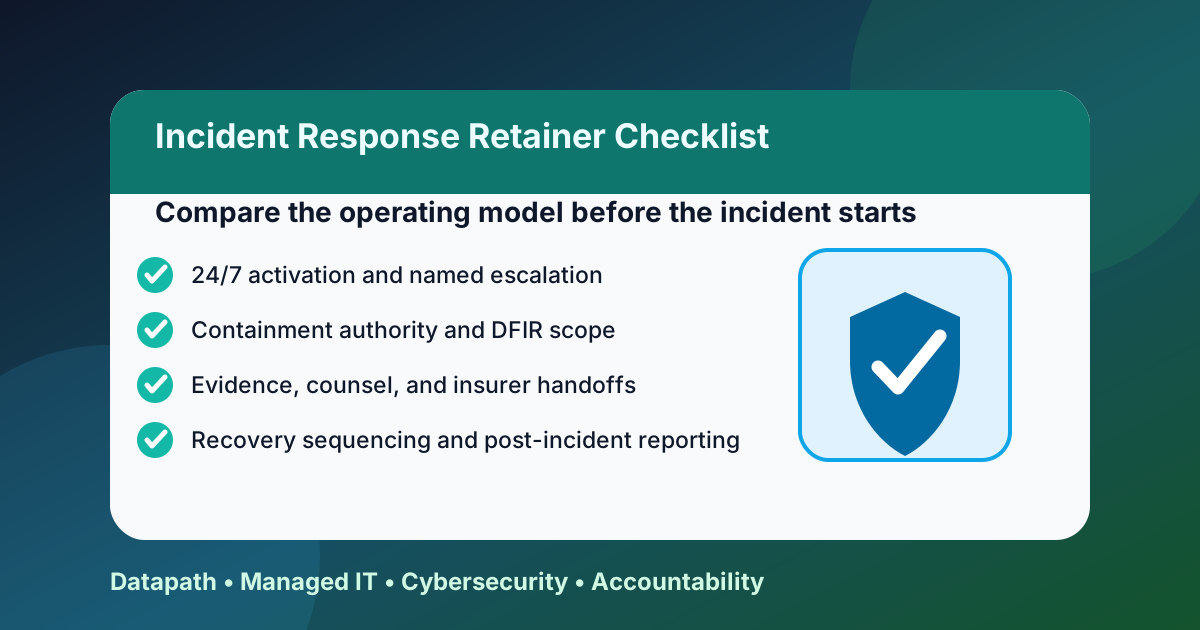
An incident response retainer provider should include 24/7 activation, named escalation contacts, clear response SLAs, containment authority, digital forensics scope, evidence-preservation rules, legal and cyber-insurance coordination, recovery support, tabletop readiness, and post-incident reporting. If the retainer only promises emergency availability without defining who can act and what they can do, it is not ready for a real incident.
Datapath’s current Search Console data shows page-two demand around 24x7 managed incident response provider searches. That intent is blunt: buyers are not asking for a generic cybersecurity brochure. They want to know who will answer at 2:00 a.m., who has authority to help contain the incident, and whether the provider can help the business recover without destroying forensic evidence.
At Datapath, we recommend treating retainer selection as an operating-model decision, not a logo exercise. The right partner should connect your internal IT team, executive leadership, outside counsel, insurer, managed services provider, backup owner, and communications lead before the first emergency call. Our incident response retainer services are built around that handoff discipline, and this checklist gives IT leaders a practical way to compare options.
How should you compare incident response retainer providers?
Compare incident response retainer providers by testing the agreement against a realistic first-hour incident: suspected ransomware, compromised administrator credentials, data exfiltration, business email compromise, or a destructive cloud account event. The provider should be able to explain activation, triage, containment, evidence handling, communications, and recovery without vague handoffs.
Start with activation authority
A retainer should name who can activate the provider, how activation happens, what information is required, and what happens if the primary contact is unavailable. If only one executive can authorize help, the agreement may fail during a holiday, outage, or active ransomware event.
CISA describes an incident response plan as a written document approved by senior leadership that helps the organization before, during, and after a suspected or confirmed incident, clarifying roles, responsibilities, and key activities.1 The retainer should fit that plan. It should not sit outside it.
Ask these questions before signing:
| Activation question | What a strong answer includes |
|---|---|
| Who can declare an incident? | Named primary and backup contacts from IT, leadership, and security |
| How is the provider reached? | Phone, portal, emergency email, and after-hours escalation path |
| What starts the clock? | A clear definition of activation time and first-response commitment |
| What if internal systems are down? | Out-of-band contact list and alternate communications path |
| Who approves containment actions? | Pre-authorized actions by severity and business impact |
Verify what “24/7 response” actually means
A 24/7 incident response claim can mean many things: an answering service, an on-call coordinator, a managed detection team, or a DFIR team ready to start investigation. Those are not equivalent. We recommend asking providers to define first contact, technical triage, analyst engagement, leadership briefing, and onsite or remote support expectations separately.
For lean IT teams, the most dangerous gap is a retainer that can advise but not help execute. If your internal staff cannot isolate endpoints, revoke privileged sessions, preserve logs, coordinate firewall changes, and protect backups under pressure, the retainer needs an operating path into those actions. That path may involve your internal team, Datapath’s managed cybersecurity services, your EDR vendor, counsel-approved DFIR resources, or all of the above.
Match scope to your actual systems
Incident response scope should reflect the environment that can hurt the business. For a healthcare organization, that may include EHR access, medical-device vendor pathways, remote staff, HIPAA documentation, and backup validation. For a financial services firm, it may include Microsoft 365, file transfer, ACH controls, vendor risk, GLBA safeguards, and regulated customer data. For K-12 or municipal teams, it may include identity, student or citizen records, public-safety systems, and continuity obligations.
NIST’s incident response project notes that the 2025 SP 800-61 Revision 3 shifted incident response into broader cybersecurity risk management across CSF 2.0 functions so organizations can prepare, reduce incident impact, and improve detection, response, and recovery.2 That is the right lens for retainer selection: the provider should understand your Govern, Identify, Protect, Detect, Respond, and Recover dependencies, not only the forensic toolset.
What should be in the retainer checklist?
The checklist should separate prepaid hours from operational capability. A low-hour retainer with strong readiness and clear authority may outperform a larger retainer that leaves everything ambiguous until the incident starts.
Use this provider comparison table
| Retainer area | What to require | Red flag |
|---|---|---|
| 24/7 activation | Named emergency path, backup contacts, response clock, and out-of-band communications | “Call support” with no incident-specific escalation |
| Triage and severity | Criteria for ransomware, BEC, cloud compromise, endpoint alerts, exfiltration, and outage impact | Same workflow for every alert |
| Containment authority | Written rules for isolating endpoints, disabling accounts, blocking traffic, and preserving backups | Provider can only advise while attackers move |
| DFIR scope | Log sources, endpoint evidence, cloud telemetry, chain-of-custody, and report format | Forensics described only as “investigation” |
| Counsel and insurer coordination | Process for involving breach counsel, insurance panel vendors, and notification decision-makers | Provider bypasses legal or insurance requirements |
| Recovery support | Backup validation, clean-room rebuild guidance, identity reset sequence, and business-priority restoration | Retainer stops after root-cause analysis |
| Tabletop readiness | Annual or semiannual exercises, contact testing, scenario planning, and remediation tracking | No practice until the real incident |
| Reporting | Executive summary, timeline, indicators, affected systems, actions taken, findings, and remediation owners | Only ticket notes or tool screenshots |
Confirm evidence handling before cleanup starts
Evidence handling is where rushed response can backfire. Teams naturally want to wipe infected systems, reset everything, and restore service. Sometimes that is necessary. But if the organization destroys logs, endpoint artifacts, identity history, or communications records before scope is understood, it may undermine legal review, insurance claims, regulatory reporting, and root-cause analysis.
CISA’s cyber incident response service description emphasizes root-cause work, including searching for tools, techniques, procedures, behaviors, and artifacts in the victim network.3 Your retainer should explain how the provider preserves enough evidence to support that analysis while still helping the business contain the damage.
In practice, we want to know:
- which systems should be imaged or preserved before rebuild
- which logs must be exported from Microsoft 365, identity platforms, firewalls, EDR, and servers
- who documents containment actions and timestamps
- how evidence is shared with counsel, insurers, executives, and technical teams
- what must be retained for audit, customer, regulatory, or board review
Require recovery coordination, not just investigation
An incident response provider that only investigates can leave the business with a different problem: a clear report and no clean recovery path. Mid-market teams need help connecting investigation to restore sequencing, identity cleanup, endpoint rebuilds, firewall changes, backup validation, vendor coordination, and executive decisions.
IBM’s 2025 Cost of a Data Breach reporting found that the global average breach lifecycle fell to 241 days, the lowest in nine years, and connected faster containment to AI-powered defenses and stronger security operations.4 The obvious lesson for buyers is not “buy AI.” It is that time matters. A retainer should reduce confusion, compress decision cycles, and help your team move from detection to containment to recovery with fewer handoff failures.
For the broader recovery layer, compare this checklist with our guides to ransomware incident response planning, disaster recovery testing evidence, and managed cybersecurity service package scope. The retainer should complement those controls instead of replacing them.
When does a retainer make sense for mid-market and regulated teams?
An incident response retainer makes sense when internal IT owns critical systems but does not have enough forensic depth, after-hours coverage, legal coordination experience, or recovery surge capacity to handle a serious incident alone. It is especially relevant for healthcare, financial services, K-12, municipal, and multi-site businesses that need evidence discipline and continuity, not just advice.
Watch for these trigger conditions
We recommend evaluating a retainer when any of these conditions are true:
- Your cyber-insurance policy expects pre-approved response vendors or rapid carrier notice.
- Your internal IT team does not have 24/7 coverage for ransomware, account compromise, or critical alerts.
- Your environment depends heavily on Microsoft 365, cloud platforms, VPN, EHR, ERP, payment, or student information systems.
- You need counsel-guided evidence collection for HIPAA, GLBA, CJIS, FERPA, PCI DSS, SOC 2, or customer-contract obligations.
- Your backup and disaster recovery process has not been tested under a ransomware or identity-compromise scenario.
- Executives do not know who can approve containment, communications, downtime, or outside response spend.
If your organization already uses co-managed IT services or fully managed IT services, the retainer should define how the MSP and response provider work together. Otherwise the two teams may collide during the most expensive hours of the incident.
Do not confuse a retainer with a complete response capability
A retainer is not a magic shield. It does not replace asset inventory, logging, backups, identity controls, endpoint security, network segmentation, user reporting, or executive decision rules. It gives the organization a faster path to specialized help when those controls are tested.
That is why we tie retainer planning to recurring operations. The same account lists, endpoint coverage reports, backup maps, firewall diagrams, contact trees, and vendor notes used during normal service reviews become response assets during an incident. If they are missing, even a strong provider loses time.
Need an incident response retainer provider checklist tied to your real environment?
Datapath helps IT leaders compare retainer scope, 24/7 activation, containment authority, evidence handling, recovery dependencies, and MSP handoffs before a live incident forces the issue.
Why Datapath for incident response retainer provider selection
Choosing an incident response retainer provider should force a harder question: can your organization actually execute the first hour? Datapath helps mid-market and regulated teams turn that question into defined roles, response paths, containment authority, recovery sequencing, and leadership-ready reporting.
Our work at Datapath connects incident response to the systems that determine whether the business can keep operating: identity, endpoints, firewalls, Microsoft 365, backups, vendors, documentation, and executive accountability. If the retainer sits outside those systems, it will be slower than it needs to be.
Use this checklist as a vendor comparison tool, then validate it against your own environment. The best retainer is the one that makes your real incident plan more executable, not the one with the most dramatic breach-war-story slide deck.
Frequently Asked Questions
What is an incident response retainer provider?
An incident response retainer provider is a pre-vetted outside team engaged before a cyber incident to provide emergency response, forensic investigation, containment guidance, evidence handling, recovery coordination, and post-incident reporting. The retainer should define activation rules, response expectations, scope, and decision authority before the incident starts.
What should an incident response retainer include?
A practical retainer should include 24/7 activation, first-response commitments, severity triage, containment guidance, DFIR scope, evidence preservation, counsel and insurer coordination, recovery support, tabletop readiness, and a final report with remediation owners. Buyers should require written scope, not verbal assurance.
Is 24/7 monitoring the same as an incident response retainer?
No. 24/7 monitoring watches alerts and may escalate suspicious activity. An incident response retainer defines what happens when a serious incident is suspected or confirmed, including activation, investigation, containment, evidence handling, communications, recovery support, and after-action reporting.
Who should be allowed to activate an incident response retainer?
At minimum, the retainer should name a primary and backup activator from IT or security leadership, plus an executive escalation path. Regulated organizations should also define when counsel, cyber insurance, communications, and senior leadership are notified.
How often should a retainer be tested?
We recommend testing the retainer at least annually through a tabletop exercise or activation drill, then retesting after major changes to identity, backup, cloud, EDR, insurer, counsel, MSP, or executive contacts. CISA also recommends reviewing incident response plans quarterly as living documents.1
Can Datapath help compare retainer providers?
Yes. Datapath can help compare incident response retainer scope, readiness hours, activation rules, DFIR boundaries, evidence expectations, insurer coordination, recovery dependencies, and MSP handoffs. We can also support the surrounding managed IT, cybersecurity, backup, and documentation work that makes response faster.
Sources
- CISA Incident Response Plan Basics
- NIST Incident Response project
- CISA Cyber Incident Response service description
- IBM 2025 Cost of a Data Breach Report overview
