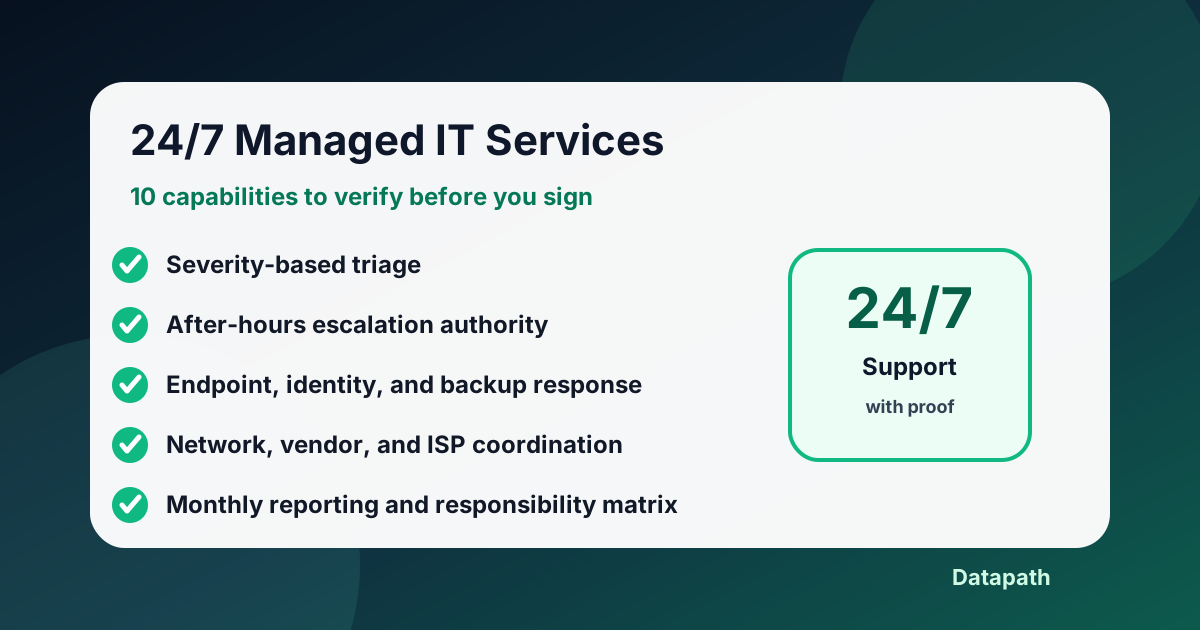

What should 24/7 managed IT services include?
24/7 managed IT services should include severity-based triage, after-hours escalation, remote monitoring, endpoint and identity response, backup and recovery checks, network and firewall support, vendor coordination, documented authority, shared ticket visibility, and monthly reporting. The service is only useful if the provider can prove who responds, what they can fix, and what evidence leadership receives.
Datapath’s Search Console data showed live impressions for 24/7 managed IT services, 24/7 managed IT support, and related always-on support searches. That demand makes sense. Mid-market businesses no longer run only from 8:00 a.m. to 5:00 p.m., and the systems that break after hours are often the ones leadership notices first: Microsoft 365, remote access, EHR workflows, payment systems, internet circuits, firewalls, backups, phones, and security alerts.
At Datapath, we treat 24/7 support as an operating model, not a slogan. The right provider should define coverage, scope, approval rules, escalation paths, and reporting before the first incident. If you are already comparing support models, start with our managed IT services and co-managed IT services pages, then use the ten-point checklist below to pressure-test the details.
1. Severity-based triage instead of “everything is urgent”
The first thing 24/7 managed IT services should include is a clear severity model. Without severity definitions, after-hours support becomes either too noisy or too slow. Password resets, single-user issues, ransomware indicators, ISP outages, and failed backups should not follow the same path.
A practical severity model should define:
- Severity 1: major outage, suspected breach, patient-care or revenue-critical disruption;
- Severity 2: multi-user degradation, major application failure, urgent executive or operational blocker;
- Severity 3: single-user interruption, degraded noncritical system, routine support issue;
- Severity 4: planned work, documentation, low-impact requests, scheduled maintenance.
CISA’s joint guidance for MSPs and customers emphasizes transparent discussions about securing data, responsibilities, remote access, MFA, least privilege, and contractual commitments.1 That same transparency belongs in the severity model. Buyers should know exactly what gets handled overnight and what waits for normal business hours.
2. Named escalation paths with real authority
A 24/7 help desk that cannot make decisions is just an answering service. The provider should know who to contact, when to contact them, what actions are pre-approved, and what requires business approval.
| Escalation question | Weak answer | Strong answer |
|---|---|---|
| Who is contacted after hours? | ”Your main IT person” | Named primary and backup contacts by severity |
| What can the MSP change? | ”Case by case” | Pre-approved actions by system and incident type |
| Who updates leadership? | ”The technician will let someone know” | Incident communication owner and update cadence |
| What happens after resolution? | ”Ticket closed” | Timeline, root cause, next actions, and evidence retained |
This is where many low-cost MSP agreements fail. They advertise 24/7 availability but do not define emergency change authority, vendor escalation authority, or executive communication. The result is delay when speed matters most.
3. Monitoring that leads to response, not just alerts
Monitoring is not the same as management. A provider may deploy agents, dashboards, endpoint tools, backup consoles, and alert rules, but the buyer still needs to know who reviews alerts, who validates them, who remediates them, and who reports unresolved risk.
NIST Cybersecurity Framework 2.0 is useful here because it organizes cybersecurity outcomes around Govern, Identify, Protect, Detect, Respond, and Recover.2 A 24/7 managed IT provider should not stop at Detect. The service should connect detection to response ownership, remediation notes, recurring issue review, and leadership reporting.
Ask the provider to show how alerts move from tool to ticket to action. If they cannot explain that workflow in plain language, the monitoring stack is mostly theater.
4. Endpoint, identity, and Microsoft 365 coverage
For most mid-market organizations, the highest-risk after-hours events are not always server crashes. They are suspicious sign-ins, endpoint alerts, mailbox compromise indicators, MFA fatigue attempts, malicious inbox rules, lost devices, and administrative account changes.
NIST’s zero trust guidance explains that modern security has moved away from assuming trust based on network location and toward users, assets, resources, authentication, and authorization before access is granted.3 That is why 24/7 managed IT services should include endpoint and identity response, not only infrastructure uptime.
The provider should define coverage for:
- Microsoft 365 sign-in and administrative alerts;
- endpoint detection and response triage;
- urgent user disablement or password reset workflows;
- device isolation or containment authority;
- conditional access and MFA escalation;
- mailbox compromise investigation handoffs.
If identity security is a major gap, compare Datapath’s Microsoft 365 identity security services and managed cybersecurity services alongside general managed IT support.
5. Backup review and recovery escalation
Backups need after-hours ownership because backup failures and recovery events do not politely wait for the morning. Green dashboards also create false comfort when nobody tests restore paths, reviews exceptions, or documents dependencies.
NIST’s contingency planning guidance covers the need for information-system contingency planning and recovery preparation.4 In business terms, that means 24/7 managed IT services should clarify who watches backup failures, who escalates missed jobs, who initiates restore workflows, and who verifies recovery evidence.
A mature agreement should cover:
- failed backup job escalation;
- backup scope review for critical systems;
- ransomware-safe backup handling;
- restore-test documentation;
- recovery-time and recovery-point assumptions;
- communication during restore events.
For buyers evaluating resilience, Datapath’s disaster recovery services and backup and disaster recovery guide are more specific than generic help desk language.
6. Network, firewall, VPN, and ISP coordination
Many after-hours incidents are network incidents: internet outages, VPN failures, firewall alerts, Wi-Fi controller issues, DNS problems, branch-office connectivity, or vendor access problems. A strong provider should not bounce every network issue back to the client.
That does not mean the MSP can magically repair an ISP outage. It means the provider should know the circuit inventory, firewall platform, escalation contacts, change authority, monitoring path, and communication process before the outage.
For multi-site teams, we recommend verifying:
- which firewalls, switches, wireless systems, and circuits are monitored;
- who opens ISP or carrier tickets;
- who can make emergency firewall or VPN changes;
- how rollback is handled;
- how network incidents are summarized for leadership;
- whether remote users and cloud environments are inside the support model.
If your environment has multiple offices, pair this review with managed firewall services and our managed firewall coverage checklist.
7. Clear scope for user support and after-hours help desk
Not every after-hours user request deserves the same response. A single user’s printer issue can probably wait. A physician locked out of an EHR workflow, a finance user blocked during close, or a city department unable to access a public-facing system may need immediate help.
The agreement should define which user-support events are covered after hours and which are not. Strong scope language usually separates:
| Support type | What to define |
|---|---|
| User access | Password resets, lockouts, MFA resets, urgent disablement |
| Business applications | Escalation path for EHR, ERP, finance, dispatch, or student systems |
| Devices | Lost devices, endpoint isolation, urgent executive issues |
| Collaboration | Microsoft 365, Teams, email, shared mailbox, SharePoint access |
| Nonurgent support | What waits for business hours |
This is especially important for healthcare, finance, K-12, municipal, and professional-services teams where after-hours work may be rare but operationally important when it happens.
8. Documentation that survives staff turnover
A 24/7 provider cannot respond well if the environment lives in someone’s head. The service should improve documentation over time: asset lists, contact trees, vendor notes, escalation rules, backup scope, firewall diagrams, Microsoft 365 admin roles, service accounts, and known application dependencies.
Documentation should be shared enough that the client is not trapped. We are blunt about this because it is a common MSP failure: the provider claims accountability but stores the operating knowledge in a black box. That makes switching providers, auditing work, or supporting internal IT harder than it should be.
Use our 30-60-90 day MSP onboarding plan to compare how documentation should improve during the first quarter of service.
9. Monthly reporting that shows risk, not just activity
Ticket counts are not enough. Leadership needs to know what changed, what failed, what recurred, what improved, and what remains risky. A 24/7 service should translate support activity into operational evidence.
Monthly reporting should include:
- after-hours incidents and response timelines;
- recurring ticket categories;
- backup failures and restore-test status;
- security alerts validated, escalated, or remediated;
- patch, endpoint, and identity risks;
- vendor or ISP issues;
- open decisions requiring leadership approval;
- project or roadmap blockers.
This is where vCIO services and vCISO services often connect to managed IT. Support data is only valuable when it becomes a better roadmap.
10. A responsibility matrix before the contract starts
The final requirement is the one buyers most often skip: a written responsibility matrix. It should state what the MSP owns, what the client owns, what is shared, what is excluded, and what costs extra.
For a mid-market business, the matrix should cover help desk, endpoints, Microsoft 365, identity, backups, firewalls, vendors, security alerts, compliance evidence, onboarding, offboarding, after-hours escalation, incident communication, and executive reporting.
CISA’s MSP guidance warns that provider-customer trust relationships can create risk and recommends clear expectations around access, MFA, least privilege, segregation, backup testing, and contractual responsibilities.1 That is the exact reason a responsibility matrix matters. It turns “we handle IT” into accountable operating boundaries.
Why Datapath for 24/7 managed IT services
Good 24/7 managed IT services do not start with a hotline. They start with scope, evidence, authority, and accountability. The provider should know what to monitor, what to fix, what to escalate, what to document, and what leadership needs to see every month.
Datapath helps mid-market and regulated organizations connect managed IT services, co-managed IT support, cybersecurity operations, backup resilience, network support, and executive reporting into one operating model. If your current provider cannot show severity definitions, after-hours authority, backup evidence, and a responsibility matrix, the next step is not another vague renewal. It is a structured service review.
Need 24/7 managed IT services with real accountability?
Datapath can review your after-hours escalation, monitoring, backup evidence, security alert response, vendor handoffs, and monthly reporting model before the next outage exposes the gaps.
Frequently asked questions
What do 24/7 managed IT services usually include?
24/7 managed IT services usually include monitoring, urgent ticket triage, after-hours escalation, endpoint and identity alert response, backup failure escalation, network and firewall support, vendor coordination, documentation, and monthly reporting. The exact scope should be written in the contract and responsibility matrix.
Are 24/7 managed IT services the same as 24/7 help desk support?
No. A 24/7 help desk may only answer user requests, while 24/7 managed IT services should cover a broader operating model: infrastructure monitoring, security alerts, backups, vendor escalation, emergency change authority, reporting, and incident communication. Buyers should verify the difference before signing.
How should a business evaluate a 24/7 managed IT provider?
Evaluate the provider by severity definitions, escalation authority, shared ticket visibility, security coverage, backup and recovery evidence, network support scope, documentation access, monthly reporting, and contract exclusions. Ask for examples, not promises.
Do all issues get fixed immediately with 24/7 managed IT services?
No. A strong 24/7 model prioritizes issues by business impact. Major outages, suspected security incidents, and critical access failures should receive urgent response, while low-impact requests may be queued for normal business hours.
Should 24/7 managed IT services include cybersecurity monitoring?
Yes, but the scope must be explicit. The provider should define which endpoint, identity, email, firewall, vulnerability, and backup alerts they triage, what they can remediate, when they escalate, and what evidence appears in monthly reporting.
What is the biggest red flag in a 24/7 managed IT contract?
The biggest red flag is vague “always available” language with no severity model, response authority, escalation contacts, exclusions, reporting sample, or responsibility matrix. That usually means the buyer will discover the real service boundary during an outage.
