
What should an IT change management policy template include?
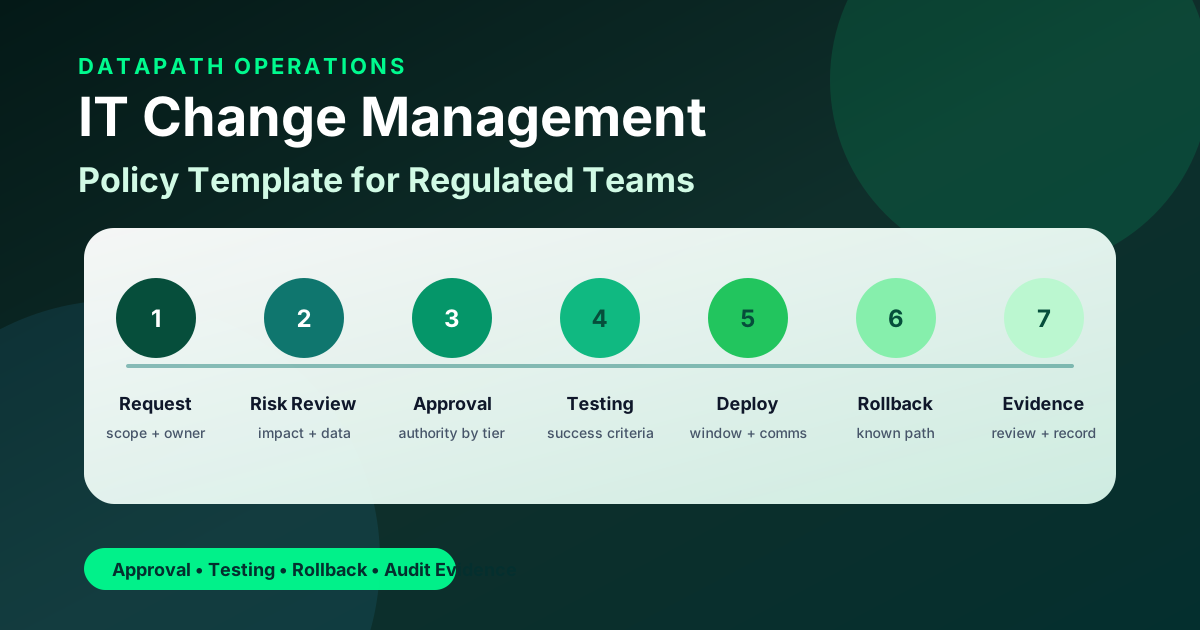
An IT change management policy template should define which technology changes require control, who can approve them, how risk is scored, what testing is required, how rollback works, how emergency changes are handled, and what evidence must be retained. The goal is stable execution: faster safe changes, fewer avoidable outages, clearer accountability, and cleaner audit records.12
Most growing organizations do not need enterprise bureaucracy. They need a policy that prevents the same recurring failures: undocumented firewall changes, rushed Microsoft 365 administration, unclear vendor ownership, emergency patches with no follow-up, and infrastructure updates that nobody ties back to business impact.
In our experience, the strongest policies are short enough for teams to use and specific enough for leadership to enforce. If your team is comparing managed IT services, reviewing MSP SLA metrics, or tightening vulnerability remediation SLAs, change management should sit directly beside those operating controls.
Need change control that protects uptime without slowing every ticket?
Datapath helps regulated and growing teams define practical change approval, testing, rollback, and review workflows that fit real operations.
Why does change management matter for regulated businesses?
Change management matters because many IT failures are not caused by exotic threats. They come from ordinary changes made without enough visibility: a firewall rule left open, a role assignment changed without approval, a backup policy edited without a restore test, or an application update pushed before dependencies were checked.
NIST SP 800-53 CM-3 describes configuration change control as a systematic process for proposing, justifying, implementing, testing, reviewing, and disposing of system changes.1 CIS Control 4 also expects secure configuration processes for enterprise assets, software, and network infrastructure, with documentation reviewed annually or when significant changes occur.3
Change control is an uptime control
A practical policy protects availability. Before a high-impact change, the team should know the affected systems, the users or sites at risk, the maintenance window, the rollback steps, and the communication plan. Without that information, even a routine update can turn into a business interruption.
For mid-market teams, this becomes more important as the environment spreads across Microsoft 365, cloud services, line-of-business applications, firewalls, endpoint tools, and third-party platforms. The more connected the stack becomes, the more one small change can affect identity, access, reporting, or recovery.
Change control is a security control
A change policy also reduces security drift. Firewall exceptions, privileged access changes, endpoint exclusions, conditional access edits, and backup retention changes all affect risk. They should not happen through side-channel messages or undocumented admin action.
CIS frames secure configuration as a lifecycle issue, not a one-time setup. Secure settings degrade as software is updated, vulnerabilities are reported, and business exceptions accumulate.3 That is exactly why approved exceptions, configuration baselines, and review cadence belong in the policy.
Change control is an evidence control
Regulated teams also need proof. If an auditor, insurer, board member, or incident responder asks why a change happened, the answer should be visible in the record: request, approval, risk assessment, implementation note, test result, rollback plan, and closure review.
That evidence does not need to be fancy. A ticket with the right fields, attachments, timestamps, and approvals is often enough. What fails is informal change approval scattered across email, chat, technician notes, and memory.
What should the policy define before anyone changes production systems?
A useful policy starts by defining the operating rules. It should tell people which changes need review, which changes are pre-approved, which changes require business approval, and which emergency changes are allowed before full review.
Define the change types
We recommend separating changes into four plain categories:
| Change type | Typical examples | Approval expectation |
|---|---|---|
| Standard change | Pre-tested, repeatable work such as routine user provisioning or approved endpoint updates | Pre-approved with documented procedure |
| Normal change | Firewall rule update, server patch cycle, SaaS configuration change, network change | Risk review and named approval before implementation |
| High-risk change | Identity policy, backup retention, segmentation, EHR/ERP, finance workflow, multi-site network update | Business owner plus technical approval |
| Emergency change | Urgent containment, outage restoration, zero-day mitigation | Expedited approval, then required post-change review |
This taxonomy keeps teams from over-controlling routine work while still forcing discipline where the blast radius is real.
Define the minimum request fields
Every normal or high-risk change request should capture enough information for someone else to understand the decision later. At minimum, require:
- change title and requester
- business reason
- affected systems, users, locations, and vendors
- data sensitivity or regulated workflow impact
- risk tier and implementation window
- testing plan and success criteria
- rollback plan
- communication plan
- approver and implementation owner
- evidence retained after completion
That list is intentionally practical. It helps IT, leadership, and vendors agree on what is changing and why before the work starts.
Define approval authority by risk
Not every change needs the same approver. A password-policy adjustment, a firewall change for a finance application, and an emergency containment action should not follow the same path.
A right-sized approval model might look like this:
| Risk tier | Approval authority | Required evidence |
|---|---|---|
| Low | Service desk lead or documented standard procedure | Ticket closure notes |
| Medium | Technical owner or IT manager | Request, test note, implementation note |
| High | IT leadership plus business owner | Risk assessment, approval, rollback, communication record |
| Emergency | On-call authority with after-action review | Incident link, reason, implementation note, post-change review |
The point is not to slow the organization down. The point is to make risk acceptance explicit instead of accidental.
How do you make an IT change management policy usable?
A change management policy fails when it reads well but never shapes the actual workflow. The policy should show up inside tickets, maintenance windows, vendor handoffs, service reviews, and after-action reports.
Connect change records to service tickets and assets
Every material change should connect to the asset, service, location, or workflow it affects. That connection matters during troubleshooting. If a clinical application breaks Tuesday morning, the team should be able to see what changed Monday night.
This also supports broader governance. A current compliance-ready IT asset inventory makes change review easier because the team can quickly identify owners, dependencies, data sensitivity, and recovery priority.
Require testing and rollback before approval
NIST CM-3 includes testing, validation, and documentation of changes as an important enhancement.1 We agree with the principle: if a change is important enough to affect production, it is important enough to define what success and rollback look like before implementation.
A practical rollback plan should answer:
- What will we restore or reverse?
- Who has authority to call rollback?
- How long can we troubleshoot before rolling back?
- What data, logs, or configuration exports must be preserved?
- Which users or stakeholders must be notified?
If nobody can answer those questions, the change is not ready.
Treat emergency changes as controlled exceptions
Emergency change authority is necessary. It is also easy to abuse. The policy should allow urgent work for active incidents, high-severity outages, exploited vulnerabilities, and containment needs while requiring a post-change review after the immediate risk is handled.
That review should document why normal approval was bypassed, what was changed, what evidence was preserved, whether any compensating controls are needed, and whether the emergency change should become a standard procedure or be reversed.
Where do MSPs and vendors fit into change control?
Managed service providers, cloud consultants, application vendors, and cybersecurity partners often perform work that changes production environments. That means their role has to be defined inside the policy, not bolted on after a problem.
CISA’s vendor supply chain risk guidance emphasizes that organizations should understand vendor practices, security posture, and trustworthiness before relying on ICT products and services.4 The FTC Safeguards Rule guidance also says covered financial institutions must spell out security expectations in service-provider contracts and build in ways to monitor provider work.5
Define which vendor changes require client approval
An MSP may need authority to perform routine maintenance, endpoint updates, alert tuning, or documented standard changes without waiting for a steering committee. But some actions should require explicit approval from the client:
- privileged identity policy changes
- firewall, VPN, or ZTNA rule changes
- backup retention or immutability changes
- production server, EHR, ERP, finance, or student-system changes
- changes that affect compliance evidence or regulated data handling
- emergency changes that alter security posture beyond immediate containment
The contract and operating handbook should both reflect that boundary.
Require evidence from provider-performed changes
A vendor’s change record should not disappear into the vendor’s internal system. Clients need enough visibility to govern risk. That can include monthly change reports, exception registers, emergency-change summaries, affected asset lists, and links to related incident or problem records.
This is where third-party cyber risk assessment and change management overlap. A provider with privileged access is part of the control environment. Their change discipline affects the client’s uptime, security, and audit posture.
Review changes during QBRs and service reviews
Quarterly business reviews should include more than ticket volume. They should examine high-impact changes, failed changes, emergency changes, recurring exceptions, aging approvals, and lessons learned. For regulated teams, we recommend turning that review into an accountability artifact leadership can actually use.
That operating rhythm pairs naturally with Datapath managed services, co-managed IT services, and vCIO services, because the work is not just technical execution. It is governance, prioritization, and continuous improvement.
Why Datapath for IT change management policy template work?
Datapath helps regulated and growth-focused organizations turn change management from a slow approval ritual into a practical operating control. We connect service desk work, infrastructure management, cybersecurity review, vendor coordination, and executive reporting so change records reflect real business risk.
If your team is preparing for an audit, switching providers, formalizing co-managed IT, or trying to reduce change-related outages, start by comparing your current process against the template above. Then review our managed IT services, MSP evaluation guide, resources and guides hub, or talk with our team about building an operating model that keeps changes moving without leaving accountability behind.
FAQ: IT change management policy template
What is an IT change management policy?
An IT change management policy is a written operating rulebook for proposing, approving, testing, implementing, documenting, and reviewing changes to technology systems. It helps teams reduce outages, security drift, undocumented admin action, and audit gaps.
What changes should be covered by the policy?
The policy should cover production systems, identity platforms, network infrastructure, firewalls, cloud services, backup systems, endpoint tools, critical SaaS applications, and regulated workflows. Low-risk standard changes can be pre-approved, but higher-risk changes need explicit review.
Who should approve IT changes?
Approval should match risk. Routine standard changes can be pre-approved by procedure, medium-risk changes can be approved by a technical owner, and high-risk changes should include IT leadership plus the affected business owner. Emergency changes need expedited authority and a mandatory post-change review.
How is change management different from patch management?
Patch management focuses on updating systems to reduce vulnerabilities or improve stability. Change management is broader: it governs any production-impacting technology change, including firewall rules, identity settings, cloud configuration, backup policy, vendor access, and application changes.
What evidence should be kept for change management?
Keep the change request, risk assessment, approvals, implementation notes, testing results, rollback plan, communication records, incident links, and post-change review notes. The evidence should be attached to the ticket or system of record where auditors and operators can retrieve it later.
Sources
- NIST SP 800-53 Rev. 5 CM-3: Configuration Change Control
- NIST SP 800-128: Guide for Security-Focused Configuration Management of Information Systems
- CIS Control 4: Secure Configuration of Enterprise Assets and Software
- CISA: Procuring Safe and Secure ICT Products and Services Fact Sheet
- FTC Safeguards Rule: What Your Business Needs to Know
Footnotes
-
NIST SP 800-53 Rev. 5 CM-3: Configuration Change Control ↩ ↩2 ↩3
-
NIST SP 800-128: Guide for Security-Focused Configuration Management of Information Systems ↩
-
CIS Control 4: Secure Configuration of Enterprise Assets and Software ↩ ↩2
-
CISA: Procuring Safe and Secure ICT Products and Services Fact Sheet ↩
