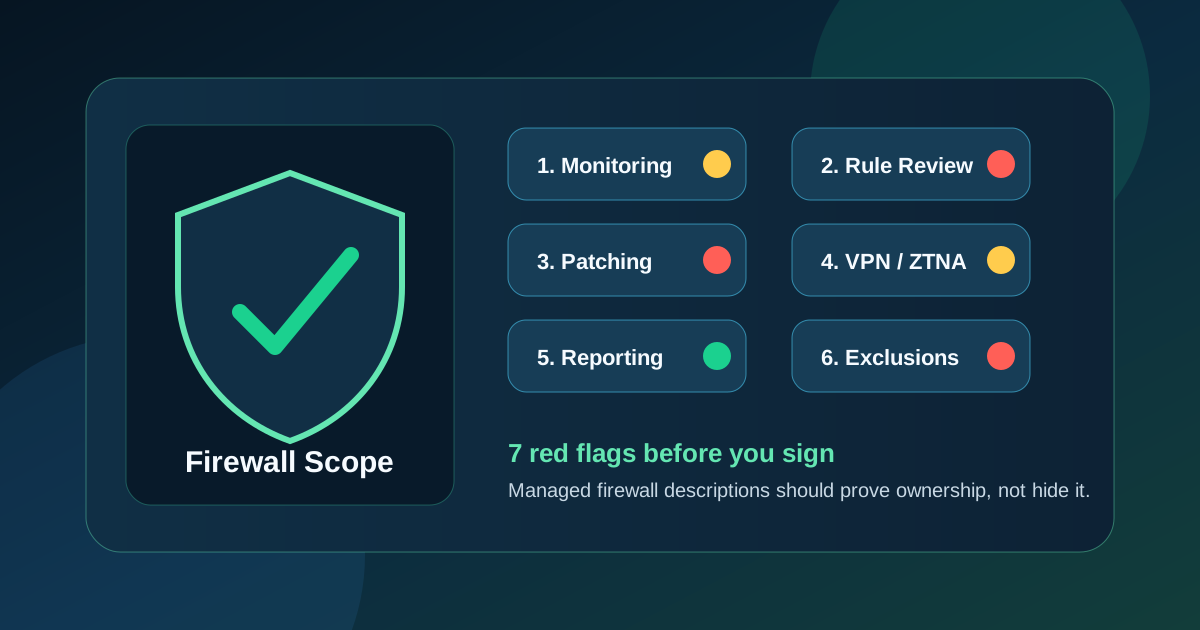

What red flags should you watch for in a managed firewall service description?
A managed firewall service description is risky when it does not clearly define rule-change ownership, policy review cadence, firmware and backup responsibilities, log monitoring, VPN or ZTNA support, incident escalation authority, reporting deliverables, exclusions, and SLA terms. If the document only says “firewall management” or “24/7 monitoring” without operating detail, keep asking questions before you sign.
The firewall is often treated like a device, but the business risk is operational. Rules drift. Temporary vendor access becomes permanent. VPN users leave the company. Firmware windows get postponed. Logs fill up without anybody deciding what matters. A service description should convert those recurring decisions into accountable work.
Datapath sees this most often when mid-market teams compare proposals that sound similar on the surface. The cheaper quote may cover basic device administration while excluding security analysis, policy cleanup, after-hours response, or compliance-ready evidence. If your team is comparing managed firewall services, use the seven red flags below before you shortlist providers.
Need a managed firewall service description reviewed?
Datapath helps regulated and mid-market teams compare firewall scope, rule review, monitoring, escalation, reporting, and exclusions before weak language becomes operational risk.
1. The service description says “monitoring” but not who responds
A strong managed firewall service description defines what is monitored, when alerts are reviewed, how severity is classified, and who can act. A weak one says “24/7 monitoring” but never explains whether anyone investigates events, opens tickets, blocks traffic, escalates to incident response, or contacts internal leadership after hours.
Monitoring without response is a dashboard, not a service. For firewall operations, the minimum monitoring scope should include device health, link availability, high-risk inbound traffic, suspicious outbound traffic, VPN activity, blocked connections, administrator changes, log gaps, and repeated scans against exposed services.
Ask the provider to define:
- Which alerts create tickets automatically.
- Which alerts are reviewed by a human analyst.
- Which events trigger after-hours escalation.
- Who can approve containment or emergency rule changes.
- What evidence appears in the monthly report.
This matters because CISA maintains the Known Exploited Vulnerabilities catalog as an input for vulnerability prioritization, and that catalog includes vulnerabilities exploited in the wild.1 If an edge device or exposed service becomes relevant to an active campaign, a passive monitoring promise is not enough. Your firewall service needs a path from signal to decision.
For teams that also need broader alert triage, compare firewall monitoring against Datapath’s managed cybersecurity services and our guidance on prioritizing security alerts without alert fatigue. Firewall logs should not live in a silo.
2. Rule changes are treated like ordinary help desk tickets
Rule changes are security decisions. A managed firewall service description should require business purpose, requester, approver, implementation notes, rollback plan, expiration date where appropriate, and post-change validation. If the provider treats every rule request like a generic support ticket, policy drift is almost guaranteed.
NIST SP 800-41 Rev. 1 frames firewall work around firewall policy, configuration, testing, deployment, and management.2 That lifecycle is the point. The service should not merely accept changes; it should keep the policy explainable.
Watch for these weak phrases:
| Weak service-description phrase | What to ask instead |
|---|---|
| ”Rule changes included” | What information is required before a rule is implemented? |
| ”Unlimited firewall tickets” | Are security reviews and cleanup included or only requested changes? |
| ”Standard change requests” | What is the SLA, approval path, rollback process, and evidence record? |
| ”Emergency changes supported” | Who has authority to make emergency changes, and when are they reviewed later? |
The strongest providers maintain a rule register that identifies broad rules, stale objects, duplicate rules, shadowed policies, expired vendor access, risky inbound exposure, and rules with no visible owner. That register gives leadership a cleaner view than raw firewall configuration exports.
If your firewall supports remote sites, cloud workloads, or segmented networks, rule changes also need network context. Datapath’s managed NGFW and network segmentation guide explains why firewall policy and segmentation decisions have to be reviewed together.
3. There is no recurring rule-review cadence
A firewall that was clean at implementation can become messy within months. A serious managed firewall service description should define how often rules, objects, NAT policies, VPN accounts, tunnels, geolocation restrictions, and external exposures are reviewed. If the document only promises changes “as requested,” the buyer is carrying the governance burden.
A practical cadence looks like this:
| Review item | Typical cadence | Why it matters |
|---|---|---|
| Emergency changes | Within 5 business days | Confirms temporary decisions did not become permanent exposure |
| VPN and vendor access | Monthly or quarterly | Removes old users, vendors, and tunnels |
| Broad allow rules | Quarterly | Reduces unnecessary attack surface |
| Firmware and lifecycle status | Monthly review, scheduled maintenance | Keeps security updates visible |
| External exposure | Monthly for high-risk environments | Finds internet-facing risk before an incident |
| Executive summary | Monthly or quarterly | Converts technical drift into decisions leadership can fund |
Do not let a provider hide behind the firewall brand. Next-generation firewall features are useful only when someone reviews whether application-aware policies, intrusion prevention, URL categories, VPN groups, identity rules, and exceptions still match business need.
This is where Datapath ties firewall operations to recurring account review rather than one-time configuration. The same discipline that makes a good managed IT services relationship work also makes firewall governance stronger: named owners, predictable review, documented exceptions, and visible next steps.
4. Firmware, backups, and high availability are vague or excluded
Firewall maintenance sounds boring until a device fails, a high-availability pair does not fail over, a firmware vulnerability becomes urgent, or the team discovers the last usable configuration backup is months old. The service description should define exactly who owns firmware planning, configuration backups, restore validation, license status, HA health checks, certificate expirations, and maintenance windows.
Look for specificity. Good language says the provider will review firmware versions, identify security updates, schedule maintenance windows, back up configurations before changes, validate HA status, and record completion. Bad language says maintenance is “available,” “as needed,” or “may be billable.”
The 2026 Verizon DBIR notes that the incidents in that edition cover the period from November 1, 2024, through October 31, 2025, and the report is built from law enforcement, forensic firms, insurers, industry sharing groups, and Verizon caseload data.3 The practical lesson for firewall buyers is not one statistic; it is that edge exposure, exploitation, and operational evidence should be treated as routine management concerns, not special projects.
At minimum, require a maintenance matrix:
| Maintenance area | Service description should state |
|---|---|
| Firmware | Review cadence, approval path, emergency update handling, rollback plan |
| Configuration backups | Backup frequency, storage location, restore test expectation |
| HA or failover | Health-check cadence, test scope, alerting path |
| Licensing | Renewal owner, security subscription coverage, lapse escalation |
| Certificates | Expiration tracking for VPN, inspection, portals, and management interfaces |
| Lifecycle | End-of-support visibility and replacement planning |
If those details are excluded, the provider may still be useful for basic support, but it is not carrying the full managed firewall operating responsibility.
5. VPN, ZTNA, and third-party access are buried in exclusions
Many firewall incidents are not about the firewall appliance itself. They involve remote access, vendor tunnels, site-to-site VPNs, stale accounts, shared credentials, unmanaged devices, or access paths that were created for a project and never retired. A managed firewall service description should treat remote access governance as core scope, not a vague add-on.
The document should answer:
- Are VPN user adds, removals, and group changes included?
- Are site-to-site tunnels included or billed separately?
- Are vendor tunnels reviewed for owner, purpose, and expiration?
- Are ZTNA or SASE controls part of the firewall service or a separate security service?
- Are logs reviewed for unusual remote access behavior?
- Is offboarding connected to firewall access removal?
The key is not whether the environment uses traditional VPN, ZTNA, SASE, or cloud firewall controls. The key is whether access is tied to identity, device posture where possible, approval, logging, and expiration.
CIS Controls v8 emphasizes controls that are focused, feasible, measurable, and informed by attacker behavior.4 Remote access is exactly where those principles matter. Broad access that nobody reviews is hard to measure and harder to defend.
For Microsoft 365 and identity-heavy environments, connect this question to conditional access policy best practices and Microsoft 365 identity security services. Firewall access and identity access should reinforce each other.
6. Reporting is only a ticket count or uptime graph
A managed firewall service description should define reporting deliverables in plain language. Ticket counts and uptime graphs are not enough. Leadership needs to see risk decisions, not only activity.
Useful reporting should include:
- Firewall health and availability.
- Significant rule changes and who approved them.
- Open risky rules or undocumented exceptions.
- VPN, tunnel, and remote access changes.
- Firmware, backup, license, and lifecycle status.
- Notable security events and escalation outcomes.
- Recommended cleanup or roadmap actions.
- Decisions required from the business.
This is especially important for healthcare, finance, K-12, government, and other regulated teams. A firewall can support compliance only if the organization can show what was reviewed, what changed, who approved exceptions, and what remains unresolved.
Datapath’s resource guides and MSP evaluation guide both emphasize the same buying principle: accountability has to be visible. If a monthly report cannot help a CFO, COO, compliance lead, or IT director understand risk and next steps, the report is probably operational noise.
7. Exclusions quietly remove the work that matters most
The exclusions section is where weak managed firewall service descriptions usually reveal themselves. Read it slowly. Some exclusions are reasonable; a provider cannot include every project, every device, every forensic investigation, and every custom report in a flat monthly service. The red flag is when normal firewall security work is excluded so broadly that the managed service becomes little more than availability monitoring.
Scrutinize exclusions for:
| Exclusion to review | Why it can be a red flag |
|---|---|
| Rule-set design or validation | This may remove the most important security judgment from scope |
| Custom reporting | This may block compliance evidence when leadership needs it |
| Security analysis | This may mean logs are collected but not interpreted |
| VPN or tunnel endpoints | This may leave vendor and branch access unmanaged |
| Emergency changes | This may create delay during containment or outage response |
| Firmware or patch projects | This may turn urgent security maintenance into a separate procurement step |
| Cloud firewall policy | This may ignore hybrid environments where traffic no longer sits behind one appliance |
A fair provider will define boundaries. A strong provider will also tell you what should be included for your risk profile, what is optional, and what should be handled by broader cybersecurity services or incident response support.
If you are comparing several proposals, build a simple scoring sheet:
| Evaluation category | Weight | Strong answer |
|---|---|---|
| Monitoring and escalation | 20% | Human-reviewed events, severity model, after-hours path |
| Rule governance | 20% | Approval, expiration, review cadence, cleanup register |
| Maintenance | 15% | Firmware, backups, HA, licensing, lifecycle planning |
| Remote access | 15% | VPN/ZTNA users, tunnels, vendors, logs, offboarding |
| Reporting | 15% | Executive risk summary and evidence, not only ticket counts |
| Exclusions | 15% | Clear boundaries without excluding ordinary security operations |
That table forces the conversation away from vague service names and toward accountable outcomes.
Why Datapath for managed firewall service description review
A managed firewall service description should make firewall ownership easier to understand, not harder. Datapath helps mid-market and regulated teams review firewall scope, network segmentation, remote access, monitoring, maintenance, reporting, and escalation before provider language turns into surprise exclusions.
Start with the Datapath managed firewall services page if you need recurring firewall operations, or review our broader managed IT services and managed cybersecurity services if firewall governance needs to connect with endpoint, identity, cloud, backup, and incident response. You can also return to Datapath for the broader service model or talk with our team about reviewing a current proposal.
Compare managed firewall scope before you sign
We can help your team identify vague monitoring language, weak rule-review terms, missing maintenance scope, and exclusions that shift security work back to you.
Frequently Asked Questions
What should a managed firewall service description include?
A managed firewall service description should include firewall administration, rule changes, policy review, monitoring, firmware maintenance, configuration backups, VPN or ZTNA support, logging, reporting, escalation paths, SLA terms, exclusions, and onboarding responsibilities. It should also define who approves changes and who responds during urgent events.
Is managed firewall monitoring the same as managed firewall security?
No. Monitoring is only one part of managed firewall security. A stronger service also includes rule governance, maintenance, backups, reporting, remote access review, log escalation, and incident handoffs. If monitoring does not trigger investigation or response, it is not enough for most regulated teams.
How often should firewall rules be reviewed?
Quarterly rule review is a practical baseline for many mid-market environments, with more frequent review for internet-facing systems, high-risk regulated data, heavy vendor access, or recent incidents. Emergency rule changes should be reviewed shortly after implementation so temporary exposure does not become permanent.
What firewall service exclusions should buyers question?
Buyers should question exclusions for rule-set validation, security analysis, custom compliance reporting, VPN or tunnel work, firmware updates, emergency changes, and cloud firewall policy. Some exclusions may be reasonable, but they should not remove the normal work required to keep firewall access governed.
Who should own firewall change approval?
Firewall change approval should be shared between technical and business owners. The provider can validate security impact and implementation steps, but the business should approve the purpose, users, data exposure, and acceptable risk for sensitive or externally reachable access.
