
What should a patch management audit checklist include?
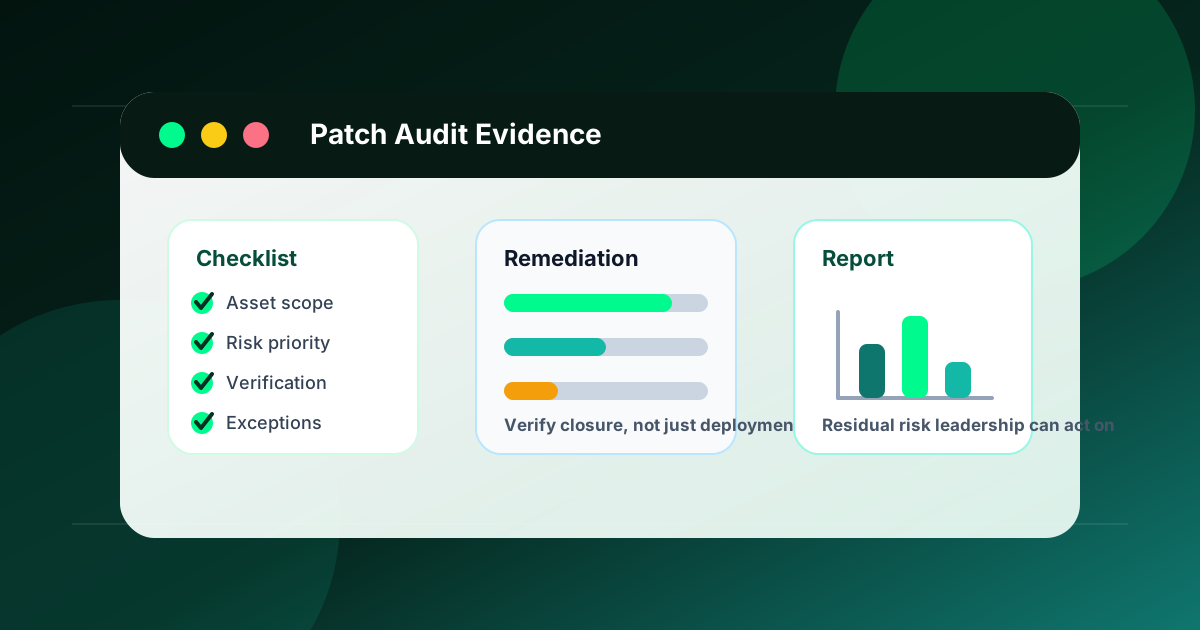
A practical patch management audit checklist should verify asset coverage, software and firmware scope, vulnerability intake, risk-based prioritization, testing, deployment rings, failed-patch follow-up, exception approval, rescan evidence, executive reporting, and record retention. The audit should prove that patches were identified, applied, verified, or formally risk-accepted instead of merely scheduled.1
Patch audits fail when they ask the wrong question. The question is not, “Do we have a patching tool?” The question is, “Can we prove which systems were in scope, which vulnerabilities mattered most, what changed, what failed, who accepted exceptions, and whether the risk actually closed?”
That distinction matters for mid-market and regulated organizations because patching sits at the intersection of security, uptime, compliance evidence, and operational trust. NIST defines enterprise patch management as identifying, prioritizing, acquiring, installing, and verifying patches, updates, and upgrades across an organization.1 If verification and evidence are missing, the program is incomplete.
For Datapath clients, we treat patch audits as part of a broader accountable security rhythm across managed cybersecurity services, managed IT services, vulnerability remediation SLAs, vulnerability management programs, and IT change management.
| Audit area | Evidence to request | Failure signal |
|---|---|---|
| Asset scope | Endpoint, server, network, cloud, and application inventory | Unknown assets or unsupported software are excluded from metrics |
| Risk priority | KEV, CVSS, exposure, asset criticality, and business impact notes | All patches follow the same calendar regardless of exploitation risk |
| Deployment proof | Tool logs, ticket records, change windows, restart status | ”Success” reports do not show failed, offline, or pending systems |
| Exception handling | Risk owner, compensating controls, expiration date, approval | Deferred patches sit in a backlog with no formal acceptance |
| Verification | Rescan results, version checks, failed-patch remediation tickets | The team deploys but never proves closure |
| Reporting | Trend metrics, overdue risk, executive summary, audit package | Leadership receives a single compliance percentage with no context |
Need patch management evidence auditors can trust?
Datapath helps regulated and mid-market teams turn patching, failed-deployment follow-up, exceptions, and remediation reporting into a defensible operating model.
Which patch management evidence should auditors review first?
Auditors should start with the evidence that proves coverage and closure. A patch report is weak if it only shows successful deployments. A defensible report shows the full denominator: in-scope assets, missing assets, unsupported systems, failed deployments, pending reboots, overdue vulnerabilities, accepted exceptions, and verified remediation.
Start with asset inventory and software scope
The first audit step is asset scope. If the asset inventory is incomplete, every downstream metric is suspect. We recommend reviewing endpoints, servers, network appliances, hypervisors, cloud workloads, SaaS administration points, third-party applications, line-of-business applications, firmware, and end-of-life software separately.
This is where mid-market environments often get exposed. Workstations are patched by one tool, servers by another, network devices by a vendor, and specialized applications by the business unit that bought them. The audit should name those ownership seams instead of hiding them under one blended percentage.
A useful inventory record includes:
- asset name and owner;
- device type and operating system;
- business criticality;
- internet exposure;
- regulatory relevance;
- patch source and tool coverage;
- support status;
- last successful check-in;
- last patch date;
- current exception status.
Confirm risk-based prioritization, not calendar-only patching
A monthly patch cycle is not enough by itself. CISA maintains the Known Exploited Vulnerabilities Catalog as an authoritative source of vulnerabilities exploited in the wild and says organizations should use KEV as an input to vulnerability management prioritization.2 That signal should change urgency.
The checklist should verify that the team ranks vulnerabilities using more than one input:
- Known exploitation. Is the vulnerability in the CISA KEV Catalog or confirmed active in the environment?
- Exposure. Is the affected asset internet-facing, remotely accessible, or reachable from high-risk networks?
- Technical impact. Could exploitation produce remote code execution, privilege escalation, credential theft, data access, or service disruption?
- Asset importance. Does the asset support identity, clinical operations, finance, student systems, public services, or executive workflows?
- Fix confidence. Is the vendor patch stable, tested, and compatible with the deployed version?
The point is not to chase every severity score with panic. The point is to show that the organization can move faster when exploitation, exposure, and business criticality justify it.
Match patching to change control and uptime constraints
Patch audits should not reward reckless deployment. Regulated teams still need testing, change windows, rollback planning, and communication. NIST frames patching as preventive maintenance, and preventive maintenance only works when security urgency and operational stability are both visible.1
The audit should check whether emergency patching has its own change path. If a firewall, VPN, identity server, EHR-connected workstation, accounting platform, or dispatch application needs urgent remediation, the process should identify who approves the change, who validates functionality, who communicates downtime, and who confirms rollback readiness.
For teams with fragile systems, this is where managed IT services and security operations have to cooperate. Patching cannot live in a security silo if it can interrupt patient care, payment processing, classrooms, public services, or field operations.
How do you audit failed patches and exceptions?
Failed patches and exceptions are where the real audit usually begins. A patch management audit checklist should separate normal pending work from risk that is aging, recurring, unsupported, or informally accepted. The ugly truth: many environments look compliant until someone asks what happened to the devices that did not patch.
Track failed deployments to closure
A failed patch is not automatically negligence. Devices are offline, reboots fail, application dependencies break, and vendor installers behave badly. The governance problem appears when failures remain invisible.
For each failed deployment, the audit should request:
- affected asset and owner;
- failed update or vulnerability identifier;
- first detection date;
- attempted deployment date;
- failure reason;
- remediation owner;
- next action;
- due date;
- verification result;
- business impact if unresolved.
If the same assets fail every month, the audit should treat that as a program issue. Recurring failure may point to broken endpoint management, stale agents, disabled services, unsupported operating systems, bad maintenance windows, or a business unit that keeps devices offline.
Require formal exception records for deferred patches
Deferred patches need a risk record, not a shrug. We recommend requiring exception records that include the affected asset, vulnerability, business justification, compensating controls, risk owner, approver, expiration date, and planned remediation.
Compensating controls might include segmentation, access restrictions, web application firewall rules, EDR monitoring, application allowlisting, temporary service disablement, vendor escalation, or accelerated replacement planning. The audit should confirm that these controls are real and time-bound.
Exception records should expire. If an exception keeps renewing, it is not an exception anymore. It is a technology debt item that needs leadership visibility, budget discussion, or architectural change.
Verify remediation with rescans or version checks
Deployment is not proof of closure. Verification is proof. The audit should request rescans, installed-version checks, configuration validation, exploitability confirmation, or vendor tool output that shows the vulnerability no longer exists on the target asset.
This is especially important for third-party applications, browsers, plug-ins, VPN clients, firmware, and server software. A patch tool may report success while the vulnerable component remains present because an old version, abandoned installer, duplicate path, or bundled dependency still exists.
CIS Control 7 focuses on continuously assessing and tracking vulnerabilities so organizations can remediate and minimize the window of opportunity for attackers.3 The word “tracking” matters. A program that cannot track closure is not yet a managed vulnerability program.
What should the patch audit report show leadership?
Leadership does not need raw patch logs. Leadership needs a clear view of residual risk, overdue work, exceptions, trend direction, and decisions required. The best patch audit reports translate technical details into accountable business language without hiding the technical evidence underneath.
Use metrics that expose the denominator
A useful patch audit report includes enough context to prevent misleading averages. A single “96% patched” number can hide the four systems that matter most. We prefer a compact scorecard:
| Metric | Why it matters |
|---|---|
| In-scope asset count | Shows the denominator behind every compliance claim |
| Tool coverage percentage | Reveals devices or applications outside normal management |
| Critical/KEV exposure count | Highlights vulnerabilities most likely to be exploited |
| On-time remediation by risk tier | Shows whether deadlines match urgency |
| Failed deployment backlog | Shows operational friction and recurring tooling gaps |
| Pending reboot count | Separates installed updates from completed remediation |
| Approved exceptions by age | Shows risk that leadership has accepted but not eliminated |
| Median remediation time | Shows whether the program is getting faster or slower |
The scorecard should be segmented by asset class and business area. A strong desktop number does not compensate for exposed servers, unmanaged network appliances, or unsupported clinical systems.
Connect findings to cybersecurity and compliance work
Patch audit findings should feed the rest of the security program. Overdue critical vulnerabilities belong in the vulnerability remediation SLA process. Unsupported systems belong in the IT roadmap. Repeated failures belong in endpoint management cleanup. Exceptions belong in cyber insurance and audit evidence.
That connection is why patch audits fit naturally with cybersecurity risk assessments, cybersecurity compliance services, and broader Datapath cybersecurity services. The audit should not end as a spreadsheet. It should create owners and decisions.
Review the checklist on a real cadence
We recommend reviewing the checklist monthly for operating metrics and quarterly for leadership evidence. The monthly review finds failed deployments, overdue work, stale agents, and patch-window problems. The quarterly review asks whether the process itself is improving.
For regulated teams, evidence cadence matters because audits, cyber-insurance renewals, incident reviews, and board questions rarely arrive when the evidence is tidy. The safest position is to maintain a rolling audit package: current policy, inventory snapshot, risk-tier deadlines, deployment results, exception register, rescan evidence, and executive summary.
Why Datapath for a patch management audit checklist
Datapath helps mid-market and regulated organizations turn a patch management audit checklist into operating discipline. We are not interested in decorative dashboards that say every device is fine while failed deployments, unsupported systems, and unresolved exceptions sit outside the report.
Our team connects patch evidence to managed cybersecurity services, co-managed IT services, managed IT services, and practical Datapath resource guides. If your team needs to prove patch coverage, clean up recurring failures, prepare for cyber insurance, or explain remediation risk to leadership, talk with Datapath about a patch management audit and remediation review.
Frequently Asked Questions
What is a patch management audit checklist?
A patch management audit checklist is a structured review of whether an organization can identify assets, prioritize vulnerabilities, deploy updates, track failures, approve exceptions, verify remediation, and report residual risk. The goal is to prove the patch process works, not just that a patching tool exists.
What evidence should we keep for patch management audits?
Keep asset inventories, patch policies, risk-tier rules, deployment logs, failed-patch tickets, change approvals, exception records, compensating-control notes, rescan results, version checks, and executive summaries. Evidence should show what was in scope, what changed, what failed, and what risk remains.
How often should a patch management audit be performed?
Most teams should review patch metrics monthly and complete a deeper evidence review quarterly. High-risk or regulated environments may review critical vulnerabilities, internet-facing assets, and KEV exposure more frequently because risk changes faster than a quarterly governance calendar.
Should patch audits include third-party applications and firmware?
Yes. Operating-system patching alone is incomplete. A useful audit includes browsers, productivity tools, VPN clients, remote access tools, firmware, network appliances, hypervisors, servers, line-of-business applications, and any vendor-managed systems that can create security or uptime risk.
What is the biggest mistake in patch audit reporting?
The biggest mistake is reporting only a blended compliance percentage. Leadership needs the denominator, exclusions, overdue critical risk, failed deployments, pending reboots, accepted exceptions, and verified closure. A high percentage is meaningless if the riskiest systems are outside the metric.
Can an MSP help with patch management audit evidence?
Yes, if the MSP owns more than tool operation. A useful provider should help define scope, monitor failures, manage exceptions, verify remediation, connect findings to vulnerability management, and produce audit-ready reporting. Datapath builds that evidence discipline into managed IT and managed cybersecurity work.
