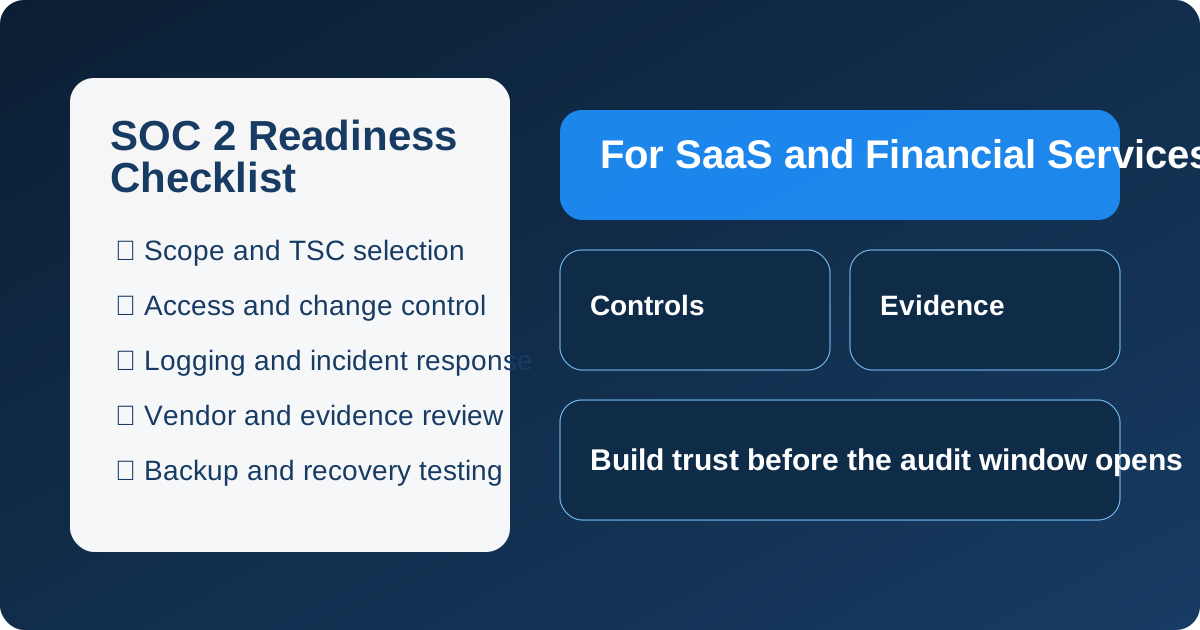

What should a SOC 2 readiness checklist for SaaS include?
A SOC 2 readiness checklist for SaaS should include scope, Trust Services Criteria selection, system boundaries, control owners, policy documents, access reviews, change management, vendor oversight, incident response, backup testing, monitoring evidence, renewal ownership, and audit-support responsibilities. The goal is to prove that controls are designed, operating, and supported by evidence before the audit window starts.12
For SaaS teams, SOC 2 readiness is rarely just an audit project. It is usually a sales, customer-trust, security, and operating-discipline project at the same time. Procurement teams want proof that customer data is handled responsibly. Leadership wants a clean path through diligence. Auditors want evidence that controls match the system description. Internal teams want to avoid a last-minute scramble.
That is why Datapath treats readiness as an operating model first. The checklist should help a company decide what is in scope, who owns each control, what evidence must be produced, what SOC 2 readiness assessment duration is realistic for SaaS, and whether the team needs outside SOC 2 readiness services. If your organization is also reviewing broader cybersecurity compliance services, SOC 2 compliance checklist work, or financial services IT support, the readiness checklist should connect those conversations instead of living in a separate spreadsheet.
Preparing for SOC 2 and unsure whether your evidence is audit-ready? Review Datapath’s SOC 2 readiness services or schedule a readiness review before the audit clock starts.
When does SOC 2 readiness become an audit-support project?
SOC 2 readiness becomes an audit-support project when the company needs more than a checklist: named evidence owners, realistic readiness duration, remediation decisions, auditor handoff notes, and renewal evidence that can survive sampling. SaaS teams should move into outside support when buyer deadlines, scattered evidence, or Type 2 timing make internal coordination risky.
| Search wording | What the buyer likely needs | Best Datapath path |
|---|---|---|
| SOC 2 readiness and audit support for SaaS companies | Help moving from customer pressure to scope, owners, evidence, remediation, and auditor-ready support | SOC 2 readiness services |
| SOC 2 readiness assessment duration SaaS | A realistic timeline before promising a Type 1 or Type 2 date to buyers | Use the duration ranges below, then schedule a readiness review if evidence is unclear |
| Evidence ownership for SOC 2 renewals | A recurring owner calendar so access, change, vendor, incident, backup, and leadership evidence is not rebuilt annually | SOC 2 readiness services |
| SaaS companies SOC 2 audit readiness challenges | A remediation calendar for weak scope, missing owners, stale vendor files, and inconsistent evidence | SOC 2 readiness services |
| How do companies budget for SOC 2 readiness projects? | A budget that separates audit fees, readiness support, remediation, tooling, and internal owner time | Use the budget section below, then compare what must be operated after the first report |
How should SaaS companies scope SOC 2 readiness?
SaaS companies should scope SOC 2 readiness by defining the product, infrastructure, data flows, support tools, identity systems, vendors, people, and commitments that affect customer data. AICPA’s SOC framework focuses on system-level controls, so a readiness checklist has to describe the real service environment before it can test controls.13
Start with the system description, not the control list. The system description is where the organization explains what service is being examined, who uses it, what infrastructure supports it, what data is processed, which people operate the service, and which vendors or subprocessors matter. If that description is vague, control evidence will be vague too.
| Scope decision | What to document | Why it matters |
|---|---|---|
| Product boundary | Customer-facing app, APIs, admin tools, production databases | Auditors need to know what service the controls protect |
| Infrastructure boundary | Cloud accounts, networks, containers, endpoints, backups | Security and availability controls depend on where the service runs |
| Data boundary | Customer data, regulated data, logs, exports, retention rules | Confidentiality, privacy, and deletion expectations depend on data flow |
| People boundary | Engineering, support, security, leadership, contractors | Access, approval, and incident controls need accountable owners |
| Vendor boundary | Cloud providers, payment tools, support platforms, monitoring tools | Subprocessors and critical vendors influence the control story |
| Commitment boundary | SLAs, contracts, security questionnaires, privacy promises | Criteria selection should match what customers were promised |
The fastest way to find a weak scope is to ask, “If an auditor sampled this control today, which system, owner, and evidence folder would we show?” If the answer changes depending on who is asked, the readiness work is not mature yet.
Which Trust Services Criteria should a SaaS company choose?
Most SaaS companies start with Security because it is the common criterion in SOC 2, then add Availability, Confidentiality, Processing Integrity, or Privacy when those criteria match customer commitments, data handling, or product risk. AICPA’s Trust Services Criteria cover security, availability, processing integrity, confidentiality, and privacy, but not every engagement needs every criterion.2
The right criteria should come from buyer promises and real system behavior. A lightweight internal tool that stores low-risk customer records may have a different scope from a financial SaaS platform moving sensitive transaction data, a healthcare workflow product touching protected information, or a data platform promising uptime to enterprise customers.
| Criterion | SaaS signal that it may belong in scope | Readiness question |
|---|---|---|
| Security | You handle customer data, production access, admin tools, or cloud infrastructure | Can we prove access, change, monitoring, and incident controls operate? |
| Availability | Contracts or buyers expect uptime, recovery, and resilience | Can we prove backup, recovery, capacity, and monitoring practices? |
| Confidentiality | You store sensitive customer data, financial data, or proprietary data | Can we prove data is restricted, encrypted, retained, and deleted correctly? |
| Processing Integrity | The product transforms, calculates, or transmits business-critical data | Can we prove processing is complete, accurate, timely, and authorized? |
| Privacy | You collect or process personal information under privacy commitments | Can we prove notice, consent, use, retention, and deletion obligations? |
Do not choose extra criteria just to look more mature. Each criterion adds evidence work, auditor focus, and renewal overhead. A better approach is to choose criteria deliberately, then build enough operating discipline that the company can expand scope later without rebuilding the program.
What is a realistic SOC 2 readiness assessment duration for SaaS?
A realistic SOC 2 readiness assessment duration for SaaS is often 4 to 12 weeks when controls are documented, owners are clear, and evidence is usable. Teams with immature access reviews, vendor oversight, incident response, backup testing, or change management may need 3 to 6 months before audit evidence is reliable enough.
That timing is not the same as audit support or the formal audit period. A readiness assessment finds gaps and prepares the operating model. Audit support helps owners answer evidence requests, resolve exceptions, and keep remediation moving. A Type 1 report evaluates controls as of a specific date, while a Type 2 report includes operating effectiveness over a period.4 AWS, for example, states that its SOC 2 and SOC 3 reports are issued twice per year and cover 12-month periods, which illustrates why operating-period discipline matters for mature programs.5
Use this planning range as a practical benchmark:
| Starting condition | Typical readiness planning range | What usually drives the timeline |
|---|---|---|
| Controls documented and operating | 4 to 8 weeks | Evidence mapping, sample checks, auditor prep |
| Policies exist but evidence is inconsistent | 8 to 12 weeks | Access reviews, change records, vendor files, backup tests |
| Early-stage SaaS with informal operations | 3 to 6 months | Control design, owner assignment, tooling, repeatable evidence |
| Regulated or financial-services SaaS | 3 to 6+ months | Stronger vendor risk, confidentiality, incident, and governance evidence |
The practical question is not, “How fast can we get a report?” It is, “How long until we can show that the controls are real, owned, and repeatable?” A rushed audit can create more friction if customers later find that the report does not cover the systems, commitments, or operating period they expected.
For SaaS leaders comparing readiness assessment duration and audit support, the handoff point matters. Readiness should end with named owners, evidence folders, remediation decisions, and a defensible audit path. If the assessment only produces a gap list, the team still has to translate that list into operating work before auditor requests start arriving.
What factors affect SOC 2 readiness time for SaaS?
The biggest factors affecting SOC 2 readiness time for SaaS are control maturity, system complexity, data sensitivity, evidence quality, vendor exposure, auditor availability, and how many people need to change daily habits. Delays usually come from inconsistent evidence, unclear control owners, immature access reviews, undocumented change approvals, and leadership decisions that arrive too late.
Here are the factors that usually move a SaaS readiness project from simple to slow:
| Readiness factor | Fast path | Slow path |
|---|---|---|
| Scope | One production product and clear cloud boundary | Multiple products, legacy systems, unclear data flows |
| Access control | SSO, MFA, role-based access, periodic reviews | Shared accounts, stale admins, manual approvals |
| Change management | Ticketed changes with review and deployment records | Informal deployments, weak emergency-change evidence |
| Vendor risk | Current vendor list with risk tiers and security documents | Unknown subprocessors or expired vendor evidence |
| Incident response | Documented plan, roles, escalation, tabletop evidence | Template plan with no testing or owner accountability |
| Backup and recovery | Tested restores and retained results | Backups exist but restore evidence is missing |
| Leadership cadence | Weekly decisions, named owners, blocker escalation | Readiness is a side task with no executive attention |
If a SaaS company is under sales pressure, the temptation is to buy a tool and assume the timeline will shrink. Automation helps, but it does not replace ownership. A platform can collect evidence, but it cannot decide what customer commitments belong in scope, approve risky access, review vendor exposure, or make leadership tradeoffs.
What SOC 2 audit readiness challenges slow SaaS companies down?
The most common SOC 2 audit readiness challenges for SaaS companies are unclear scope, missing control owners, inconsistent evidence, weak access-review records, informal change approvals, stale vendor files, and leadership decisions that happen after remediation should have started. These challenges turn a short readiness assessment into a longer remediation program.
Treat these challenges as operating issues, not only audit issues:
| Audit readiness challenge | What to fix before audit support |
|---|---|
| Scope is unclear | Confirm products, cloud accounts, customer data, vendors, people, and criteria before collecting evidence |
| Owners are missing | Assign one accountable owner for every control, evidence source, exception, and remediation task |
| Evidence is inconsistent | Standardize where access reviews, change tickets, vendor files, incident records, and backup tests live |
| Vendor files are stale | Refresh critical vendor SOC reports, security questionnaires, risk tiers, contracts, and renewal reviews |
| Leadership decisions are late | Escalate budget, accepted-risk, tooling, staffing, and audit-timing decisions while remediation can still happen |
If more than two of these issues are present, readiness and audit support should include a remediation calendar, not just an evidence checklist. That is usually the difference between a calm audit handoff and a control-owner scramble.
What evidence does a SaaS company need for a SOC 2 audit?
A SaaS company needs SOC 2 evidence that proves controls were designed and operated as described. Common evidence includes policies, system inventory, access review records, MFA configuration, onboarding and offboarding tickets, change approvals, deployment logs, vendor reviews, incident-response tests, vulnerability remediation records, backup tests, and management review artifacts.
Evidence should be mapped to controls before the audit period begins. That matters because a control can be well written and still fail if the team cannot show that it operated consistently. The AICPA SOC 2 description criteria are intended to help service organizations prepare and evaluate the system description used in the examination, which is another reason evidence should connect back to the actual service, not a generic policy folder.3
| Evidence category | Examples to collect | Owner to assign |
|---|---|---|
| Governance | Risk register, policy approvals, leadership review notes | Executive sponsor or compliance owner |
| Identity and access | SSO/MFA settings, access approvals, quarterly access reviews | IT/security lead |
| HR lifecycle | Background checks where applicable, onboarding, offboarding, security training | HR and IT |
| Change management | Pull requests, peer review, tickets, deployment logs, rollback records | Engineering lead |
| Vulnerability management | Scan results, risk ratings, remediation tickets, exception approvals | Security lead |
| Logging and monitoring | Alert rules, log retention, incident tickets, escalation records | Security operations owner |
| Vendor management | Vendor inventory, SOC reports, contracts, risk reviews, renewal checks | Compliance or operations owner |
| Backup and recovery | Backup status, restore tests, RTO/RPO evidence, failure remediation | Infrastructure owner |
| Incident response | Plan, roles, tabletop exercise, post-incident review evidence | Security and leadership |
One useful readiness test is brutally simple: pick five controls and ask the owner to produce the last three pieces of evidence. If the team needs a week to reconstruct what happened, the evidence process is not ready for audit pressure.
Who should own SOC 2 evidence for renewals?
SOC 2 evidence for renewals should have named control owners, one program owner, and executive sponsorship. The program owner coordinates the calendar, but individual owners must operate and document their controls. Renewal readiness fails when evidence collection depends on one person chasing every artifact after the audit period has already passed.
For SaaS companies, renewal ownership should be built as a recurring operating rhythm:
- The executive sponsor owns priority, deadlines, and cross-team tradeoffs.
- The compliance or security lead owns the readiness calendar and auditor coordination.
- IT owns identity, endpoint, backup, monitoring, and infrastructure evidence.
- Engineering owns change management, secure development, deployment, and production access evidence.
- HR or operations owns onboarding, offboarding, training, and policy acknowledgement evidence.
- Finance, legal, or operations owns vendor reviews, contracts, and subprocessors.
- Leadership reviews exceptions, overdue evidence, and customer-impacting risks.
This is where NIST Cybersecurity Framework 2.0 language is useful even outside a formal NIST engagement. The framework organizes cybersecurity outcomes around Govern, Identify, Protect, Detect, Respond, and Recover, which gives leadership a clear way to see whether SOC 2 evidence is connected to risk management instead of sitting in an audit silo.6
How do companies budget for SOC 2 readiness projects?
Companies should budget SOC 2 readiness by separating audit fees, readiness support, remediation work, compliance automation, security tooling, staff time, and renewal operations. The hidden cost is usually internal effort: control owners must attend workshops, fix gaps, produce evidence, review exceptions, and keep controls operating after the initial report.
Budgeting is easier when the company separates one-time readiness from recurring operations:
| Budget item | One-time or recurring? | What to watch |
|---|---|---|
| Readiness assessment | One-time or periodic | Scope quality, gap prioritization, evidence map |
| Audit firm fees | Annual or report-based | Type 1 vs Type 2 path, criteria, system complexity |
| Remediation work | One-time plus backlog | Identity cleanup, logging, backup testing, vendor reviews |
| Compliance automation | Recurring | Evidence integrations, owner workflow, exception tracking |
| Security tooling | Recurring | MFA, EDR, vulnerability scanning, SIEM, backup monitoring |
| Internal staff time | Recurring | Workshops, evidence review, access reviews, change process |
| Renewal operations | Recurring | Quarterly controls, vendor refresh, policy review, leadership reporting |
The wrong budget question is, “What is the cheapest way to pass?” The better question is, “What investment makes customer diligence, renewal evidence, and security operations more predictable?” That framing protects both conversion and credibility. A report that does not match how the company operates may satisfy one questionnaire, but it will not create durable trust.
When should SaaS companies use SOC 2 readiness and audit support?
SaaS companies should use SOC 2 readiness and audit support when enterprise buyers are asking for a report, internal evidence is scattered, the company is choosing Trust Services Criteria for the first time, Type 2 timing is unclear, or the team lacks enough compliance and security capacity to keep controls operating.
Outside support is especially useful when the team needs to:
- translate buyer questionnaire pressure into a practical control roadmap
- decide whether Type 1, Type 2, or a staged path makes sense
- map controls to existing systems instead of inventing audit-only work
- clean up access reviews, logging, backup testing, and change evidence
- evaluate whether compliance automation is configured correctly
- prepare leadership for audit timing, cost, and customer expectations
- keep evidence ready for renewals instead of rebuilding it every year
Datapath’s role in this kind of work is operational rather than theatrical. We help teams connect compliance pressure to managed IT, cybersecurity, backup, identity, monitoring, and vendor accountability. That is why readiness often overlaps with our SOC 2 readiness services, cybersecurity services, managed cybersecurity services guide, SOC 2 evidence collection checklist, and SOC 2 gap assessment checklist.
Can SOC 2 readiness be fast-tracked without creating audit risk?
SOC 2 readiness can be fast-tracked only when scope is narrow, owners are available, controls already exist, and evidence can be produced quickly. A fast-track plan should prioritize critical controls, freeze scope early, remove stale access, document change and incident workflows, test backups, and review vendors before the audit period begins.
A safe fast-track plan usually looks like this:
| Week | Focus | Output |
|---|---|---|
| 1 | Scope and readiness kickoff | System boundary, criteria decision, owner map |
| 2 | Evidence inventory | Control-to-evidence matrix and missing artifact list |
| 3 | Identity and access cleanup | MFA proof, privileged access review, offboarding fixes |
| 4 | Change and vendor evidence | Ticket linkage, deployment samples, vendor risk files |
| 5 | Incident, logging, and backup readiness | IR plan, monitoring coverage, restore-test evidence |
| 6 | Final gap closure | Exception log, leadership review, auditor-ready evidence pack |
This does not mean every company can be ready in six weeks. It means the team can run a disciplined readiness sprint when the foundation is already partly in place. If controls are informal, vendors are unknown, or production access is messy, a fast-track project should be honest about those gaps instead of hiding them in the hope that the audit will go quietly.
How should leadership compare SOC 2 readiness tools and providers?
Leadership should compare SOC 2 readiness tools and providers by asking whether they reduce evidence friction, improve control ownership, support renewals, and match the company’s operating environment. A dashboard is useful only if the underlying controls are real, evidence is current, and people know what decisions they own.
Use this scorecard before buying a platform or engaging a provider:
| Comparison area | Strong signal | Risk signal |
|---|---|---|
| Scope guidance | Helps define system, criteria, vendors, and data flows | Starts with a generic control list |
| Evidence workflow | Assigns owners, cadence, exceptions, and renewal reminders | Dumps artifacts into one folder |
| Integrations | Connects to identity, cloud, code, ticketing, EDR, backup tools | Requires manual screenshots for most evidence |
| Remediation support | Explains what to fix and why it matters | Flags gaps without prioritization |
| Audit handoff | Prepares auditor-ready evidence and narratives | Leaves the team to translate tool output |
| Operational fit | Connects SOC 2 to security, IT, vendor, and recovery operations | Treats SOC 2 as a standalone compliance chore |
The most useful readiness partner is not the one with the flashiest dashboard. It is the one that helps the organization keep promises under pressure: access is reviewed, changes are traceable, incidents have owners, vendors are understood, backups are tested, and leadership can see what is still unresolved.
What does a practical SOC 2 readiness checklist look like?
A practical SOC 2 readiness checklist is organized by scope, ownership, control operation, evidence, and renewal cadence. It should be specific enough for teams to execute but simple enough for leadership to review. The checklist should also distinguish what must be done before audit, during the audit period, and before renewal.
Use this checklist as a working starting point. CISA Cyber Essentials reinforces the same operational basics that show up in readiness work, including multifactor authentication, incident response, and disaster recovery discipline.7
| Checklist item | Done when |
|---|---|
| Confirm business reason for SOC 2 | Sales, customer, investor, or risk driver is documented |
| Choose Type 1, Type 2, or staged path | Leadership and auditor agree on timing and expected use |
| Define system boundary | Product, cloud, data, vendors, and people are documented |
| Select Trust Services Criteria | Criteria match customer commitments and actual risk |
| Assign control owners | Each control has a named accountable owner |
| Map policies to practice | Policies match how systems and teams actually operate |
| Clean up privileged access | Admin users, shared accounts, and stale access are remediated |
| Document access reviews | Review cadence, evidence, exceptions, and approvals are retained |
| Validate change management | Tickets, approvals, code review, deployment logs, and emergency changes are traceable |
| Review vendor risk | Critical vendors have current security evidence and risk ratings |
| Test incident response | Roles, escalation, communications, and post-incident records are documented |
| Test backup and recovery | Restore tests, exceptions, and remediation are retained |
| Confirm logging and monitoring | Critical events are logged, reviewed, escalated, and retained |
| Build evidence calendar | Owners know what evidence is due monthly, quarterly, and annually |
| Run readiness sampling | Sample controls can be supported without reconstruction |
| Hold leadership review | Executives understand open risks, exceptions, timing, and budget |
If your checklist cannot show owner, cadence, system, evidence, and escalation path for each critical control, it is probably still a topic list, not a readiness program.
Why Datapath for SOC 2 readiness planning?
Datapath helps SaaS, financial-services, healthcare, and regulated mid-market teams turn SOC 2 pressure into clearer IT and security operations. We do not treat readiness as a paperwork exercise. We focus on scope, ownership, evidence, remediation, and the recurring operating habits that make audits and renewals calmer.
That approach matters because SOC 2 often exposes the same weaknesses that create day-to-day risk: unclear access ownership, inconsistent tickets, poor backup testing, weak vendor accountability, alert noise, and leadership reports that do not show what is actually improving. Fixing those issues helps with the audit, but it also helps the business run with more trust.
If your team is preparing for SOC 2, compare this checklist with your current evidence, then review Datapath’s SOC 2 readiness services, cybersecurity compliance services, SOC 2 compliance checklist for IT teams, managed cybersecurity services guide, and Datapath resources hub. When you want a practical read on readiness gaps, talk with our team.
FAQ: SOC 2 readiness checklist for SaaS
What is a SOC 2 readiness checklist for SaaS?
A SOC 2 readiness checklist for SaaS is a pre-audit plan that maps scope, controls, owners, evidence, vendors, policies, and timelines before a formal SOC 2 examination. It helps the company prove that controls are not only documented but operating in the real product and support environment.
What is a realistic SOC 2 readiness assessment duration for SaaS?
SOC 2 readiness assessment duration for SaaS is often 4 to 12 weeks when controls are mature and evidence is usable. Teams with informal access reviews, weak vendor oversight, missing backup tests, or unclear change records may need 3 to 6 months.
What evidence does a SaaS company need for SOC 2?
A SaaS company usually needs policies, system descriptions, access reviews, MFA proof, onboarding and offboarding records, change approvals, deployment logs, vendor reviews, incident-response evidence, vulnerability remediation records, backup tests, monitoring evidence, and management review artifacts.
What factors affect SOC 2 readiness time for SaaS?
The biggest factors affecting SOC 2 readiness time for SaaS are scope complexity, data sensitivity, criteria selection, control maturity, evidence quality, vendor exposure, internal owner availability, remediation backlog, and whether leadership can make timely decisions about risk, tooling, and audit timing.
What SOC 2 audit readiness challenges slow SaaS companies down?
SOC 2 audit readiness challenges for SaaS companies usually include unclear scope, missing control owners, inconsistent evidence, weak access-review records, informal change approvals, stale vendor files, and late leadership decisions about remediation, tooling, staffing, or audit timing.
How should a company budget for SOC 2 readiness?
Budget for audit fees, readiness support, remediation work, compliance automation, security tooling, and internal staff time. The largest hidden cost is usually the time control owners spend fixing gaps, producing evidence, and keeping the program ready after the initial report.
Who should own evidence for SOC 2 renewals?
One program owner should coordinate evidence, but each control needs a named operational owner. IT, engineering, HR, legal, operations, finance, security, and leadership may all own evidence depending on the control. Renewal evidence should be collected on a recurring calendar, not rebuilt annually.
Can SOC 2 readiness be fast-tracked?
SOC 2 readiness can be fast-tracked when scope is narrow, controls already exist, owners are available, and evidence can be produced quickly. It should not be fast-tracked by ignoring weak controls, hiding unclear vendors, or starting an audit period before evidence is reliable.
What is the difference between SOC 2 readiness assessment and audit support?
A readiness assessment finds gaps before the audit period. Audit support helps organize evidence, answer auditor requests, coordinate owners, and keep the process moving during the examination. Many SaaS teams need both, especially when SOC 2 is new or customer deadlines are tight.
When should SaaS companies use SOC 2 readiness and audit support?
SaaS companies should use SOC 2 readiness and audit support when enterprise buyers are asking for a report, Type 2 timing is unclear, evidence is scattered, internal owners are overloaded, or the team needs help translating control gaps into remediation work.
Which Trust Services Criteria should SaaS companies choose?
Most SaaS companies include Security and then add Availability, Confidentiality, Processing Integrity, or Privacy when those criteria match customer commitments and data flows. The right scope should follow real product risk and buyer promises, not a generic desire to include everything.
Does SOC 2 readiness matter for financial-services SaaS?
Yes. Financial-services SaaS teams often face higher expectations for confidentiality, vendor oversight, incident response, uptime, and evidence quality. SOC 2 readiness should connect to broader regulated-industry operations, not just the narrow audit checklist.
Sources
- AICPA: SOC suite of services
- AICPA: Trust Services Criteria with revised points of focus
- AICPA: SOC 2 description criteria
- AICPA: Maintaining high standards for SOC engagements
- AWS: SOC compliance FAQ
- NIST: Cybersecurity Framework 2.0
- CISA: Cyber Essentials