
Who are the best incident response companies in Fresno California?
The best incident response companies in Fresno California are the providers that can help leadership make defensible decisions quickly: contain the incident, preserve evidence, restore critical operations, coordinate with cyber insurance and counsel, and document what happened. For regulated teams, the provider also needs enough managed IT context to fix the conditions that let the incident spread.
That answer matters because incident response is not a normal support ticket. A ransomware, business-email compromise, vendor-access abuse, or cloud-account takeover can force decisions about shutdowns, law enforcement reporting, backup integrity, customer communication, and production recovery in the same hour. A generic “we remove malware” vendor may be useful for one device. It is not enough for a multi-site business, clinic, school, municipality, or financial-services office.
For Fresno organizations comparing options, we recommend evaluating incident response firms by what they can prove before an incident happens. If your current provider also manages identity, endpoints, firewalls, Microsoft 365, backups, and documentation, the response can move faster because the team already knows the environment. That is one reason Datapath connects incident readiness with managed cybersecurity services, incident response retainer services, and operational review.
Need to compare incident response readiness before there is an emergency?
Datapath helps Fresno and Central Valley organizations evaluate containment, recovery, evidence, and remediation readiness before ransomware or account compromise forces the issue.
What should Fresno leaders compare first?
The first comparison should be capability under pressure, not brochure language. CISA’s StopRansomware guidance says ransomware and data-extortion incidents can severely disrupt business processes and includes both prevention best practices and a response checklist for organizations.1 NIST’s current incident-response publication frames response as part of the full Cybersecurity Framework lifecycle: Govern, Identify, Protect, Detect, Respond, and Recover.2
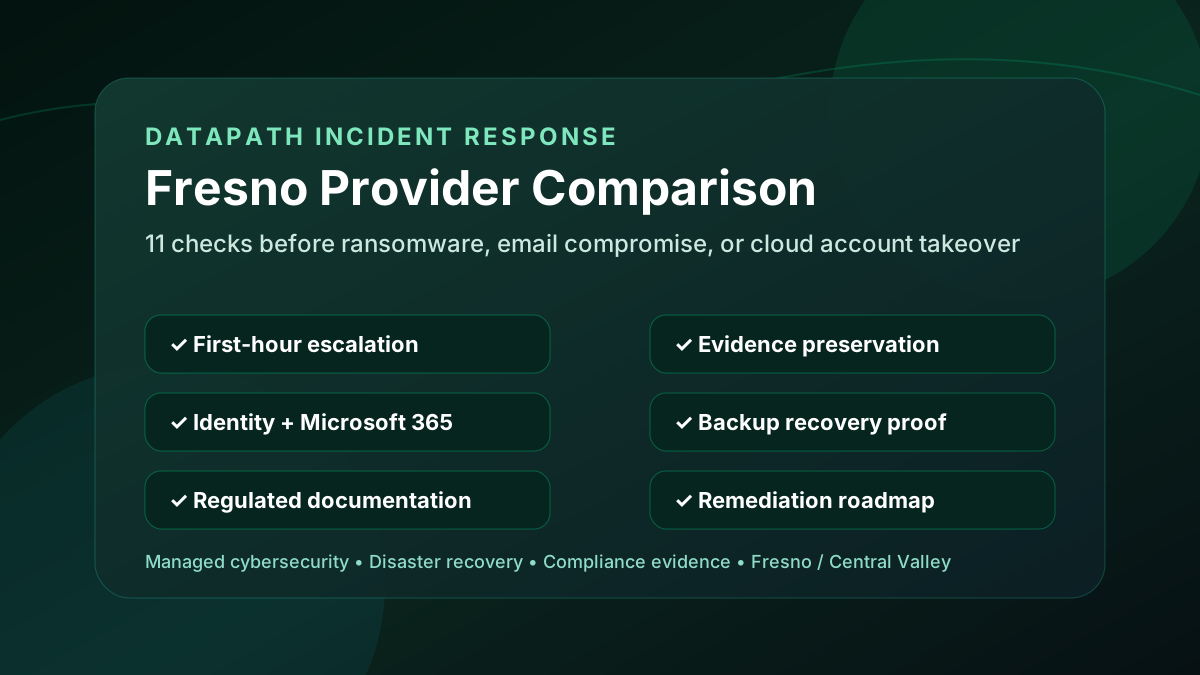
That means a strong provider must help before, during, and after the incident. The following 11 checks separate real response capacity from help-desk improvisation.
1. Clear emergency escalation path
A provider should be able to state exactly how an incident gets escalated, who answers after hours, what information the client must provide, and who has authority to disconnect systems or disable accounts. If escalation depends on leaving a voicemail with a general support queue, the response model is too weak.
Ask for the first-hour process. You want to know whether the provider can triage ransomware, suspicious administrator activity, email compromise, data exfiltration signals, and vendor-access abuse without wasting time debating ownership.
2. Evidence preservation before cleanup
Fast cleanup can destroy evidence. A mature responder knows when to isolate, snapshot, preserve logs, collect volatile data, and document actions before rebuilding systems. CISA’s ransomware response guidance includes evidence-oriented steps such as identifying impacted systems, reviewing logs, preserving artifacts, and reporting through appropriate channels.1
For healthcare, finance, education, and public-sector organizations, evidence is not paperwork theater. It affects breach analysis, insurer review, executive reporting, vendor accountability, and future control remediation.
3. Ransomware containment playbooks
The provider should have written procedures for common containment moves: isolating hosts, disabling compromised credentials, restricting VPN and remote access, blocking malicious infrastructure, shutting down exposed services, and stopping lateral movement. The plan should also define when containment becomes a business decision because a shutdown may interrupt clinical, instructional, public, or revenue operations.
A useful test is blunt: can the provider explain what it would do if multiple sites saw simultaneous encryption, abnormal data transfers, and suspicious privileged-account activity?
4. Identity and Microsoft 365 response coverage
Many Fresno businesses run heavily on Microsoft 365, Entra ID, SharePoint, OneDrive, Teams, and cloud email. Incident response therefore needs more than endpoint cleanup. It needs mailbox audit-log review, OAuth app-consent review, conditional-access inspection, privileged-role review, guest-user access review, and evidence that persistence has been removed.
This is where related planning matters. If your team has not reviewed Microsoft 365 guest user access or phishing-resistant MFA rollout, an incident will expose those gaps at the worst possible moment.
5. Backup and recovery validation
A provider should not promise recovery simply because backups exist. CISA recommends offline, encrypted backups of critical data and regular testing of backup availability and integrity in disaster recovery scenarios.1 The same guidance warns that many ransomware variants attempt to find, delete, or encrypt accessible backups.1
Compare providers by their ability to verify backup scope, immutability, administrator separation, restore order, clean-network recovery, and post-restore validation. For a deeper operating model, pair this article with Datapath’s disaster recovery services and our backup and disaster recovery guide.
6. Forensic and legal coordination boundaries
Not every incident response company is a forensic firm, and not every forensic firm understands your daily IT environment. The right relationship defines when outside forensics, breach counsel, cyber insurance, law enforcement, or a regulator-facing team should be engaged.
CISA’s ransomware reporting page says every ransomware incident should be reported to the U.S. government and that victims can report once to the FBI, CISA, or the U.S. Secret Service so the other agencies are notified.3 Your provider does not replace counsel, but it should know how to preserve facts so counsel and insurers are not forced to reconstruct the incident from memory.
7. Endpoint, network, and firewall telemetry
Response speed depends on visibility. Ask what endpoint detection, firewall logs, DNS records, VPN records, server logs, and cloud telemetry the provider can actually inspect. If the answer is “we will see what is available,” that may be honest, but it also means readiness work is incomplete.
For multi-site organizations, firewall and network data matter because attackers often move through remote access, exposed services, unmanaged devices, and flat networks. Datapath’s managed firewall services can help bring those signals into a response-ready model instead of treating firewalls as isolated appliances.
8. Regulated-industry documentation
Fresno-area healthcare, education, finance, and government teams need documentation that survives scrutiny. The response record should include timeline, systems affected, accounts affected, containment decisions, evidence collected, communications, recovery steps, unresolved risks, and remediation actions.
NIST SP 800-61 Rev. 3 emphasizes that incident response should be integrated into cybersecurity risk management, not treated as a one-time technical event.2 In practice, that means the final report should feed risk assessment, policy updates, security roadmap, training, vendor oversight, and executive review.
9. Communications discipline
During an incident, vague communication creates chaos. A provider should help define who receives technical updates, who briefs executives, what status language is safe to use, and how often updates occur. The provider should also avoid speculative claims before facts are known.
We like simple operating language: what we know, what we do not know yet, what we are doing next, what decision leadership must make, and what evidence supports the current position.
10. Remediation after containment
Containment is not remediation. A company may stop encryption but still have exposed credentials, unsafe remote access, weak MFA, stale accounts, unsupported systems, missing logging, excessive vendor access, or untested backups.
A credible incident response partner should turn findings into a remediation plan with owners, deadlines, and verification evidence. If your organization already has a cybersecurity risk assessment, compare incident findings against that baseline. If there is no baseline, the incident response should create one.
11. Local operating knowledge plus specialist reach
Local presence matters when devices, sites, executives, insurance contacts, or operational systems need hands-on coordination. Specialist reach matters when malware analysis, legal privilege, insurer panel requirements, or deep forensics are required. The best fit may be a provider that knows your environment and can coordinate specialist resources without pretending to be every role at once.
For Central Valley organizations, Datapath brings the local managed IT and cybersecurity context many incident-only firms lack. We know response is easier when asset inventories, admin access, backups, network diagrams, and service ownership are already under control.
How should you score incident response companies before an incident?
Use a practical decision matrix. Do not wait for a ransomware note to discover whether your provider has cloud logs, backup evidence, or escalation authority.
| Evaluation area | Strong answer | Weak answer |
|---|---|---|
| First-hour escalation | Named process, severity triggers, after-hours path, authority model | Generic support queue |
| Evidence preservation | Isolation, snapshots, log retention, chain-of-action notes | Immediate wipe-and-rebuild reflex |
| Ransomware containment | Written playbooks for accounts, endpoints, remote access, network spread | Ad hoc technician judgment |
| Microsoft 365 coverage | Entra ID, mailbox, OAuth, SharePoint, OneDrive, Teams logs | Endpoint-only cleanup |
| Backup recovery | Tested restore order, immutable/offline copies, clean-network recovery | ”Backups are running” |
| External coordination | Defined insurance, counsel, law enforcement, forensic handoff boundaries | Provider improvises after impact |
| Post-incident remediation | Prioritized findings, owners, due dates, verification evidence | Cleanup ticket closed with no roadmap |
Ask for sample deliverables
Before signing an incident response retainer or relying on an MSP, ask for sanitized examples: incident timeline, executive summary, containment checklist, recovery plan, and post-incident remediation tracker. A provider that cannot show the shape of its deliverables probably has not standardized the work.
Test the plan with a tabletop exercise
A short tabletop exercise exposes gaps without a real outage. Walk through a ransomware or Microsoft 365 compromise scenario and ask who disables accounts, who calls insurance, who preserves logs, who approves shutdowns, who communicates with leadership, and who validates recovery.
Datapath’s ransomware incident response playbook and cyber incident response tabletop exercise checklist are useful starting points if your team wants to stress-test the process.
Make the provider connect response to prevention
The cheapest incident is the one that never becomes an incident. Your provider should connect response planning to vulnerability remediation, endpoint security, privileged access, backup testing, firewall policy, email security, training, and executive reporting. If response and prevention live in separate silos, accountability will fracture.
Why Datapath for best incident response companies in Fresno California searches?
Datapath helps Fresno and Central Valley organizations make incident readiness operational. We connect managed IT, cybersecurity monitoring, backup and disaster recovery, firewall management, Microsoft 365 administration, and executive reporting so response is not disconnected from daily operations.
We are not the right fit for every incident. Some events require insurer-appointed forensic firms, breach counsel, law enforcement, or specialized malware analysis. But for mid-market and regulated organizations that need a practical partner before, during, and after an incident, Datapath can help build the readiness model, coordinate the response path, and turn findings into remediation.
If your leadership team is comparing incident response companies, start by reviewing the 11 checks above against your current environment. Then explore Datapath’s Fresno managed IT services, incident response retainer services, and resources hub or talk with our team about a response-readiness review.
FAQ: Best incident response companies in Fresno California
What makes an incident response company good for Fresno businesses?
A good incident response company for Fresno businesses can escalate quickly, preserve evidence, contain identity and endpoint threats, validate backup recovery, coordinate with insurance and counsel, and document decisions clearly. Local operating knowledge helps when the incident affects multiple offices, executives, vendors, and business-critical systems.
Should an MSP handle incident response or should we hire a forensic firm?
It depends on the incident. An MSP can be valuable because it knows the environment, systems, users, backups, and vendors. A forensic firm may be needed for deep evidence collection, legal privilege, insurer requirements, or breach analysis. The best plan defines the handoff before an emergency.
What should be in an incident response retainer?
An incident response retainer should define response availability, severity triggers, contacts, covered systems, initial triage scope, evidence handling, communication cadence, insurer coordination, recovery support, reporting, and post-incident remediation. It should also state what is excluded or handed to outside specialists.
How can a company prepare before ransomware happens?
Prepare by maintaining offline or immutable backups, testing restores, enforcing MFA, patching internet-facing systems, reducing exposed remote access, centralizing logs, documenting critical assets, and practicing the response plan. CISA’s StopRansomware guide emphasizes prevention and response preparation, not only cleanup after encryption.1
How often should incident response plans be tested?
Most mid-market teams should test incident response at least annually and whenever major systems, vendors, locations, insurance requirements, or leadership responsibilities change. Regulated organizations should also preserve exercise evidence and remediation notes so tabletop findings turn into measurable control improvements.
