
What should school districts do with CISA’s K-12 Cybersecurity Foundations guidance?
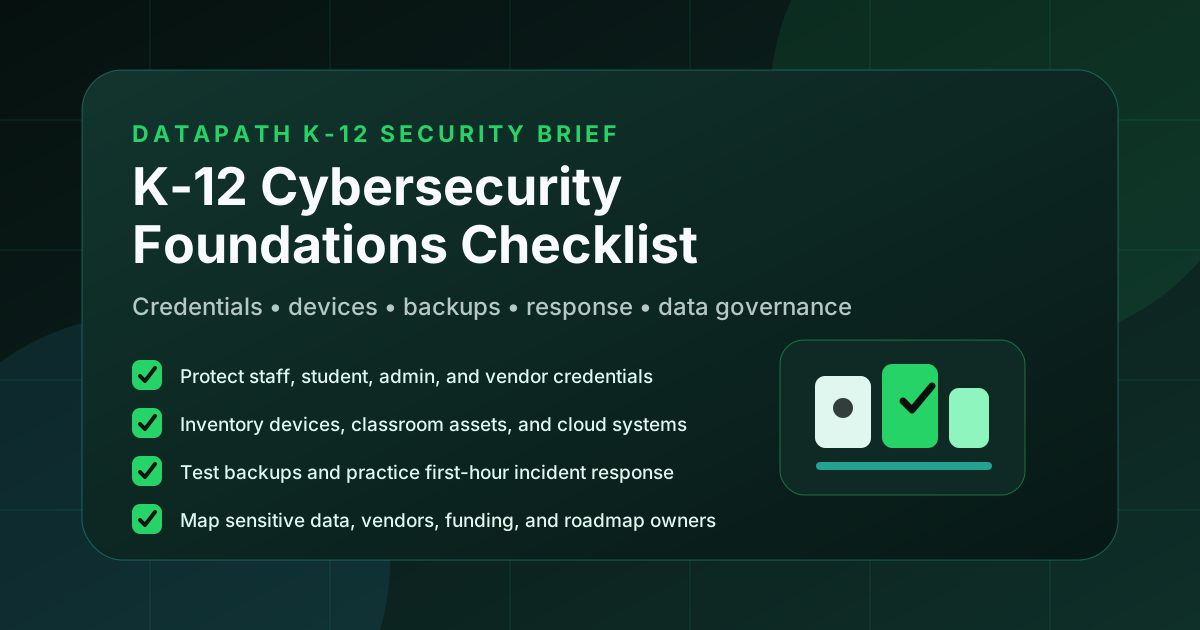
School districts should turn CISA’s K-12 Cybersecurity Foundations guidance into a written control-and-evidence checklist: protect login credentials, safeguard devices, test backups, practice incident response, train staff, govern sensitive data, align spending to recognized frameworks, and maintain a long-term cybersecurity plan. The value is not the PDF. The value is proving what the district can actually operate.
On August 12, 2026, CISA released the K-12 Cybersecurity Foundations Resource Package, a set of guides, videos, and supplemental materials intended to help K-12 schools and districts prevent, mitigate, and respond to prevalent cyber threats.1 CISA framed the package around the reality that schools hold sensitive student and staff data, depend on many systems, have users with different privilege levels, and often lack the budget or personnel for a mature security program.1
That is exactly why a district cannot treat the release as another compliance-looking download. For superintendents, cabinet leaders, business officials, and technology directors, the practical question is blunt: can the district show who owns each cyber foundation, where the evidence lives, and what gets funded next? Datapath helps K-12 leaders turn that question into operating discipline through visible risk, practical controls, and documented accountability. Datapath’s K-12 managed IT services are built around that model.
Why is CISA’s August 2026 K-12 package a timely risk signal?
CISA’s August 2026 package is timely because it reframes K-12 cybersecurity as a school-safety and continuity issue, not a back-office IT preference. The agency says cyber incidents can disrupt learning and operations, compromise student privacy and safety, and consume scarce resources that districts cannot afford to waste.1
The release also gives districts a defensible structure for board-level conversations. Instead of presenting cybersecurity as an abstract list of tools, district leaders can organize decisions around eight objectives CISA names publicly: protecting credentials, safeguarding devices and assets, testing backups, strengthening incident response, improving training, enacting sensitive-data policies, aligning investments with recognized frameworks, and developing long-term customized plans.1
That matters for small and mid-sized districts across California’s Central Valley and Ohio because cybersecurity work often stalls when it is too technical for leadership and too unfunded for IT. CISA’s framing gives both groups a common language. Leadership can ask for status, risk, funding needs, and evidence. IT can translate urgent work into outcomes that affect instruction, payroll, nutrition services, transportation, communications, special education records, student information systems, and district finance.
What should the checklist include first?
A useful checklist should start with controls that reduce the biggest operational failure modes: stolen credentials, unmanaged devices, untested backups, unclear incident authority, weak user training, poorly governed sensitive data, scattered investments, and no long-term roadmap. Each item should have an owner and evidence artifact, not just an intention.
| CISA objective | District question | Evidence to keep |
|---|---|---|
| Protect login credentials | Which accounts can reach student data, finance systems, cloud admin portals, and remote access? | MFA policy, privileged-account list, disabled-account report, access-review notes |
| Safeguard devices and assets | Does IT know what is on the network and who manages it? | Asset inventory, endpoint coverage report, patch aging, exception register |
| Test backups | Can the district restore critical data during ransomware or vendor failure? | Restore-test logs, backup scope, RTO/RPO targets, recovery order |
| Strengthen incident response | Who can declare an incident, isolate systems, call counsel, notify vendors, and communicate with families? | Incident response plan, tabletop notes, contact tree, decision log template |
| Improve training | Are staff and students taught the attacks they actually face? | Training completion, phishing results, new-hire workflow, role-specific materials |
| Manage sensitive data | Where do student, staff, health, finance, and special-program records live? | Data map, retention rules, vendor roster, data-sharing approvals |
| Align investments | Are purchases tied to CISA CPGs, NIST CSF 2.0, and district risk? | Roadmap, budget mapping, control gaps, board-ready risk summary |
| Build a long-term plan | What changes over 30, 90, 180, and 365 days? | Funded roadmap, assigned owners, milestone reporting, accepted-risk list |
This is also where districts should connect the new guidance to existing efforts such as E-Rate, cybersecurity pilot planning, refresh cycles, vendor renewals, and insurance questionnaires. If cybersecurity lives outside the budget calendar, it gets squeezed into emergency purchases. If it lives inside the district roadmap, leaders can compare tradeoffs before a crisis forces the decision.
Need help turning CISA's K-12 guidance into an operating plan?
Datapath helps school districts convert cybersecurity guidance into practical controls, backup tests, access reviews, incident-response evidence, and funded remediation roadmaps.
How should districts protect login credentials?
Districts should protect login credentials by requiring MFA for staff and administrators, limiting privileged accounts, removing stale accounts quickly, reviewing access to student and finance systems, and monitoring suspicious sign-ins. Credentials are the front door to email, cloud storage, student information systems, payroll, vendor portals, and administrative tools.
The mistake is treating MFA as a single checkbox. Districts need different rigor for students, teachers, aides, substitutes, finance users, technology staff, building administrators, and vendors. Administrative accounts should not be used for daily email. Shared accounts should be eliminated or tightly controlled. Vendor accounts should have named sponsors, expiration dates, and logging. Emergency access accounts should be documented and tested without becoming a bypass for normal controls.
This connects directly to Datapath’s Microsoft 365 identity security services and related guidance on Microsoft Entra emergency access accounts. K-12 identity work is not only about passwords. It is about preventing one compromised mailbox or stale vendor account from becoming access to sensitive district systems.
How should districts handle devices and assets?
Districts should maintain an asset inventory that covers staff laptops, student devices, servers, network gear, classroom technology, cloud assets, printers, cameras, phones, and vendor-managed systems. If the district cannot identify an asset, assign an owner, and see its security status, it cannot reliably patch, monitor, insure, or recover it.
A practical asset review should answer:
- Which devices are district-owned, personally owned, leased, or vendor-managed?
- Which devices are unsupported, missing endpoint protection, or outside patch policy?
- Which systems store or process student, staff, health, finance, or assessment data?
- Which devices leave campus and need off-network protection?
- Which network segments can reach administrative systems?
- Which vendors can remotely support district assets?
This is not glamorous work, but it is where cybersecurity becomes operationally real. A ransomware tabletop that assumes clean asset visibility is fiction if the district cannot identify which endpoints, servers, switches, or cloud workloads actually support instruction and administration.
What does backup testing need to prove?
Backup testing needs to prove that critical district services can be restored within realistic time and data-loss limits. A dashboard that says “backup successful” is not enough. Leaders need evidence that student information, finance, file shares, identity systems, communication platforms, and other priority data can be restored when ransomware, deletion, system failure, or vendor disruption occurs.
CISA’s broader cybersecurity performance guidance describes the Cross-Sector Cybersecurity Performance Goals as a baseline set of practices for reducing the likelihood and impact of known risks.2 For districts, backup testing should be treated as a recurring control, not a once-a-year technical exercise. The test should identify what was restored, who performed the restoration, how long it took, whether permissions came back correctly, whether dependencies worked, and what gaps remain.
Districts should be especially careful with cloud applications. Many SaaS platforms include availability protections, but that does not automatically mean the district has point-in-time recovery, long retention, legal hold, or protection from malicious deletion. Ask vendors exactly what is backed up, how restoration works, who can request it, how long data is retained, and what export options exist if the district changes systems.
How should incident response be practiced?
Incident response should be practiced with a short tabletop exercise that names real district systems, real decision-makers, and real vendor contacts. The exercise should test who has authority to isolate devices, disable accounts, contact law enforcement, activate insurance counsel, notify application vendors, communicate with families, and authorize downtime workarounds.
A K-12 incident plan should not be buried in a binder. It should be usable during a bad morning when email may be unavailable, phones are overloaded, a vendor portal is inaccessible, and leadership needs clear language. The plan should include out-of-band contacts, role assignments, escalation triggers, evidence handling, communication templates, and a post-incident review process.
For districts that need more formal readiness, Datapath’s incident response retainer services and cyber incident communications plan template can help define the first-hour workflow before stress exposes gaps.
How should districts govern sensitive data and vendors?
Districts should map sensitive data by system, owner, vendor, user group, retention requirement, and sharing purpose. K-12 environments hold more than classroom records: student demographics, special education documentation, health information, staff records, payroll data, parent contact information, behavioral records, assessment data, and authentication logs may all require careful handling.
A vendor inventory should show which providers receive sensitive data, which contracts define security responsibilities, which tools have admin access, which integrations sync identity or roster data, and how incidents must be reported. The K-12 vendor security requirements checklist is a natural companion to CISA’s guidance because school cyber risk increasingly moves through third-party platforms, remote support paths, and data-sharing workflows.
How should leadership turn this into a funded roadmap?
Leadership should turn the checklist into a 30-90-180-day roadmap with owners, risk ratings, cost ranges, and evidence targets. The first 30 days should confirm the inventory, credential baseline, backup status, and incident contacts. The next 90 days should close high-risk access gaps, test restores, update response workflows, and document vendor responsibilities. The 180-day view should connect security improvements to budget, procurement, and lifecycle planning.
NIST CSF 2.0 gives districts a broader structure for governance, identification, protection, detection, response, and recovery.3 CISA’s K-12 package gives the sector-specific translation. The job for district leadership is to make the work accountable: who owns it, what evidence proves it, what remains unfunded, and what risk the district is explicitly accepting.
FAQ: K-12 cybersecurity foundations checklist
Is CISA’s K-12 Cybersecurity Foundations package mandatory?
No. CISA’s resource package is guidance, not a universal mandate. Its practical value is that it gives school leaders and IT teams a credible public framework for prioritizing foundational cybersecurity work and explaining why controls such as MFA, backups, incident response, and sensitive-data governance need funding.
What should a small district do first?
A small district should start with the controls that reduce the most common catastrophic failures: protect administrator and staff credentials, identify critical devices and systems, verify recoverable backups, name incident-response roles, and document vendors with access to sensitive data. Those steps create visibility before the district spends money on more complex tooling.
How often should districts test backups?
Districts should test backups on a recurring schedule and after major system changes. The exact cadence depends on system criticality, but the test should prove restoration of real priority data, not merely confirm that a backup job ran. Evidence should include restoration time, data scope, failures, and remediation actions.
Who should own the K-12 cybersecurity roadmap?
Technology leadership should coordinate the roadmap, but ownership must include cabinet-level leadership because the work affects school operations, finance, communications, legal obligations, vendors, and budget. Cybersecurity becomes sustainable when it is treated as district risk management, not an isolated IT department task.
How does managed IT support help with CISA’s K-12 guidance?
Managed IT support helps when it converts guidance into repeatable operations: access reviews, patch reporting, backup monitoring, restore testing, endpoint coverage, vendor coordination, incident-response readiness, and leadership reporting. The provider should show evidence and open risks, not simply claim that tools are installed.
What should school leaders do next?
Start by building a one-page status view against the eight CISA objectives. Mark each item green, yellow, or red only if the district can point to evidence. Then pick the highest-risk red item that affects student data, instruction continuity, payroll, or district communications and assign an owner and due date. That is how K-12 cybersecurity moves from awareness to execution.