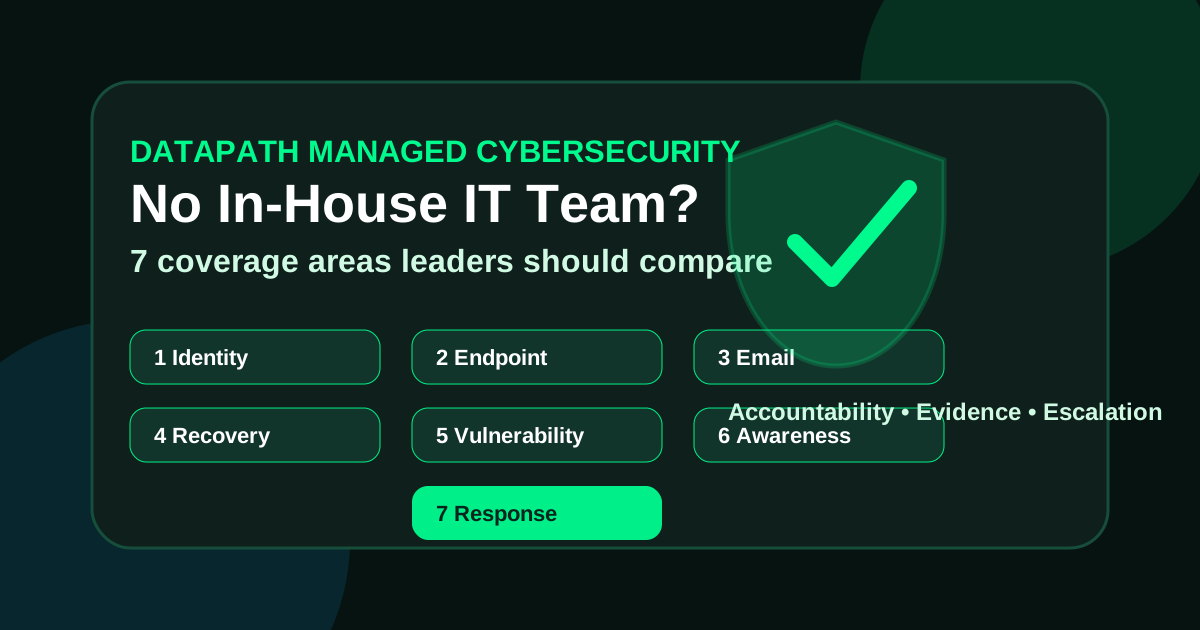

Can you get managed cybersecurity without in-house IT?
Yes. Managed cybersecurity without in-house IT is practical when the provider accepts clear responsibility for daily security operations, escalation, documentation, and leadership reporting. The buyer still owns business decisions, risk acceptance, and vendor oversight, but the provider can run the controls: identity, endpoint protection, email security, backup validation, monitoring, vulnerability follow-up, and incident response coordination.
That answer matters because many growing organizations are stuck between two bad options. They are too complex to rely on antivirus, a firewall, and an overloaded office manager, but not large enough to hire a full internal security team. Healthcare clinics, school districts, municipalities, professional services firms, and 100-plus-employee businesses often need security evidence before they can justify a permanent internal hire.
CISA has warned that managed service providers and their customers both need transparent discussions about security responsibilities, privileged access, monitoring, backups, and incident notification.1 NIST CSF 2.0 frames cybersecurity as a full operating cycle: govern, identify, protect, detect, respond, and recover.2 For a company without in-house IT, that means a managed cybersecurity provider has to cover the operating cycle, not merely install tools.
At Datapath, we usually recommend comparing managed cybersecurity options by accountability first and products second. A tool list is easy to buy. A defensible operating model is harder to fake.
Which managed cybersecurity options fit teams with no internal IT?
The best managed cybersecurity option depends on the gap you are actually trying to close. A company with no internal IT usually needs several layers, but the order should follow risk: privileged access first, then endpoint and email protection, then monitoring, backup resilience, vulnerability remediation, user training, and response planning.
Use this listicle as a buyer’s map. It is not a promise that every provider packages these services the same way. It is the set of functions we would expect leadership to evaluate before trusting an outside team with sensitive systems.
| Option | Best fit | What the provider must own | Evidence to request |
|---|---|---|---|
| 1. Identity security management | Microsoft 365, VPN, cloud apps, privileged accounts | MFA, access reviews, admin roles, conditional access, offboarding | Admin inventory, MFA coverage, access review notes |
| 2. Managed endpoint security | Laptops, desktops, servers, remote workers | EDR/MDR tooling, policy tuning, alert escalation, remediation | Device coverage, detections, response notes |
| 3. Managed email and phishing defense | Email-heavy teams, finance workflows, executives | Anti-phishing policies, user reporting, impersonation controls | Message trace notes, policy exports, simulation metrics |
| 4. Backup and recovery oversight | Ransomware-risk or regulated environments | Backup monitoring, restore testing, recovery evidence | Restore logs, backup scope, RTO/RPO notes |
| 5. Vulnerability and patch management | Aging infrastructure, compliance pressure, cyber insurance | Scan review, patch follow-up, exceptions, prioritization | Vulnerability reports, SLA tracking, exception register |
| 6. Security awareness and user coaching | Teams with phishing, social engineering, or risky workflows | Training cadence, phishing simulations, report-button workflow | Completion rates, campaign data, follow-up actions |
| 7. Incident response coordination | Leadership teams that need calm during security events | Severity triage, containment steps, vendors, communications | Incident plan, escalation matrix, post-incident report |
No in-house IT security team?
Datapath can help you compare managed cybersecurity coverage, identity controls, backup resilience, and response ownership before risk turns into a crisis.
1. Identity security management
Identity is the first managed cybersecurity option to evaluate because most modern attacks start with access. If an attacker gets into email, Microsoft 365, VPN, remote management, or a privileged vendor account, the rest of the security stack has to work uphill.
For organizations without in-house IT, identity security should include:
- MFA enforcement for administrators, remote access, email, and critical cloud applications
- privileged-account inventory and emergency access review
- conditional access or equivalent policy enforcement where supported
- joiner, mover, and leaver workflows for employee changes
- quarterly access reviews for executives, finance, HR, and system administrators
- vendor and service-account review
CISA’s MSP guidance specifically calls out MFA for MSP accounts that access customer environments and recommends contract language requiring MFA on the services received.1 That is blunt guidance, and it is correct. If a provider wants privileged access to your environment, MFA and role control are not optional polish.
Datapath connects this work to managed IT services and Microsoft 365 identity security services because identity is both a support issue and a security issue. Password resets, new hires, terminated users, shared mailboxes, vendors, and emergency access all need the same owner.
2. Managed endpoint security
Endpoint security covers laptops, desktops, servers, and the tools used to detect suspicious activity on those systems. Without internal IT, endpoint management cannot stop at installing software. Someone has to confirm the agent is deployed, policies are current, alerts are reviewed, and remediation actually happens.
A useful managed endpoint security service should answer:
- Which devices are covered and which are missing?
- Are servers, shared workstations, and remote laptops included?
- Who responds when EDR flags malicious behavior?
- What happens if a device is offline, unmanaged, or repeatedly infected?
- How are executives and high-risk users handled differently?
The trap is buying endpoint protection as a standalone subscription. That can create a false sense of coverage. A dashboard is not a response process. For no-in-house-IT teams, managed cybersecurity services should include alert ownership, containment steps, documentation, and escalation rules.
For broader buyer context, compare this section with our managed cybersecurity service package checklist and our managed cybersecurity services. Those pages explain why traditional antivirus alone is too thin for organizations that need evidence, not just software.
3. Managed email and phishing defense
Email remains one of the easiest ways to reach employees, finance teams, executives, vendors, and clients. If your organization lacks internal IT, phishing defense must include policy configuration and user workflow, not just a gateway filter.
A strong managed email security option should include:
- SPF, DKIM, and DMARC review where appropriate.
- Anti-phishing policy tuning in Microsoft 365 or the email security platform.
- Impersonation protection for executives, finance, HR, and vendor-payment workflows.
- A simple suspicious-email reporting process.
- Triage of reported messages and user feedback.
- Follow-up training based on real patterns.
This is where security awareness and technical controls intersect. A user who reports a suspicious email needs a response path. An executive impersonation attempt should feed policy tuning. A business email compromise scare should trigger identity review, mailbox rule review, and payment-process review.
If phishing is the driver, start with Microsoft 365 phishing protection services and our practical guide to Microsoft 365 phishing protection best practices. Datapath can connect those controls back into the broader Datapath managed security operating model.
4. Backup and recovery oversight
Backups are part of cybersecurity because ransomware turns recovery into the real test. A company without in-house IT should not accept “backup jobs are green” as proof of resilience. The useful question is whether the provider can restore critical data, prove the restore worked, and explain the recovery sequence under pressure.
CISA’s StopRansomware guidance points organizations toward backup integrity, recovery planning, and third-party risk review; its MSP advisory also tells customers to make backup and disaster recovery requirements explicit in provider contracts.13 That matters because ransomware actors often target recovery paths, not just production files.
A managed backup and recovery option should document:
- critical systems and data sources covered
- backup frequency, retention, and administrative access
- immutable, isolated, or otherwise protected copies where appropriate
- restore testing cadence
- recovery time and recovery point expectations
- evidence captured during restore tests
- escalation path when backups fail
For healthcare, finance, government, and K-12 environments, we recommend pairing backup oversight with disaster recovery services and a written recovery test plan. Our disaster recovery testing checklist shows the level of evidence executives should expect.
5. Vulnerability and patch management
Vulnerability management is where many no-in-house-IT models break down. A scan report is not remediation. The provider needs authority, process, and reporting discipline to turn findings into patched systems, accepted exceptions, or funded projects.
A practical managed vulnerability program should include:
- asset inventory and scan scope
- severity ranking based on exposure and business criticality
- patching cadence and emergency patch process
- exception handling when systems cannot be patched quickly
- third-party application update ownership
- firewall, VPN, server, endpoint, and cloud configuration review
- executive reporting that explains open risk in plain language
NIST CSF 2.0 places asset management, risk assessment, platform security, continuous monitoring, response, and recovery inside one framework.2 That is the right lens. Vulnerability management touches all of those functions. If nobody owns assets, nobody can honestly prioritize fixes.
Datapath’s cybersecurity risk assessment services and our guide to building a vulnerability management program are useful next steps when the environment has known technical debt, unsupported systems, or cyber-insurance pressure.
6. Security awareness and user coaching
For organizations without internal IT, employees often become the first and last line of detection. They see suspicious email, odd login prompts, vendor payment changes, fake browser updates, and weird computer behavior before anyone else does.
Security awareness training should not be treated as a once-a-year compliance video. A managed program should include onboarding, recurring refreshers, phishing simulations, targeted coaching, executive reporting, and a route for users to report suspicious messages or activity.
A useful provider will show:
- who completed training
- which roles need targeted content
- what phishing simulations revealed
- how reported messages were handled
- what policy or technical control changed because of user reports
- what leaders should reinforce in staff meetings
For teams with no internal IT, this is less about blaming users and more about creating a feedback loop. User reports should improve email policies, identity controls, endpoint response, and incident playbooks. If the managed provider cannot connect awareness data to technical follow-up, the program is too shallow.
Review Datapath’s security awareness training services if your team needs a documented cadence with metrics and follow-through.
7. Incident response coordination
Incident response is the option buyers forget until the bad day arrives. Without in-house IT, the question is not “Who has an incident response plan?” It is “Who will answer, triage, contain, coordinate vendors, preserve evidence, brief leadership, and document what happened?”
The FTC Safeguards Rule is written for financial institutions, but its incident response elements are broadly useful: clear goals, internal processes, roles, responsibilities, communications, weakness remediation, documentation and reporting, and a post-event review.4 Those are the exact mechanics no-in-house-IT teams need from a provider.
A managed incident response coordination model should define:
| Response element | What leadership should verify |
|---|---|
| Severity triage | Who decides whether an event becomes an incident? |
| Authority | Who can isolate a device, disable an account, or block network access? |
| Vendor coordination | Who contacts cyber insurance, legal, EHR, ERP, ISP, Microsoft, or other vendors? |
| Communications | Who updates executives, employees, customers, regulators, or public stakeholders? |
| Evidence | Where logs, screenshots, tickets, and decisions are preserved? |
| Recovery | Who confirms systems are safe to restore? |
Datapath’s incident response retainer services help define those responsibilities before an event. That preparation matters more than heroic improvisation.
How should buyers compare providers when they have no security team?
Buyers should compare providers by operating responsibility, not by logo sheets. If you have no in-house IT, the provider’s proposal must explain who owns decisions, actions, reporting, and evidence across the full security lifecycle.
Ask these questions before signing:
- Which security functions are fully managed, and which are advisory only?
- Who has privileged access, and how is that access reviewed?
- What MFA, logging, and monitoring requirements apply to provider accounts?
- Which systems are excluded from coverage?
- What response actions can the provider take without waiting for approval?
- What reports will leadership receive monthly or quarterly?
- How are unresolved vulnerabilities, failed backups, missing agents, and risky exceptions escalated?
- How does the provider coordinate with insurance, legal, SaaS vendors, cloud platforms, and line-of-business systems?
- What contract language defines incident notification, backup expectations, and service-provider monitoring?
CISA’s MSP advisory is explicit that MSPs have trusted connectivity and privileged access into customer systems, and that customers should understand security responsibilities and contractual commitments.1 That is why procurement should involve leadership, not only whoever inherited the technology function.
Why Datapath for managed cybersecurity without in-house IT
Managed cybersecurity without in-house IT works when the provider can combine technical execution with operational accountability. The seven options above are not isolated products; they are a connected operating model for identity, endpoint, email, recovery, vulnerabilities, awareness, and response.
Datapath supports regulated and mid-market organizations that need security to be measurable, documented, and tied to business continuity. If your organization needs help comparing coverage, review our managed cybersecurity services, co-managed IT services, and managed IT services models, then talk with our team about the right ownership structure.
Need cybersecurity coverage without hiring an internal team?
Datapath can help define the managed cybersecurity model, response rules, reporting cadence, and evidence package your leadership can actually govern.
Frequently Asked Questions
Can a company outsource cybersecurity without having in-house IT?
Yes. A company can outsource cybersecurity without in-house IT if the provider has clear authority for monitoring, remediation, escalation, documentation, and incident coordination. Leadership still owns business risk decisions, but the managed provider can operate the controls day to day.
What should managed cybersecurity include for a company with no IT department?
It should include identity security, endpoint protection, email defense, backup validation, vulnerability management, security awareness, incident response coordination, reporting, and vendor escalation. The exact scope should be written into the agreement so there is no confusion during an incident.
Is managed cybersecurity the same as managed IT?
No. Managed IT usually covers daily support, systems administration, devices, cloud applications, vendors, and infrastructure operations. Managed cybersecurity focuses on reducing, detecting, responding to, and documenting security risk. In practice, teams without internal IT often need both because support workflows and security controls overlap.
Who is responsible if a managed cybersecurity provider handles our security?
The provider can be responsible for assigned operational tasks, but the business retains responsibility for governance, risk acceptance, budget decisions, and provider oversight. Contract language should define authority, notification expectations, evidence, exclusions, and escalation paths.
What is the first cybersecurity service to buy with no in-house IT?
Start with an assessment of identity, endpoints, email, backups, vulnerabilities, and incident response responsibilities. If you need a single first control area, prioritize identity security and MFA because compromised accounts are a common path into cloud, email, remote access, and administrative systems.
How do we know whether a managed cybersecurity provider is doing the work?
Ask for recurring evidence: MFA coverage, endpoint coverage, alert summaries, vulnerability remediation status, backup restore tests, training metrics, access review results, and incident or escalation records. If the provider cannot show evidence, leadership cannot govern the service.
Sources
Footnotes
-
CISA, “Protecting Against Cyber Threats to Managed Service Providers and their Customers.” ↩ ↩2 ↩3 ↩4
-
CISA, “StopRansomware Guide.” ↩
-
Federal Trade Commission, “FTC Safeguards Rule: What Your Business Needs to Know.” ↩
