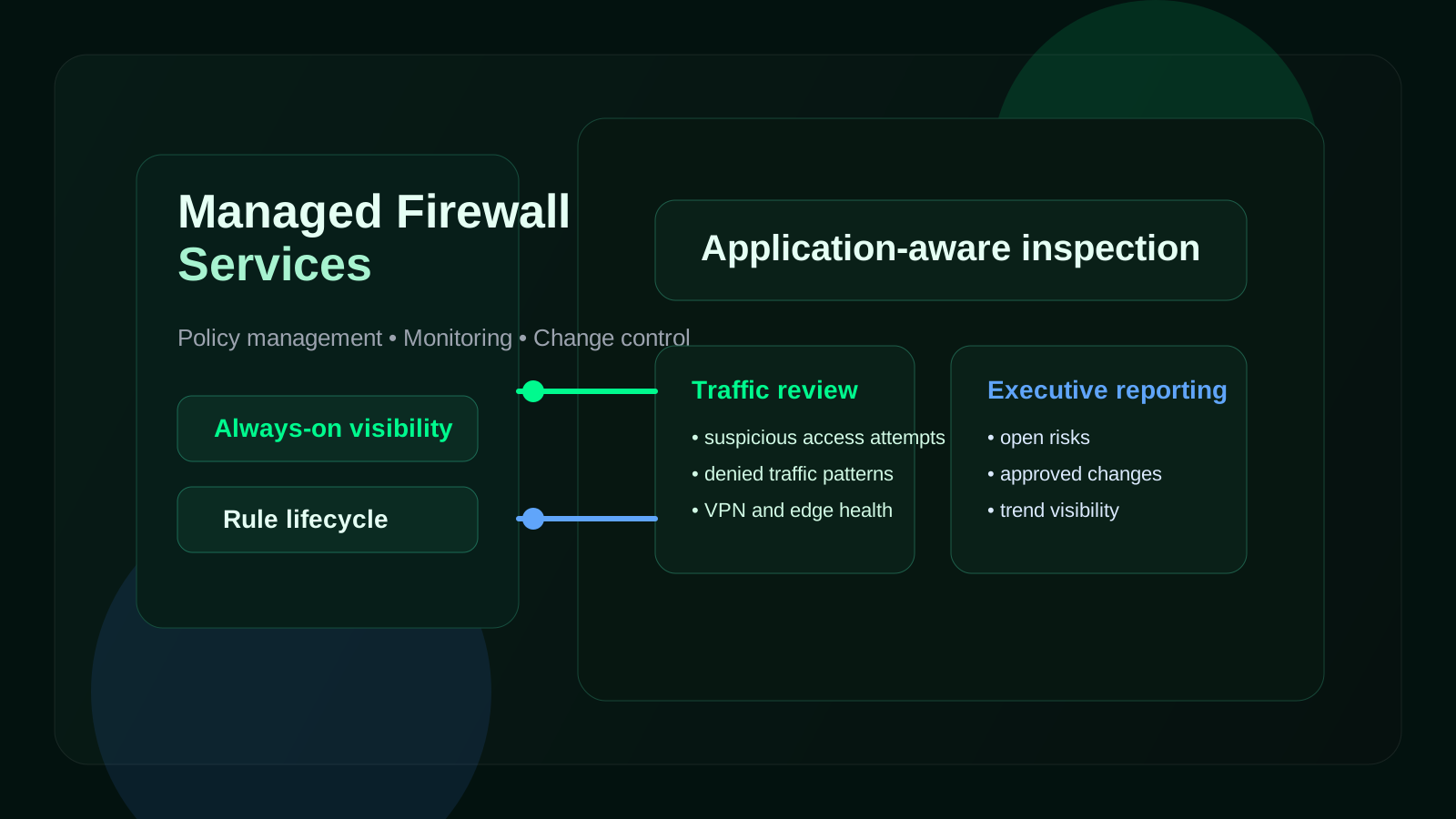

What are managed firewall services?
Managed firewall services are outsourced firewall operations for business networks: firewall policy, rule changes, health and security monitoring, firmware, backups, VPN or ZTNA access, logging, reporting, and escalation. A strong managed firewall service gives one accountable provider ownership for firewall security, rule governance, evidence, and response workflow—not just occasional appliance administration.
For buyers comparing managed firewall services, firewall management services, managed firewall security services, managed firewall solutions, or a managed firewall service provider, the practical answer is simple: choose a provider that can prove written scope, recurring rule review, monitoring ownership, emergency-change authority, and useful reporting before contract signature.
| Search phrase | What the buyer should verify first |
|---|---|
| managed firewall services | Included scope for policy, monitoring, maintenance, reporting, and escalation |
| firewall management services | Rule-change workflow, backups, firmware planning, object cleanup, and health checks |
| managed firewall security services | Log review, suspicious-traffic escalation, MDR handoff, segmentation, and evidence |
| managed firewall service provider | Named owners, response authority, onboarding steps, sample reports, and pricing assumptions |
| managed firewall solutions | Fit across offices, cloud networks, remote access, compliance needs, and existing IT operations |
For a fast shortlist, ask every managed firewall provider for five proofs before you book a technical call:
- a written scope for rules, VPNs, tunnels, logs, firmware, backups, sites, and cloud firewall policies
- a sample firewall management report showing open risks, changes, stale-rule cleanup, and escalation history
- a first-90-days cleanup plan for risky rules, exposed services, objects, remote access, and logging gaps
- pricing assumptions for devices, sites, HA pairs, log volume, support hours, compliance evidence, and exclusions
- response authority that says who can block traffic, roll back rules, escalate to MDR, or approve emergency changes
If your search is simply managed firewall services or firewall management services, do not settle for a result that only explains firewall hardware. The buying decision is whether a provider will own recurring firewall operations: rule governance, monitoring, emergency changes, documentation, reporting, and escalation. That is the difference between a managed firewall service provider and a technician who occasionally changes rules.
That distinction matters in 2026 because the edge of the network is still one of the most exposed parts of the business. The Verizon 2026 DBIR reports that 31 percent of breaches now start with software vulnerabilities, which means exposed systems, unpatched services, VPNs, firewalls, remote access paths, and poorly governed internet-facing infrastructure deserve executive attention.1 NIST’s firewall guidance also frames firewall work as policy, configuration, testing, deployment, and management, not just hardware selection.2
In plain English: a firewall managed service should keep access decisions current, visible, and defensible. It should answer questions like:
- Which inbound and outbound rules are still needed?
- Who approved vendor, VPN, or remote access exceptions?
- Are risky rules reviewed and cleaned up?
- Are firmware, backups, and health checks current?
- Are firewall logs reviewed by people who know what matters?
- Does suspicious activity reach the right response team quickly?
If the provider cannot answer those questions, the service is probably closer to break-fix firewall support than true managed firewall security services.
For buyers scanning search results, the short answer is this: choose managed firewall services when you need accountable people to govern rules, monitor events, document changes, maintain the platform, and escalate security findings. Choose basic firewall support only when you need occasional configuration help. That difference should be obvious in the provider’s title, scope, reporting sample, and first-90-days plan before you book a sales call.
If you are already comparing providers and need a service-level view, start with Datapath’s managed firewall services page before you shortlist platforms or pricing models. The service page is the faster path if your team needs managed firewall security coverage, implementation help, recurring rule review, or provider accountability.
Need managed firewall security services with clear ownership?
Datapath helps regulated and mid-market teams review firewall policy, remote access, monitoring, escalation, and reporting before risky exceptions turn into incidents.
Managed firewall services checklist for quick comparison
A strong managed firewall service should make these responsibilities explicit before contract signature. This is the minimum checklist for buyers comparing managed firewall services, firewall management services, managed firewall security services, and managed firewall solutions:
- Scope: which firewalls, sites, HA pairs, cloud policies, VPNs, tunnels, and switching handoffs are covered.
- Rule governance: how new rules are approved, documented, reviewed, cleaned up, and tied to business purpose.
- Monitoring: who reviews firewall health, suspicious traffic, VPN anomalies, exposed services, and log gaps.
- Maintenance: how firmware, backups, high availability, license renewals, and lifecycle work are planned.
- Response authority: who can block traffic, disable access, roll back changes, or escalate to MDR during an incident.
- Reporting: whether leadership receives risks, decisions, changes, and evidence—not only ticket counts.
- 90-day cleanup: what the provider will inventory, fix, document, and report during onboarding.
Use that checklist to separate true managed firewall security services from generic firewall administration.
Are firewall management services the same as managed firewall services?
Firewall management services usually refer to the administrative work of keeping firewall rules, objects, firmware, backups, VPN settings, and availability healthy. Managed firewall services should include that administration plus a broader operating model: recurring policy review, security monitoring, alert escalation, reporting, compliance evidence, and coordination with managed IT, MDR, identity, endpoint, and backup teams.
For page-two buyers comparing terms like firewall management services, managed firewall service, firewall managed services, and managed firewall solutions, the practical test is simple: ask whether the provider only changes rules on request or actively owns firewall risk reduction over time. Datapath’s managed firewall services page shows how that recurring ownership connects to managed cybersecurity services and broader managed IT services.
A firewall management services scope should be explicit about the daily operating work, not hidden behind a generic “managed security” label. Before comparing quotes, confirm whether the monthly service includes rule-change workflow, stale-rule review, object cleanup, firmware planning, backup validation, VPN or ZTNA administration, log review, alert escalation, and executive-ready reporting. If those responsibilities are missing or treated as separate projects, the offer may be basic firewall support rather than a managed firewall service.
Use the distinction this way when shortlisting providers:
| Query buyers use | What they probably need | Provider proof to request |
|---|---|---|
| managed firewall services | Ongoing ownership for firewall policy, monitoring, maintenance, reporting, and escalation | A written scope showing included devices, sites, rule reviews, firmware work, logs, reports, and response paths |
| firewall management services | Reliable administration of rules, objects, VPN settings, backups, updates, and health | Change-control records, backup validation, firmware cadence, and stale-rule cleanup evidence |
| managed firewall service provider | An accountable outside team, not only a firewall product | Named service owners, escalation authority, onboarding steps, reporting samples, and first-90-days plan |
| managed firewall solutions | A firewall operating model that fits sites, cloud, remote access, compliance, and MDR handoffs | Platform-fit rationale plus proof the provider can coordinate identity, endpoint, network, and incident-response workflows |
When should a managed firewall guide become a service conversation?
Use a guide while you are defining the category. Talk with a managed firewall service provider when your team already needs recurring policy review, managed firewall security, next-gen firewall managed services, VPN or ZTNA governance, log review, after-hours escalation, or multi-site firewall management. At that point, the buying decision is about operating ownership, not firewall terminology.
| Search intent | What it usually means | Best next step |
|---|---|---|
| managed firewall security | The buyer wants risk reduction, monitoring, and governance, not only device administration | Compare a service model that owns policy review, alert triage, and reporting |
| manage firewall services | The team is ready to delegate recurring firewall operations | Define who owns rule changes, firmware, backups, VPN changes, and emergency authority |
| managed firewall security services | The buyer is comparing providers by security outcomes and service scope | Review whether monitoring, escalation, and compliance evidence are included |
| managed firewall and switching infrastructure | Firewall policy needs to coordinate with switches, VLANs, branch networks, routing, and segmentation | Confirm the provider can manage firewall changes without breaking internal network paths |
| managed network & firewall services | The buyer wants one operating model for network access, switching, VPN/ZTNA, monitoring, and firewall security | Ask how network and firewall responsibilities are divided, documented, and escalated |
| managed service firewalls | The buyer is using a provider-style phrase for managed firewall operations | Compare providers by ownership, evidence, response authority, and recurring rule review |
| managed firewall IT service | Firewall operations need to connect with help desk, identity, endpoint, cloud, and backup workflows | Confirm the provider can coordinate across broader managed IT responsibilities |
| what are managed firewall service providers? | The researcher needs a plain-English definition before shortlisting vendors | Look for providers that explain ownership, response, maintenance, and reporting clearly |
| how does a managed firewall work | The researcher needs the operating model, not only a product definition | Look for policy governance, monitoring, changes, maintenance, escalation, and reporting |
| managed firewall meaning | The buyer needs a simple definition before deciding whether to compare providers | Start with the definition below, then use the scope and provider tables to compare services |
| next-gen firewall managed services | The buyer needs NGFW capabilities operated with discipline | Ask how application-aware policy, segmentation, and threat-prevention tuning are reviewed |
| leading firewalls for multi-site management | The buyer is comparing platform fit across branches, cloud edges, VPNs, and remote users | Evaluate both the firewall platform and the provider’s multi-site operating model |
If any of those rows sounds like your current project, move from research to a provider conversation. Datapath’s managed firewall security services page explains the operating model, service scope, FAQs, and related security handoffs in one place.
What should managed firewall services include?
A serious managed firewall service should include administration, rule review, monitoring, maintenance, reporting, and response workflow. At minimum, buyers should see the included firewall management services in plain language before signing: which devices, sites, tunnels, logs, change windows, reports, and after-hours escalations are covered, and which work is billed separately.
| Service area | What it should include | Conversion question to ask |
|---|---|---|
| Firewall administration | Policy objects, rule changes, NAT, routing support, VPN or ZTNA settings, and backups | Who owns each recurring task and each emergency change? |
| Policy review | Rule hygiene, stale-object cleanup, least-privilege review, risky exposure checks, and business-purpose documentation | How often are rules reviewed, and what evidence do we receive? |
| Monitoring | Health, availability, blocked traffic patterns, suspicious connections, geolocation anomalies, and VPN usage trends | Who reviews alerts after hours and what triggers escalation? |
| Maintenance | Firmware planning, release review, backup validation, HA checks, licensing review, and lifecycle planning | How are updates scheduled without creating downtime? |
| Reporting | Executive summary, open risks, change history, incident notes, and recommended improvements | Will leadership see decisions, not just logs? |
| Response handoff | Clear escalation to internal IT, MDR, incident response, vendors, or Datapath support | Who can contain or change policy during an incident? |
Modern firewalls are not just port filters. Palo Alto Networks describes next-generation firewalls as controls that identify applications, users, and content so policy can be more precise than ports and protocols alone.3 Microsoft describes Azure Firewall as a stateful firewall-as-a-service with cloud-native scalability and centralized policy management through Azure Firewall Manager.4 Those capabilities are useful only when someone operates them with discipline.
That is why managed next generation firewall services should be evaluated by operating model first and platform second.
How does a managed firewall work?
A managed firewall works by giving an accountable provider or service team recurring ownership for firewall policy, access changes, monitoring, updates, backups, reporting, and escalation. The firewall still enforces network policy, but the managed service defines who reviews rules, who approves changes, who responds to suspicious traffic, and how leadership sees the results.
The operating cycle usually looks like this:
| Managed firewall step | What should happen |
|---|---|
| Baseline | Inventory firewalls, switches, VLANs, VPNs, tunnels, cloud firewalls, admins, backups, logs, and exposed services |
| Govern policy | Review allow rules, NAT, VPN access, vendor exceptions, segmentation, and business purpose |
| Monitor | Watch health, availability, blocked traffic, VPN activity, suspicious connections, and logging gaps |
| Maintain | Plan firmware, backups, HA checks, license reviews, lifecycle work, and change windows |
| Escalate | Route urgent events to internal IT, MDR, incident response, vendors, or Datapath support |
| Report | Summarize changes, risky exceptions, open decisions, response notes, and roadmap items |
That is the practical managed firewall meaning: the organization is not only buying or hosting a firewall. It is assigning durable ownership for the firewall control.
What about managed firewall and switching infrastructure?
Managed firewall and switching infrastructure work should be coordinated because firewall policy often depends on the internal network path. VLANs, trunks, routing, wireless networks, branch switches, IoT segments, guest networks, server networks, and site-to-site links can all affect whether a firewall rule actually protects the business.
For managed network and firewall services, confirm who owns:
| Network and firewall area | Why it matters |
|---|---|
| VLAN and subnet design | Firewall rules only work when segments and routes match the intended access model |
| Switch uplinks and trunks | Misconfigured trunks can bypass segmentation or create outages during firewall changes |
| Routing and NAT | Users, vendors, cloud networks, and branch offices need predictable paths and rollback plans |
| VPN and ZTNA access | Remote access should align with identity, device posture, and least-privilege policy |
| IoT, BAS, and guest networks | Non-staff devices should not have broad access to staff, server, clinical, student, or finance systems |
| Logging and monitoring | Firewall events need enough network context to support investigation and reporting |
If a provider manages firewalls but cannot coordinate with switching, wireless, routing, or identity teams, every policy change can become slower and riskier. Datapath’s managed firewall services connect firewall operations with managed IT, cybersecurity, network segmentation, and escalation workflows so the control works in the real environment.
How is a managed firewall different from firewall-as-a-service?
Managed firewall services describe who operates the firewall and how accountability works. Firewall-as-a-service describes one possible delivery model, usually cloud-delivered inspection and policy enforcement. A managed firewall provider may manage physical appliances, virtual firewalls, cloud-native firewalls, SASE/SSE components, or FWaaS platforms.
For buyers, the practical question is not which acronym sounds newer. The better question is whether the service model matches the traffic patterns your organization actually has.
| Environment | Likely firewall model | What the provider must prove |
|---|---|---|
| Single office | Physical or virtual NGFW | Rule hygiene, remote access controls, firmware discipline, and outage response |
| Multi-site business | Centralized NGFW management, SD-WAN security, or cloud-managed firewall | Consistent policy across locations and clean site-to-site change control |
| Hybrid cloud | On-premises firewall plus Azure, AWS, or cloud-native firewall policy | Visibility across north-south and east-west traffic |
| Remote workforce | VPN, ZTNA, SASE, or FWaaS | Identity-aware access, device posture, logging, and rapid user offboarding |
| Regulated organization | NGFW plus documented control evidence | Audit-ready reporting tied to HIPAA, CJIS-adjacent needs, FTC Safeguards, SOC 2, CMMC, or cyber insurance |
The strongest provider should be able to explain where the firewall ends, where identity or endpoint controls begin, and how events move into broader managed cybersecurity services.
Why do managed firewall services matter now?
Managed firewall services matter because many organizations have more exposure than their operating model can support. The firewall may be installed, licensed, and technically capable, but rule changes may still live in old tickets, exceptions may be undocumented, firmware windows may be delayed, and logs may be ignored unless something breaks.
That creates three problems.
Policy drift grows quietly
Firewall drift rarely looks dramatic at first. It looks like old VPN users, vendor access that was supposed to be temporary, overly broad allow rules, stale NAT entries, inconsistent site policies, and emergency changes that never get reviewed. Each item feels small. Together, they make the environment harder to secure and harder to troubleshoot.
NIST SP 800-41 is still relevant because it treats firewall policy as a lifecycle: select, configure, test, deploy, and manage.2 A managed firewall provider should give that lifecycle an owner.
Attackers target exposed systems faster
The 2026 DBIR’s software-vulnerability finding is a useful executive signal: internet-facing infrastructure must be maintained with urgency, not treated as background work.1 A firewall managed service cannot patch every business application by itself, but it should reduce avoidable exposure by keeping edge devices current, reviewing access paths, and coordinating with vulnerability remediation.
That includes:
- firmware and security-update planning
- exposed service review
- VPN and remote-access cleanup
- inbound rule review
- segmentation adjustments after risk findings
- escalation when logs show repeated probing or suspicious traffic
Compliance evidence depends on operations
Compliance frameworks increasingly expect evidence that controls are governed. NIST CSF 2.0 helps organizations manage cybersecurity risk through functions like Govern, Identify, Protect, Detect, Respond, and Recover.5 CIS Controls v8.1 also emphasizes a prioritized set of safeguards mapped to multiple legal, regulatory, and policy frameworks.6
For firewall management, that means the provider should not only say “the firewall is configured.” It should produce evidence of policy review, change approval, logging, access control, segmentation decisions, and response follow-through.
What should buyers compare before choosing a provider?
Do not compare managed firewall service providers only by the firewall brand they support. Compare the operating details that determine whether the service will actually reduce risk.
| Evaluation area | Weak answer | Strong answer |
|---|---|---|
| Scope | ”We manage firewalls." | "We manage policy, firmware, backups, HA health, VPN/ZTNA changes, log review, reporting, and escalation.” |
| Change control | ”Submit a ticket." | "Every change has requester, approver, business purpose, implementation notes, rollback plan, and later cleanup review.” |
| Monitoring | ”Alerts are forwarded." | "Alerts are triaged, correlated with context, escalated by severity, and summarized in reporting.” |
| Rule review | ”As needed." | "Rules are reviewed on a defined cadence with stale, risky, broad, and duplicate policies identified.” |
| Response authority | ”We notify you." | "The runbook defines who can block, isolate, roll back, escalate, and communicate during an incident.” |
| Reporting | ”Monthly ticket report." | "Leadership receives open risks, changes, trends, decisions needed, and roadmap items.” |
| Pricing | ”Flat monthly fee." | "Pricing lists included devices, sites, tunnels, users, logs, projects, after-hours coverage, and exclusions.” |
This is where buyers should slow down. The cheapest quote can become expensive if it excludes rule cleanup, managed firewall implementation, after-hours support, MDR handoff, cloud firewall policy, compliance reporting, or project work.
How should you choose a managed firewall service provider?
Choose a managed firewall service provider by matching the provider’s operating model to the risk your firewall is supposed to control. The right partner should prove how it handles implementation, rule review, monitoring, emergency changes, cloud and branch policy, reporting, and escalation before you sign. Tool support matters, but accountability matters more.
This is the section to use when comparing proposals that all sound similar. Many providers can say they offer firewall management services. Fewer can show how a firewall managed service is implemented, governed, measured, and improved.
| Buyer intent | What the provider should prove | Why it affects outcomes |
|---|---|---|
| Managed firewall service provider | Named owners for policy, alerts, changes, firmware, backups, and reporting | Prevents the service from becoming generic device support |
| Firewall management services | Recurring rule review, stale-object cleanup, configuration backups, and approval history | Reduces policy drift and undocumented exceptions |
| Managed next generation firewall services | Application-aware policy, threat-prevention tuning, VPN/ZTNA governance, and log review | Turns NGFW features into governed controls |
| Managed firewall implementation | Discovery, migration plan, rollback process, maintenance windows, and post-cutover validation | Lowers outage risk during onboarding or provider transition |
| Managed firewall solutions | Fit across offices, cloud networks, remote users, compliance evidence, and MDR handoff | Keeps the firewall aligned with how the business actually works |
For a serious shortlist, ask each managed firewall service provider to describe the first 90 days in detail. If the answer jumps straight to licensing or brand preference, the proposal may be missing the operational discipline that makes managed firewall security services valuable. When you need the provider version instead of the educational guide, use Datapath’s managed firewall services provider page to compare scope, implementation, monitoring, segmentation, and reporting in one place.
What should buyers request before choosing managed firewall services?
Before choosing managed firewall services, request a written service scope, onboarding checklist, sample report, pricing assumptions, escalation matrix, and rule-review cadence. Those six items usually reveal whether the provider is selling true managed firewall security services or a thin firewall management services package.
| Buyer request | Why it improves provider fit |
|---|---|
| Written scope | Confirms which firewalls, sites, VPNs, tunnels, cloud policies, switches, logs, and users are included |
| Onboarding checklist | Shows how the provider will inventory rules, objects, exposures, backups, firmware, admins, and logging gaps |
| Sample report | Proves whether reporting covers risk, cleanup, decisions, and evidence instead of generic ticket counts |
| Pricing assumptions | Prevents surprises around HA pairs, after-hours work, compliance reporting, log volume, emergency changes, and projects |
| Escalation matrix | Defines who can approve, block, roll back, isolate, or escalate during suspicious activity or downtime |
| Rule-review cadence | Forces stale, broad, duplicate, temporary, and vendor rules into recurring cleanup instead of permanent drift |
If a provider cannot produce those items, keep looking or narrow the engagement to basic firewall support. A real managed firewall service should make operating ownership visible before the contract starts.
What pricing variables affect managed firewall services?
Managed firewall pricing usually depends on the number of devices, sites, VPNs, cloud networks, log volume, support hours, compliance needs, and whether the provider is only administering the firewall or also coordinating detection and response.
| Pricing variable | Why it changes cost | What to confirm |
|---|---|---|
| Number of firewalls | More devices mean more policy, backup, update, and HA work | Are HA pairs counted as one environment or two devices? |
| Number of sites | Multi-site policy needs standardization and change coordination | Are branch-office changes included or billed as projects? |
| VPN/ZTNA users and tunnels | Remote access adds identity, device, and support complexity | Are user adds, removals, and tunnel changes included? |
| Log retention and SIEM/MDR handoff | Security value depends on usable telemetry | Are logs retained, reviewed, and routed to MDR when needed? |
| Firmware and lifecycle work | Updates require planning and downtime coordination | Are emergency updates and planned upgrades covered? |
| Compliance reporting | Regulated buyers need evidence, not just support tickets | What reports map to audit, insurance, or board needs? |
| After-hours response | Coverage expectations change staffing and escalation | What is the response commitment for urgent events? |
If your organization is also comparing broader managed IT services, ask whether firewall work is included, partially included, or sold as a separate security service. Many MSP contracts include basic firewall support but do not include formal policy review, proactive monitoring, or security reporting.
What should happen in the first 90 days?
The first 90 days should produce clarity fast. A managed firewall service should not wait until the first incident to learn the environment.
| Timeline | Provider actions | Buyer outcome |
|---|---|---|
| Days 1-15 | Inventory firewalls, policies, VPNs, tunnels, licensing, firmware, backups, admin access, and logging paths | You know what exists and what is missing |
| Days 16-30 | Review risky rules, stale objects, exposed services, remote access, vendor access, and segmentation gaps | You get a prioritized cleanup list |
| Days 31-60 | Establish change workflow, escalation contacts, backup cadence, maintenance windows, and reporting format | Everyone knows how firewall decisions will be made |
| Days 61-90 | Complete high-priority cleanup, tune monitoring, test restore/rollback process, and deliver executive report | Leadership sees risk reduction and remaining decisions |
Datapath’s bias is to make this operational, not theoretical. A good 90-day plan should leave the business with cleaner policy, clearer ownership, and fewer unknowns. It should also connect the firewall to related priorities like cybersecurity risk assessments, NGFW segmentation, and multi-site firewall coverage.
How do managed firewalls fit with MDR and cybersecurity services?
Managed firewall services are strongest when they are connected to the rest of the security program. A firewall can block, log, and enforce policy, but it should not be the only system involved in detection or response.
The service should define how firewall telemetry reaches:
- MDR or SOC analysts
- endpoint detection and response tools
- identity and Microsoft 365 investigations
- vulnerability remediation workflows
- incident response runbooks
- backup and recovery decisions
- executive reporting
This handoff matters because firewall logs often show part of the story, not the whole story. A suspicious outbound connection may require endpoint investigation. Repeated VPN failures may require identity review. A new exposed service may require vulnerability management. A blocked command-and-control pattern may require incident response.
That is why buyers should evaluate managed firewall services alongside cybersecurity services and broader managed cybersecurity services, not as a disconnected network add-on.
Which organizations get the most value?
Managed firewall solutions usually produce the most value when the organization has real operational complexity but limited internal security bandwidth.
Good-fit organizations often include:
- healthcare practices and clinics protecting PHI and EHR access
- financial services teams with vendor, branch, and data-sharing requirements
- K-12 districts managing campuses, remote access, and student-data protections
- municipal and government-adjacent teams with ransomware and CJIS-adjacent risk
- mid-market businesses with 100 or more employees and lean internal IT
- multi-site organizations that need consistent policy across offices
Very small environments may only need periodic firewall administration. Larger or regulated environments usually need a managed firewall and security service with recurring review, documentation, and escalation.
Why Datapath for managed firewall operations?
Datapath helps regulated and data-sensitive organizations make firewall operations accountable. We connect firewall policy, monitoring, segmentation, remote access, and reporting to the bigger operating model: uptime, incident readiness, compliance evidence, and executive visibility.
That means we do not treat firewall management as a narrow appliance task. We look at how the firewall affects users, vendors, cloud workloads, Microsoft 365, backups, endpoints, and the risk decisions leadership needs to make. For organizations in Modesto, Fresno, Dublin, Irvine, and distributed markets, that local-plus-mature model matters.
If your team is comparing managed firewall security, managed firewall security services, or a provider to manage firewall services, start with a practical review of your current rules, remote access, logging, and escalation paths. Review Datapath’s managed firewall services, then schedule a managed firewall assessment with Datapath. You can also review our cybersecurity services, managed IT services, healthcare IT solutions, and the Datapath home page to see how firewall operations fit into the broader service model.
FAQ: Managed firewall services
What are managed firewall services?
Managed firewall services are outsourced firewall operations. They usually include firewall administration, rule changes, policy review, monitoring, firmware maintenance, backups, VPN or ZTNA support, logging, reporting, and escalation.
What is a firewall managed service?
A firewall managed service is a provider-led operating model for managing firewall policy, health, alerts, updates, and response workflow. The value is accountability over time, not just installation of a firewall product.
What is a managed firewall service provider?
A managed firewall service provider is an outside team responsible for operating firewall policy, monitoring, change control, implementation, reporting, and escalation. The provider should be able to show who owns each task, how changes are approved, and how firewall telemetry connects to broader security response.
How does a managed firewall work?
A managed firewall works by combining firewall policy enforcement with recurring service ownership. The provider reviews rules, processes changes, monitors health and security events, plans updates, validates backups, escalates urgent findings, and reports the decisions leadership needs to see.
What does managed firewall mean?
Managed firewall means the firewall control has an accountable operating owner. The service may involve physical, virtual, cloud, or next-generation firewalls, but the value comes from policy governance, monitoring, maintenance, response handoff, and reporting.
What are managed network and firewall services?
Managed network and firewall services combine firewall operations with the network paths that make policy effective: switching, VLANs, routing, VPN or ZTNA access, wireless, cloud connectivity, logging, and escalation. The provider should clarify which responsibilities are included and which remain with internal IT.
Should managed firewall services include switching infrastructure?
They should at least coordinate with switching infrastructure. Firewall rules, segmentation, VPN access, and branch connectivity often depend on VLANs, trunks, routes, switch uplinks, wireless networks, and site-to-site paths. Without coordination, firewall changes can either fail to reduce risk or accidentally interrupt users.
What are managed service firewalls?
Managed service firewalls are firewall environments operated through a managed service model. Buyers should treat the phrase the same way they would evaluate managed firewall services: confirm scope, ownership, rule review, monitoring, updates, backups, reporting, and escalation authority.
Are firewall management services different from managed firewall services?
The terms often overlap. Firewall management services may describe administration, rule changes, updates, and backups. Managed firewall services should include those tasks plus a broader operating model for monitoring, policy review, reporting, response workflow, and accountability.
Do firewall management services include monitoring?
Firewall management services should include monitoring when the provider is selling a security operating model rather than basic configuration support. Buyers should confirm who reviews firewall health, blocked traffic patterns, VPN activity, suspicious connections, alert severity, escalation timing, and monthly reporting before assuming monitoring is included.
What should a managed firewall service include?
A serious managed firewall service should include policy administration, change control, rule review, stale-object cleanup, firmware planning, backup validation, log review, after-hours escalation, reporting, and documented ownership.
What should firewall management services include?
Firewall management services should include rule-change workflow, configuration backups, firmware planning, VPN or ZTNA administration, object cleanup, log review, alert escalation, and management reporting. If the provider only makes ticket-based rule changes, it is firewall administration, not a complete managed firewall service.
Are managed firewall services the same as managed firewall security services?
They are often used interchangeably, but buyers should verify scope. Some services cover basic firewall administration only. Strong managed firewall security services also connect logs, segmentation, alerts, MDR handoff, and incident response decisions.
Do managed next generation firewall services require a specific NGFW brand?
No. A provider may manage several NGFW platforms. Brand fit matters, but buyers should focus first on operating maturity, policy discipline, reporting, response authority, and whether the provider understands the business environment.
Should managed firewall services include monitoring?
Yes. At minimum, managed firewall services should include firewall health monitoring, log review, suspicious-traffic escalation, VPN or remote-access anomaly checks, and reporting on unresolved risks. Monitoring should connect to MDR, endpoint, identity, backup, and incident-response workflows when an event needs broader investigation.
How much do managed firewall services cost?
Managed firewall services usually cost more when there are more firewalls, sites, VPN users, tunnels, cloud networks, log volume, compliance reporting needs, and after-hours response expectations. Buyers should ask what is included, what is excluded, and how emergency rule changes, firmware projects, and cleanup work are billed.
Can managed firewall services help with compliance?
Yes, when the provider documents policy review, change approval, access control, logging, segmentation decisions, and response activity. The service does not make an organization compliant by itself, but it can produce evidence auditors and insurers often ask to see.
Do managed firewall services replace MDR or a full cybersecurity program?
No. Managed firewall services strengthen one important control. They should feed broader cybersecurity operations that include endpoint security, identity controls, vulnerability management, backups, incident response, and executive risk reporting.
Sources
- Verizon: 2026 Data Breach Investigations Report
- NIST SP 800-41 Rev. 1: Guidelines on Firewalls and Firewall Policy
- Palo Alto Networks: What Is a Next-Generation Firewall?
- Microsoft Learn: What Is Azure Firewall?
- NIST Cybersecurity Framework 2.0
- CIS Critical Security Controls v8.1
- CISA Cybersecurity Performance Goals 2.0