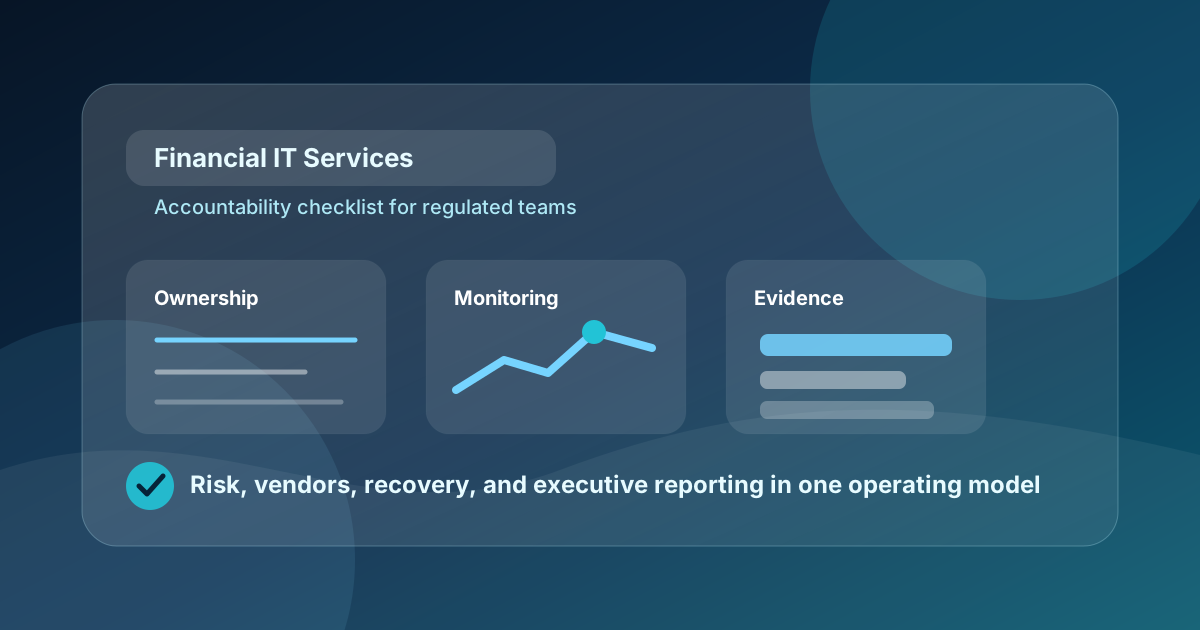

What should accountable financial IT services include?
Financial IT services should give leaders a clear answer to five questions: who owns each critical system, what signal triggers action, how fast the team must respond, what evidence proves the work, and when unresolved risk reaches leadership. That operating discipline matters more than vague promises of unlimited support.
For banks, credit unions, advisors, insurance firms, accounting firms, lenders, and other finance-adjacent teams, technology risk is business risk. Identity gaps, weak vendor controls, cloud misconfiguration, backup uncertainty, and unresolved security findings can become customer-impacting events. The goal is not only to keep systems running; it is to make responsibility visible before a problem becomes an incident, audit finding, or client-confidence issue.
Datapath approaches financial IT as a managed operating model: technical controls, service delivery, documentation, and executive reporting working together. If your team is comparing providers, use this checklist to separate basic helpdesk coverage from accountable financial IT services.
Where do many financial IT programs lose accountability?
Most gaps are not caused by a missing tool. They appear when ownership, timing, and proof are unclear.
| Accountability area | What often goes wrong | What the provider should define |
|---|---|---|
| System ownership | A critical application has a vendor, an internal user, and an MSP involved, but no accountable owner. | Business owner, technical owner, vendor contact, escalation owner, and backup owner. |
| Monitoring | Alerts fire, but nobody can explain which alerts matter or what happens next. | Alert source, severity threshold, triage owner, response window, and closure evidence. |
| Change management | Firewall, identity, SaaS, and endpoint changes are handled through informal messages. | Request path, approval rule, implementation record, rollback plan, and review cadence. |
| Vendor access | Third parties keep persistent access after projects end or staff change. | Access owner, least-privilege scope, expiration date, logging, and periodic review. |
| Audit evidence | Controls exist, but proof is scattered across email, tickets, screenshots, and vendor portals. | Evidence location, retention owner, update frequency, and executive review process. |
A provider that cannot define these mechanics may still close tickets, but it is not giving leadership enough control over operational risk.
How should financial IT services align with compliance expectations?
Regulatory language varies by institution type, but the operating pattern is consistent: safeguard sensitive information, manage cybersecurity risk, document controls, and retain evidence that the program is working.
For covered financial institutions under the FTC Safeguards Rule, the FTC states that the rule requires covered companies to develop, implement, and maintain an information security program with administrative, technical, and physical safeguards designed to protect customer information.1 The eCFR text for 16 CFR Part 314 also describes a written information security program with safeguards appropriate to the institution’s size, complexity, activities, and customer information sensitivity.2
NIST describes the Cybersecurity Framework as a resource for helping organizations understand and improve their management of cybersecurity risk, and NIST CSF 2.0 is built for industry, government, and organizations to reduce cybersecurity risk.3 That makes it a useful structure for translating finance-sector expectations into practical categories such as governance, identity, protection, detection, response, and recovery.
The practical takeaway: do not let compliance live only in policy binders. Tie each requirement to operational evidence: tickets, configuration exports, access review results, backup test records, incident timelines, vendor attestations, approval notes, and executive risk decisions.
What should the first 30 days of financial IT services cover?
The first month should establish visibility and ownership before the provider starts changing everything.
1. Build a critical-systems register
List the systems that would create financial, operational, compliance, or customer trust problems if they failed. Include Microsoft 365, identity provider, endpoint management, accounting or core finance systems, CRM, payment workflows, file repositories, remote access, network infrastructure, backup platforms, and security tooling.
Each entry should name the business process, data type, primary owner, technical owner, vendor contact, support path, and evidence source. This creates a baseline for future reviews.
2. Review identity and privileged access
Start with accounts that can move money, change permissions, access customer records, approve transactions, administer email, or alter security tools. Confirm multifactor authentication coverage, break-glass procedures, conditional access rules, inactive accounts, shared accounts, service accounts, and privileged roles.
If the organization is already using Microsoft 365, related work often includes a Microsoft 365 tenant hardening checklist, phishing-resistant MFA rollout plan, and recurring SharePoint permissions audit.
3. Confirm backup, retention, and recovery evidence
Financial firms need more than a backup icon showing green status. Ask what is backed up, how often restores are tested, who reviews failures, what recovery time is realistic, what systems are excluded, and how evidence is retained.
Use related guidance such as Microsoft 365 backup for business and a business continuity plan template for mid-market firms to separate retention, backup, legal hold, and disaster recovery instead of treating them as one interchangeable concept.
4. Put vendor access under review
Financial workflows often depend on payment processors, SaaS vendors, auditors, tax platforms, outsourced support teams, telecom providers, and line-of-business software vendors. The provider should help inventory third-party access, remove stale permissions, assign vendor owners, and document review cadence.
For deeper planning, review our vendor risk management checklist for financial services IT teams and third-party cyber risk assessment checklist.
What evidence should leadership expect every quarter?
Quarterly reporting should be short, factual, and tied to decisions. It should not be a pile of tool exports with no interpretation.
Useful reporting for financial IT services often includes:
- Open high-risk findings, owner, age, and next action.
- Identity and privileged-access review results.
- Backup success, restore-test results, and unresolved exclusions.
- Patch and vulnerability remediation trends.
- Vendor access exceptions and upcoming expirations.
- Incident, alert, and phishing trends that require budget or policy decisions.
- Roadmap items that need executive approval.
That reporting cadence is where outsourced IT becomes strategic instead of reactive. It gives leadership a way to accept risk consciously, fund remediation, or hold the service model accountable.
What should you ask a financial IT services provider before signing?
Use these questions during discovery:
- Which controls will you own, which will we own, and which require a vendor?
- What response windows apply to security alerts, access issues, outages, and executive escalations?
- How do you document evidence for access reviews, backup tests, vulnerability remediation, and vendor access?
- How do you handle exceptions when the business cannot immediately fix a risk?
- What dashboards or reports will leadership receive each quarter?
- How do you support cloud, cybersecurity, helpdesk, vendor management, and vCIO planning as one operating model?
- What happens during onboarding if you discover a critical control gap?
Compare those answers with our first MSP vendor call questions, managed IT contract SLA guide, and managed cloud migrations for mid-market finance teams.
Why Datapath for financial IT services?
Datapath helps regulated and mid-market organizations turn IT support into accountable operations. We connect managed IT services, cybersecurity services, cloud operations, vendor coordination, and executive reporting so finance leaders can see what is owned, what is overdue, and what evidence proves progress.
If your organization needs clearer accountability across financial systems, customer information, vendors, and recovery planning, start with Datapath, review our finance solutions, or use our resources before your next audit, renewal, budget cycle, or provider review.
Need more accountable financial IT services?
Datapath helps regulated organizations clarify ownership, harden systems, preserve evidence, and turn IT operations into a measurable service model.
FAQ: financial IT services
What are financial IT services?
Financial IT services are managed technology services for organizations that handle financial workflows, customer information, payments, lending, accounting, advisory work, or regulated business operations. They usually combine helpdesk, infrastructure, cybersecurity, cloud, backup, vendor management, and reporting.
How are financial IT services different from general managed IT?
The difference is accountability. Financial firms need clearer ownership, stronger evidence, tighter access control, more disciplined vendor review, and reporting that can support audits, insurance, leadership review, and client trust.
Who should own financial IT risk internally?
IT or security may own execution, but a business leader should own risk acceptance. That keeps technical decisions connected to customer impact, budget, regulatory exposure, and operational priorities.
What should a provider review first?
Start with identity, privileged access, backups, critical systems, vendor access, endpoint security, email security, cloud configuration, and evidence collection. Those areas usually determine whether the team can respond quickly and prove what happened.
How often should leadership review IT risk?
Quarterly is a practical baseline for most mid-market firms. Review sooner after incidents, audits, insurance renewals, major cloud changes, vendor changes, acquisitions, or material changes in business operations.
Sources
- FTC: Gramm-Leach-Bliley Act
- eCFR: 16 CFR Part 314, Standards for Safeguarding Customer Information
- NIST Cybersecurity Framework